2014: A Transformational Year

2014 was a transformational year for me. With my first book published (business intelligence and data mining), this new blog (anilmah.com), new travel (South Africa), a new talk (personal development through transcendence), and more, it was a productive year for me. The next year will surely bring its own joys!

Book: I wrote a well-received book on business intelligence and data mining. It was launched as an ebook on Amazon in May. It has consistently sold a couple of copies every day. At the end of the 2014, it was published by Business Expert Press (BEP), a NY-based publisher, in both print and e-book edition. (See the page on My Book).

Blog: This blog started in May of the year. There are quite a few posts on it. The topics range from travel to information technology to enlightenment to Vedas to good old Leadership, and more . My first post was a travelogue of my amazing trip to Kumbh Mela last year, and it was a big hit with the readers. My recent post on leadership lessons from organizing community events brought me more followers than all others previous posts combined. I continue to post from lived experiences.

Travels: I also had two major international travels this year, to South Africa and to India. The main purpose of the South African trip in June was to teach a course as part of an Executive MBA program. However, it also included visits to Gandhian monuments in Johannesburg and Durban. It also included sightseeing including the gorgeous city of Cape Town. (see my blog post on SA visit). The main purpose of my trip to India In November-December was to deliver a talk on personal development through transcendence at a conference in IIT Roorkee. After that I went to Yog gram for a week-long naturopathic detoxing retreat, and to Rajasthan to see my extended family (See my posts on the visits to Yog Gram and Pushkar).

Talks: I have delivered a talk on ‘Personal Development through Transcendental Meditation’ four times during the year 2014, three times in the US and once in India. Each time the talk was very well received. I essentially talk about how Transcendence is an orthogonal dimension to Intellect. For intellectually smart people, transcendence can open up new infinite avenues for creativity and fulfillment. I also share about how transcending using TM and TM-Sidhis over the last 2 years helped release my inner stresses and set me up for writing creatively from the heart and getting a great reception.

In addition, I led our South Asia community at our university into celebrations for six major festivals. Three of the celebrations included large bonfires. (See my blog posts on bonfires, and on leadership lessons from holding these events).

I am sure 2015 will bring its own joys!

The Primal Campfire Experience

The Primal Campfire Experience

Fire is a primal element. ‘Agni’ (or fire) is the first word of Rik Veda; and contains the structure of the entire universe within it. Fire is also a dangerous element. It can burn and destroy. It can reduce beautiful and valuable things into ashes in no time. It can change direction easily with the blowing of the wind. Fire can leave scars that last a lifetime. However, it can also create impressions that last a lifetime.

Fires are used for religious and cultural purposes. Sanatan dharma believes in using sacred fire (as havan or homa) to purify the spirit. Fire is used as a witness to an oath. Fires are burned for cultural activities, e.g. Holika Dahan. On Dusshera (or Vijayadashmi Day), fire is used to burn the effigy of the bad guys. Fireworks are used as celebration, as for Independence Day celebrations on the Fourth of July.

In modern times, the fire element has been completely contained and tamed. Something catching fire is usually in a bad connotation, e.g. wild fires that burn whole swathes of dry forests. Only occasionally is ‘catching fire’ used to describe some runaway social success. Children rarely get to experience fire. Fire can be seen mostly as a small contained fire in the stove to provide heat for cooking purposes. The role of fire as a source of light has been completely emasculated and been taken over by electric light. Fire has many other roles too.  (See http://en.m.wikipedia.org/wiki/Campfire for a good exposition on what a campfire means). Fire even provides a psychological sense of security. Campfires create a strong sense of bonding.

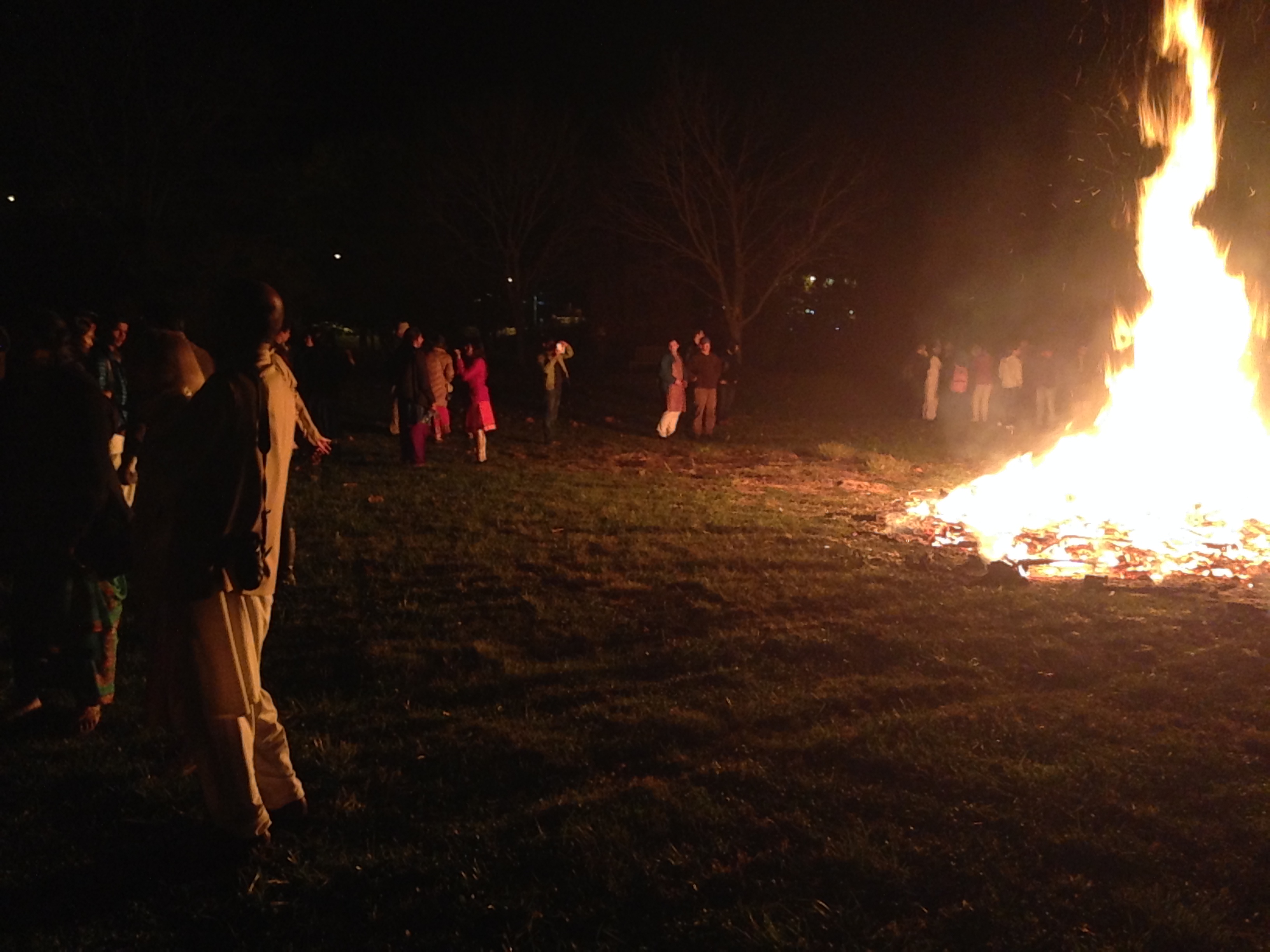
There are very few university campuses that hold bonfires or campfires regularly. It is in this spirit that we created a new tradition of bonfires or campfires at MUM. Initially it started as a bonfire for Holi in March of this year. The response from the campus community was overwhelming. Almost 200 people came and stayed with the fire for hours. One could see the grimaces from snowy cold jacket-grabbing walk spontaneously melting into warm smiles of mysterious exhilaration as they walked from the parking lot towards the campsite and began to experience the warmth of the campfire. Even with snow flurries and an inch of snow accumulated, students wildly sang and danced in the light and warmth of fire for more than 2 hours, till past midnight. We provided some peanuts and sweets to eat. We also provided dry colors to play Holi with. It was a great success. Our head of security organized the fire for us, and he shared something very insightful. He said that we used to have these kinds of events earlier, and there was no student retention problem.

So we repeated the experience last August, partly to welcome a new batch of incoming students for the Fall semester. We held a bonfire after a beautiful dance-and-music celebration of Krishna Janamashtmi. The experience was similarly wildly exhilarating. It was not cold outside, and some people earlier wondered if campfire in the summer was a good idea. But the response from the students was overwhelming. They stayed on again till almost midnight.
MUM campfire picture Oct2014
We repeated the experience again this Diwali (celebrated just a few days ago). We had a nice colorful 90-minute song-and-dance celebration in our beautiful spacious auditorium. And then the bonfire was lit at 9:30 pm. Once again a couple of hundred people walked over to the fire. Many newcomers to the bonfire said they had planned to spend just about 5 minutes at the fire just to get a taste of it. But then they stayed on for a couple of hours. They stayed because others were staying on, and it was warm and cosy there to begin with. It was a dark nearly no-moon night but the sky was lit up for us with this fire.

As education and learning becomes increasingly online, universities will need to find something special to attract and retain the students. One can create strong bonds with the students in many ways. Holding regular large bonfires is one such way. I recommend it with all my heart!

Creative writing : making a DENT in the world

Creative writing : making a DENT in the world

Recently I completed writing my first book called Business Intelligence and Data Mining Made Accessible. It is available on Amazon. This book came after 30 years of work experience, after 3 years of my thinking about it, and then the book almost completed itself effortlessly in just 30 days. I like the book, and I enjoyed the process. There are some lessons in this for creative writing projects. Here is a four-step model for making a DENT in the world.

  1. D is for Desire. One needs to have a strong and clear intent to write. There can be an urge to make a difference in the world. People write for many reasons, including recognition, money, and the sheer pleasure of contribution. The desire can come from being pressed, or encouraged, by others; it can come from watching friends become successful authors; or it can just be something that one badly wants to do.
  2. E is for Expertise. One can develop certain areas of expertise over a period of time. It could be scientific knowledge about an area; or it could be a fertile imagination and a way of expressing it in fiction. One can hone one’s talents over a long period of time. This expertise could be self-evident when one is helping others out just for fun; or doing something by oneself in a playful spirit.
  3. N is for Need. There should be a need out there to be satisfied. The need could be a general one, such as a continuous need for good fiction, or a need for a comprehensive reference book on a topic. The need could also be specific, for example addressing the needs of a particular audience known to you, including friends and family, and your students. The now famous Khan academy emerged from Sal Khan creating small video lessons to educate his niece on mathematics.
  4. T is for Timing. The timing too has to be right for it to happen. The writer must find the time to create the content; there should be access to the right channels for expression; and the intended audience should be ready and receptive to the content.

Finally, of course, there is no substitute for hard work … just sitting down and making it happen.

Comments welcome!