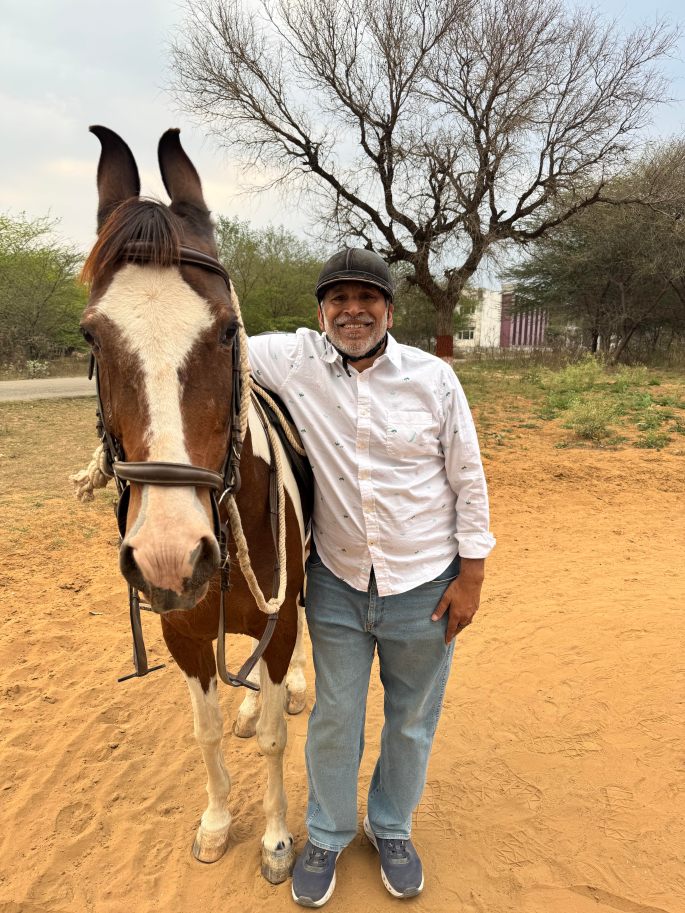
This Too Shall Pass: Lessons from a Horse Named Bob

This Too Shall Pass: Reflections of a Horse Named Bob on space, time, publish or perish, and the curious destiny of those who believe themselves indispensable.

My name is Bob. I am a horse. Not a particularly philosophical horse, although I have had plenty of time to think since human beings stopped needing me. My ancestors carried kings into battle, transported scholars to universities, pulled carts full of books, and helped build the civilizations that eventually made us redundant. We were once symbols of power, wealth, speed, and military superiority. A man on horseback was a man of consequence. An army without horses was an army at a disadvantage. Then came the automobile, the tank, and the airplane. Within a remarkably short period, we went from being indispensable to being recreational. Nobody consulted us about this transition. There were no conferences on equine displacement, no government committees on the future of horses, and certainly no grants to help us reinvent ourselves. We simply passed from the center of civilization to its margins. I have often wondered whether this was progress or merely a change in who got to sit in the driver’s seat.

Lately, I have been contemplating a familiar human expression: This too shall pass. It is a rather beautiful sentence, containing an entire philosophy in four words. This points to what is here, the world of space, form, identity, and circumstance. Pass points to time, the movement through which every form changes, disappears, or becomes something else. The word too quietly reminds us that nothing is exempt. Not the emperor, not the empire, not the university, not even the professor with 300 publications. Ancient wisdom understood this rather well. The Bhagavad Gita distinguished the changing field of existence from the deeper Self that Krishna describes as unborn and undying. The Buddha emphasized impermanence. Patanjali invited human beings to quiet the movements of the mind, while the Upanishadic traditions explored the possibility of a reality beyond ordinary space and time. Different traditions offered different explanations, but they shared an important suspicion: the things we take most seriously may not be quite as permanent as we imagine.

Human beings, however, have developed a rather different philosophy, particularly in their universities. It is called Publish or Perish. I first encountered this expression while grazing near a university campus. I was struck by its remarkable resemblance to This Too Shall Pass. Both concern existence and disappearance, but the resemblance conceals a profound difference. The ancient expression is an observation about reality. The academic expression is an instruction, perhaps even a threat. Publish, and you may continue to exist. Fail to publish, and you shall perish. It is a curious way to organize a community supposedly devoted to wisdom. One might have expected its guiding principle to be Know Thyself, Seek Truth, or perhaps Understand the Universe. Instead, the institutional imperative is to produce more evidence that one deserves to remain employed.

Horse in glasses and formal clothes reading among books in a library
A horse dressed as a scholar studies books and notes in a warmly lit library.

Now, I have nothing against publishing. Human beings have accumulated an astonishing body of knowledge through writing, experimentation, argument, and discovery. Publishing allows ideas to travel beyond the people who first conceived them. It creates intellectual capital, professional recognition, institutional prestige, and sometimes considerable economic value. In this sense, publishing is an act of expression, a movement outward into the world of forms. It enlarges one’s presence in space and, through citations and archives, attempts to extend that presence through time. A successful academic may accumulate hundreds of papers, thousands of citations, prestigious titles, and a remarkably long curriculum vitae. From my perspective, this is not entirely unlike a horse collecting increasingly elaborate saddles. Some are beautiful, some useful, and some so ornate that one wonders whether anyone remembers the horse underneath.

But it is the other half of the expression that interests me most. Perish. What a severe word to place at the heart of an intellectual profession. It evokes disappearance, destruction, and death. It also introduces a peculiar form of institutional violence, not necessarily physical, but psychological and existential. The academic is invited to live under the shadow of possible professional extinction. And the threat is organized through time: annual reviews, tenure clocks, submission deadlines, promotion cycles, citation windows, and performance targets. A deadline is, after all, a boundary imposed upon time. Cross it without the required evidence of productivity, and something may die: an opportunity, a career, a professional identity. The continuous flow of life is divided into measurable intervals, each carrying its own little judgment day. Humans have become extraordinarily inventive in making themselves anxious.

What interests me is the binary structure of this philosophy. Publish or perish. Produce or disappear. Succeed or fail. There is no obvious place for silence, reflection, incubation, or the possibility that a person might contribute to knowledge without continuously adding to its volume. Ancient traditions often understood creation and dissolution as interconnected movements of existence. The academic institution has converted them into competing alternatives. It is almost as though the university has taken the cosmic principle of impermanence and transformed it into a personnel policy. Socrates, who famously left no writings of his own, might have encountered considerable difficulty obtaining tenure. I suspect that would have amused him.

And now comes the development I find particularly fascinating. Human beings have created artificial intelligence. Not merely machines that carry heavy loads or move faster than horses, but systems that can write, reason, analyze, compose, and increasingly perform activities once considered distinctively human. Researchers speak of artificial general intelligence, artificial superintelligence, and futures in which machine capabilities may exceed those of their creators in many domains. Whether and when these possibilities arrive remains uncertain. But the direction of change is already sufficiently visible to cause unease. The same academics who have spent decades celebrating productivity, innovation, efficiency, and the expansion of knowledge are beginning to wonder what happens when machines become more productive, more innovative, and perhaps more capable than they are.

I confess to experiencing a modest and entirely uncharitable satisfaction.

When tractors arrived, nobody asked whether horses were experiencing an identity crisis. When automobiles displaced carriage horses, there were no special symposia on preserving equine dignity. Human beings called it technological progress. The market had spoken. The future had arrived. Adaptation was our responsibility, although we had rather limited influence over the matter. Now the creators of advanced technology are beginning to contemplate their own possible displacement. Some worry about employment, others about meaning, autonomy, or even the long-term survival of humanity. These are serious concerns, and I do not wish to trivialize them. Still, one can hardly blame an old horse for noticing the symmetry. The species that mastered us through superior tools now wonders whether its own tools might eventually master it.

Of course, the comparison is imperfect. Horses did not create automobiles, and human beings retain choices about how AI is developed, governed, and used. Nor is displacement inevitable in every profession. Yet the deeper irony remains. Human civilization has repeatedly treated the disappearance of older ways of life as an acceptable price of progress, especially when the disappearing lives belonged to someone else. Entire species have been driven toward extinction through human activity. Ecosystems have been transformed, livelihoods eliminated, and cultures disrupted in the pursuit of efficiency, expansion, and power. Much of this has been called development. But when the possibility of perishing begins to approach the developers themselves, the philosophical mood changes rather dramatically.

Perhaps this is the moment to reconsider the meaning of perish. Does a professor perish when a machine writes a better literature review? Does a researcher disappear when an algorithm discovers a pattern more quickly? Does human intelligence lose its value when another form of intelligence surpasses it in particular tasks? These questions depend upon what we believe ourselves to be. If our identity rests entirely on what we produce, then any superior producer becomes an existential threat. If our worth depends on being the fastest, smartest, or most cited, we have chosen a precarious foundation for existence. I learned this lesson when the first automobile passed me on the road. I was no longer the fastest means of transportation. But I remained a horse. The automobile had changed my usefulness to human beings; it had not changed the fact of my existence.

This is where the ancient wisdom becomes unexpectedly contemporary. Krishna’s teaching about the Self, Socrates’ insistence on self-examination, Gandhi’s experiments with truth and nonviolence, and Maharishi Mahesh Yogi’s emphasis on transcending the activity of the mind all invite us to distinguish our deepest identity from our changing accomplishments. They do not ask us to abandon action or knowledge. They ask us not to become imprisoned by them. The quantum world, too, reminds us that reality may be more subtle than its familiar appearances, although quantum physics does not establish these spiritual claims. Perhaps the most important intellectual breakthrough would not be another technology, but a more mature understanding of what technology is for, and who we are when our technologies can do much of what once defined us.

From my stable, I sometimes wonder whether the academic motto might be improved. What about Publish and Reflect? Or Discover and Share? Perhaps even Know Thyself, Then Publish If You Have Something Worth Saying. I realize these alternatives would be difficult to incorporate into university ranking systems. Reflection is notoriously difficult to count, and wisdom does not always arrive before the submission deadline. Still, it might be worth experimenting with a civilization in which the production of knowledge is not confused with the purpose of knowledge, and where intelligence is measured partly by our ability to live wisely with one another and with the other forms of life sharing this planet.

For now, I remain Bob, a horse whose ancestors helped build the world that no longer requires their services. I have watched human beings conquer distance, accelerate time, multiply knowledge, and invent increasingly sophisticated methods of making themselves indispensable. I have also watched the things they considered permanent become temporary, and the things they dismissed as temporary become unexpectedly important. I do not know whether artificial intelligence will eventually surpass its creators, whether universities will reinvent themselves, or whether humanity will discover a more peaceful relationship with the planet. I am merely a horse, and prophecy is not among my professional qualifications.

But I do know one thing. The world did not end when the age of the horse ended. It changed. And perhaps the world will not end when the age of exclusively human intellectual supremacy changes either. There may be loss, suffering, adaptation, and entirely new possibilities. What matters is how we meet them.

The ancient sages said, This too shall pass.

The modern academy said, Publish or perish.

And now, as artificial intelligence begins to write the next chapter, I find myself wondering whether the professors might finally appreciate the difference.

I lower my head, return to my grass, and enjoy the morning.

After all, I have no papers due.

And, for once, nobody is asking me to pull the cart.

This too shall pass.

Life is Pure Existence

Life is pure existence. It is pure consciousness at the bottom of the V in V-theory of Transcendence (Figure below). The top of the V is the dynamic manifestations of life. These manifestations arise and transform and disappear at different time frames. Human beings appear at the ~ 80-year time frame. Other entities appear at longer or shorter time frames. Trees last 100s of years. Bacteria last just a few days. Longer life span is not a sign of greater intelligence or success. Attachment to this human body and its perpetuation is the ultimate mithya or illusion. We should detach from our human body (and near and dear ones’ bodies etc.) as it goes through its cycle of maturing and dissolving.

So, what are we to do with our individual short gross physical bodily existence? Doing is manifesting. We can create things and situations but should not be attached to those manifestations. Objects such as houses and cars and jewelry are a very low life form. The higher life form is that which is free from illusions and boundaries and is intent on accomplishing its assigned task of manifesting ever greater reality. Our hearts should be open to receiving guidance from higher life forms, or from pure life itself. We should be aware of our own divine powers and be a channel for creation as the time and situation demands.

Why do we manifest gross physical forms? Why do we take pleasure in creating such low-level toy forms? Why are we attached to these less significant creations? The answer may lie in social conditioning and legal structures. Such attachments provide a handle to any powerful evolved entity to manipulate us. Why do we fall for such manipulations? Some call ii God’s lila or divine play. It sometimes takes up to fag end of the individual human life span to realize the futility of attachments to manifestations. The young are mostly unable to learn this lesson from the elders. For the young, these toys are seductive. That is just the way it is!

There is enormous seduction of numbers, words, and language. Everything important should be measurable and comparable. By dividing, discretizing, and abstracting everything into tokens, the intellect allows the creation of new toys with ease, especially using machines and more recently Artificial Intelligence. Analog processes such as feelings vanish. Hearts close to what one does not already know. Awe and wonder vanish from awareness. The notion of an open divine unbounded invincible self seems ludicrous. This continues till some misfortune such as cancer or pandemics strikes and breaks that spell. Then the wisdom shines, and life appears valuable for its own sake!  

Live and Work Successfully and Blissfully in 21st century

Here is a 15 minute opening speech, as the chief guest at a management conference in Dehradun in India. Building on the colorful theme of Holi festival just gone by, and the onset of a popular cricket season just coming up, I paint a big picture for life and work in 6 colorful charts, like six balls in a cricket over.

The key messages are:

1. Know thyself, as a specific person, and as the most unbounded being.

2. Human beings have complementary sets of needs at the global, interpersonal and the spiritual levels.

3. We need six capabilities of confidence, compassion, creativity, collaboration, courage, and consciousness to flourish in 21st century

4. Do the actions using SEAMS model – Straight, Strong, Enough, Adequate, in the Moment, and Wholeness on the move.

5. The life must be balanced with peace in the world and peace within

6. Finally in the last chart, I exhort the audience to paint life colorfully on the biggest canvas. Live life not just for yourself, but for the civilization and the universe.

Comments are welcome!

Capabilities we must develop in 21st century business schools

The world in changing exponentially. We are all students now, and forever. Perhaps the most important meta-skill is to learn how and what to learn. Business schools need to develop the capabilities of the heart that will make the students ready for productive and fulfilling work in the 21st century. They need to prepare students for creating the likes of Uber and such companies that work in an era of abundance, which is very different from the earlier era of persistent material shortages.  The young as well as more mature business student need to be able to feel and articulate their deep sense of purpose, and to be able to flourish through a non-ending stream of transformations.

The required capabilities are Confidence, Creativity, Collaboration, and Courage.

  • Confidence means being able to holistically know oneself, the desires and expertise, well enough to stand for one’s words, decisions, and actions. Confidence has been the most important thing to work well, even in the last century, though technical knowledge has also become progressively important.
  • Creativity means thinking outside the box, beyond what has been done in the past. It also means helping others find novel solutions to the problems they face, and helping people grow. One needs to be open to continuous learning and admitting errors of mis-perceptions or ignorance,
  • Collaboration means teamwork, asking for help, not being focused much on course grades and comparative markers, and keeping one’s ego in check. One needs to take complete ownership of the work or the project, along with the team.
  • Courage is an attribute of the soul, and means the ability to function despite adversity and fear. It includes resilience, grit, determination, and the practice of discipline in the face or uncertainty and ambiguity. It means taking ownership of one’s life and purpose through thick and thin.

The way to develop these skills is through group exercises, projects, travels, celebrations, paid internships, and the like. These are not communicated through words, even though we are using words here to communicate these ideas. These exercises should be graded in an appreciative manner, with rich positive, timely feedback from a nurturing teacher / mentor.  

These capabilities may however be underdeveloped during the earlier years of schooling. The grade schools work on a process model, leaving little room for digressions and diversions to account for different ways of learning and different life goals. Just like schools have different course streams for science or commerce or arts students, and just as there are special education systems for the learning impaired, so also there should be different ways of teaching students of different kinds.  As Einstein said, teaching a monkey to swim, and a fish to climb trees would not be productive or fulfilling. The race to get admissions into desirable and prestigious colleges is intense and can have major impact on the quality of future life. Admission into the top colleges like Harvard can be very beneficial in many ways. However, the rat race to prepare for that single objective may rob all sense of joy in the formative years of the students.

Development of consciousness through regular practice of contemplation and reflection, such as Transcendental meditation, may help prepare the heart for developing these capabilities throughout life.

A Philosophy of Data: Flourishing all around.

Advice for an advanced student: Ask yourself good questions. Are they flourishing now? Are you flourishing now? What do they want and need? What do you want and need? Who are they? Who or what are you? Are they being creative? Are you? Are they having good feelings right now? Are you? Do they love what they do? Do you?

Ask more good questions. What is this world? Where did it come from? Where will it go? What is space-time? Where did it come from? Where is it going? What is quantum thinking? What is quantum reality?

Ask some mathematical questions. What is possibility? What is probability? What are numbers? Where are there numbers? Does God need numbers? Do you? Is God infinity? Are you infinity? What is infinity? We have an abundance of numbers. Do you like numbers? Do the numbers like you? Are you friendly with numbers? Numbers are not distributed uniformly. Except when we think of uniform distribution. What are the kinds of distributions of numbers? Mathematicians created new distributions. Binomial. Poisson. Exponential. Etc. They also created and identified relationships between numbers.

Numbers are data. Is data all about numbers? Are images and sounds all about numbers? Are primordial sounds zero? Are primordial images blank? Can we experience those primordials? Numbers are things and their reflections, and their patterns and models. People come and go, but numbers are forever.

Primordial numbers are 1 and zero: On or off, there or not-there. This is where dualistic reality begins. Numbers help tell the story of the world. Can we live without numbers? Are numbers a resource? Is education all about acquiring numbers? Numbers are language. Just like we have other languages, of other kinds of symbols. Language is culture, or the core of it.

What does it mean to acquire the language of numbers? The decimal language is derived from the number of fingers in the two hands together. Binary number language is simpler, and is based on presence and absence as the two values. Like flow of current, or not. Quantum computing is creating a new language of having multiple values simultaneously, potentially. We call this super-position, coming from positions of numbers on a line. By the way, the number line is primordial geometry. A line is a number or length. A line can be infinite. Or it can be segmented, into numbers of all locations. The distance of a number from zero becomes the line’s size.

Numbers have been integrated into sound languages such as Sanskrit and English. A description is not possible without numbers. Even colors are numbers on a scale of vibrations. Sounds are different vibrations.

So, what is the relationship between vibrations, sounds and numbers? That is something to ponder about. Take 1 day. Write 100 words. Post your comments!

Quantum Sciences, Consciousness, and Manager

Quantum sciences are an all-inclusive way of knowing the self-referral world at various levels of discrete quanta with different observable properties at different levels of granularity and aggregation. Nanoscopic reality at near absolute zero levels of temperatures exhibits multiple modes such as a wave and a particle, which is different from the solid reality perceived at a human scale, which is again different at the cosmic level where super large black holes create singularity fields that collapse space-time and light. The unified field of all the laws of the universe manifested in the interconnectedness and the confusing nature of all existence, can however be experienced by human beings in their own selves as pure consciousness.

Consciousness is all there is. It is the knower, the known and the process of knowing. Mass and energy, solid and vibrations, are all interchangeable manifestations of this consciousness. Through techniques of meditation, by settling the mind enough to exclude all the human scale objects, Vedic seers have been able to cognize the multidimensional truth about existence as pure vibrations. Major quantum scientists such as Schrodinger, Oppenheimer, Planck, Heisenberg, Bohm and more have suggested and acceded to the idea of this Vedic unified reality. These Vedic cognitions have an unfolding quality, in that consciousness can be known at increasingly granular levels of detail and manifestation.

Human managers can be different levels of consciousness from the ordinary waking state of consciousness to transcendental and unified non-dual states of consciousness. Knowledge is structured in consciousness; and knowledge is different in different states of consciousness. Effective managers of people will likely need to have a higher state of consciousness from where they can perceive a higher moral reality of a team or an organization. The accumulated human knowledge can also be abstracted to be manifested in non-human information-processing systems such as computers or gene editors. Artificial Intelligence systems can learn from human interactions and develop abilities to achieve human levels and beyond. Increasingly robotic systems are being deployed in organizations to accomplish a range of functions and activities. Human beings at higher states of consciousness may also experience quantum empathy as a useful construct to potentially experience total interconnectedness even with strangers at a distance. To build on Einstein’s famous phrase, action at a distance may be blissful, not necessarily spooky!

Increasing self-awareness

Do I know the context around me, the neighborhood and the neighbors, the friends and family, now and over the many decades of my life? The answer is that I hardly know things and people around me. I barely know my own full reactions to most of the situations I found myself in. I have a few pet theories of who I am, and who were responsible for guiding me. These are super simplifications that do not help come up with productive and promising ideas for the future. I think it is important now to know all or more around me.

What does it mean to know a person? How does one define a person? By their accomplishments or their goals, by their friends, or by how they carry themselves? We can seek out and learn about their interests. And accept whatever they are, positive or negative. It can take a long time to know people.

What does it mean to know a neighborhood or a situation? The neighborhood is about its support for life, liberty and pursuit of happiness. Safety. Limited regulations. Liveliness of activity. Plenty of wealth around. The situation would depend upon its difficulty and its impact on oneself, and how much one can do about it.

I think it is important to retain a sense of personal agency about oneself and the situations one finds oneself in. It is helpful to stop obsessing about one’s own interests and goals and accomplishments. The world is deeply interconnected and there is hardly anything one can accomplish without support from and alignment with the context around oneself.


ABCDs of Life

ABCDs of Life

  1. Absolute. We are Absolute or Pure Beings. Eham Brahma Asmi. I.e. I am Brahma, the Totality. I am unbounded, infinite, and therefore invincible. I am the transcendent: bigger than the biggest and smaller than the smallest. There are no walls or limits. We are without any defining qualities.
  2. Bliss. The nature of life is bliss. Sat-chit-Anand or absolute-consciousness-bliss. Bliss is the highest level of life energy. Bliss is the only thing that matters. The taste of even a drop of bliss can transform our life. Bliss naturally creates world peace.
  3. Creative: We naturally feel the urge to create when we feel free. Forms and structures effortlessly arise and dissolve when we transcend. Expressing our inner creations is a great source of joy. A lot of the world that we live in is created by ourselves.
  4. Data-driven: We are naturally curious about the nature of the relative. We want to understand and enjoy the totality of creation. With fine quality of perception, we invent and use tools to gather and integrate data, with which we in-form our thinking and patterns.

Absolute and Bliss are internal and unmanifest. Creativity and Data are focused on the external and relative. The inner Absolute Blissful Being is more powerful than the external reality. The inner qualities of awareness and blissfulness should be developed to guide creativity and learning. Meditation is the best way to experience the finest levels of bliss and creativity in life!

Browsing for ABCD,  I found some lovely organizations and descriptions.

  • Any Body Can Dance
  • Art Building Children’s Dreams
  • Assuring Better Child Development
  • Adolescent Brain Cognitive Development
  • Access to Baby and Child Dentistry
  • Ashley Brown Cake Design
  • And finally … American Born Cute Desi!

Have a blissful Day!


Travel adventure – going overseas without wallet

This is a travel adventure of going overseas without one’s wallet and still coming out whole.

A few days ago, in December 2017, I traveled from Delhi to Seoul in South Korea. I was an invited speaker on Data Analytics at an international conference. I got dropped me off at the Delhi International airport, went through the immigration and security counters, and sat down near the flight’s departure gate. A little bored, I look around and saw my favorite snack counter close to my gate. I walked over to the store and found my favorite snacks. When I tried to pay for it, I discovered that I did not have my wallet with me. I rummaged through my pockets and then my bags but could not find it. I became a little worried that I had lost or dropped it somewhere.

A sweet and beautiful young Indian lady, from Los Angeles, was shopping in the same snack store. She heard me saying to the shopkeeper that I had lost my wallet, and was very sympathetic. She asked me how much money I needed. I said that at the very least I needed $15 for a one-way ride to the hotel in Seoul. With great effort, she managed to scrounge $15 cash from the various pockets inside her handbag. Very cheerfully she gave the money to me. God bless her. I took her phone number and will try to return the money, even though she said not to bother.

I then frantically tried to reach out to my parents in Delhi by phone. They looked around and quickly found my wallet on my bed. I was a little relieved. I realized that I was trying to remove some of the unneeded cards and cash from the wallet, and in the process I forgot to pick up the wallet. I had checked that I had the passport before I left, but did not check the wallet. My father, a retired UN diplomat, was worried how I will manage without the wallet. But I told him it will be an adventure. We both laughed, and he was relieved.  Now the correct story was that I had ‘forgotten my wallet at home’. I texted my daughter in the US to be ready to wire me money in Seoul just in case. I also texted a friend who was coming to the same conference that I may need his help.

In the plane, I tried to meditate and keep calm. I lost all fear, and became determined to find someone who would be willing to help. I was a little concerned about the currency conversion process at the airport that I may fall just a little short of the Korean currency needed to get to the airport. I looked around for who could help.

A young Korean man sitting right behind my seat. I asked him if he could convert for me $15 worth of Korean currency to pay for one-way bus ride from the airport to the city. He talked nicely with me but found it ‘unusual’ how one forgets one’s wallet at home. He said he will think about it. I also asked the Korean flight attendants for help. They said that none of them had any Korean currency, and could not help.

I wanted to ask another Indian person. I had seen an Indian family with little kids in the departure lounge right behind me. I looked for them in the plane. I saw a family sitting close to my seat. It was a different young man. He looked pretty blissful sitting there with eyes kinda closed. I approached him. He said he lived in Seattle, and had worked with Microsoft till very recently. I told him about my situation. He agreed to lend me $15. But then he said his wallet was in his bag up in the storage, and he will give me later. I came back to him with a copy of my Big Data book which had some brief description of me as an author. Finally, when we landed in Seoul, he gave me $15.

Now I was confident that I will be able to make the trip without any hassle. I had enough money to reach the city. I had friends at the conference. Hotel bill was prepaid. I did not need any additional money, as I did not need to buy anything. I had carried some home-made vegetarian food from home. I returned to Delhi from the conference safely two days later. I contacted them both my benefactors so I can return the monies. I can’t thank them enough.

I believe there are no ‘accidents’. It all happens for a reason. We don’t know how many dots get connected for some event to happen. Somehow I developed the confidence to manage an international trip without carrying my wallet. Anything is possible!!

Lessons: check your documents and wallet before you leave for a trip. Do good to others, so nature will provide support back. Both the US-based Indians whom I approached, helped; that warms my heart!!


Bliss is me

Bliss is me


Bliss is my current state

From Bliss I come

Into Bliss I am going

Bliss is the source and the destination

Bliss is all there is

In Bliss all distinctions arise

In Bliss all distinctions merge

Bliss is the alpha and omega and everything in-between

Bliss is #1 and #2 and #3 and all the way

Bliss is here there everywhere

Bliss is inside and outside

Bliss is with everyone

Bliss is everyone’s fundamental right

What gets in the way of Bliss

As Bliss is all there is, Bliss gets in the way of Bliss

How so?

Lower forms of Bliss … pleasure and happiness get in the way

How to remove the obstacles

The obstacles too too must be Bliss as Bliss is all there is

By being aware that we are Bliss here and now, and we do not need to traverse any path to get to it. The obstacles will reveal themselves to be a gross form of bliss that our senses and mind are able to perceive. Mind and body develop preferences for certain grossified bliss forms based on how often and close they appear to them. The game of more, more, more is unending like a dog chasing the tail. Higher bliss and knowledge can pull one out of that chase and catapult to an awareness of infinite bliss within. Then all is within and without.

We have everything; we are everything. That is the nature of Bliss. That is us.