Leadership Lessons from Organizing Cultural Events …. By Anil Maheshwari
Certain good ideas lead to properly-organized and well-attended ‘successful’ cultural events. This could be applicable to creating good organizations also. I write below from my experience of organizing a few big house-full South-Asian cultural events at MUM over the last 12 months. All the events had the customary song and dance elements. However, they also had new innovations. And they all brought in new challenges, opportunities, surprises and joy. It takes a certain gut-strength to manage it all.
Here is a list of the events we organized and the innovations we incorporated:
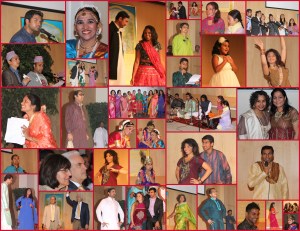
Diwalifunction in November 2013. We created a beautiful innovative poster to promote the event. We introduced the idea of including participants from all South Asian countries including not only India, but also Nepal, Bangladesh, SriLanka, Pakistan, and others. We introduced the idea of a fashion show where all students could showcase their traditional dresses. We introduced the idea of a boy-girl pair of MCs, where the MCs were from different nationalities. We invited the Mayor of the city to the event, and he got the flavor of how important Diwali is for the entire South asian community. We introduced the idea of giving free organic Burfi Prasad to all the attendees. Last but not the least, we kept the event free to the public. The program was wonderful, and the event was a big success. (Pictures courtesy: Craig Shaw).
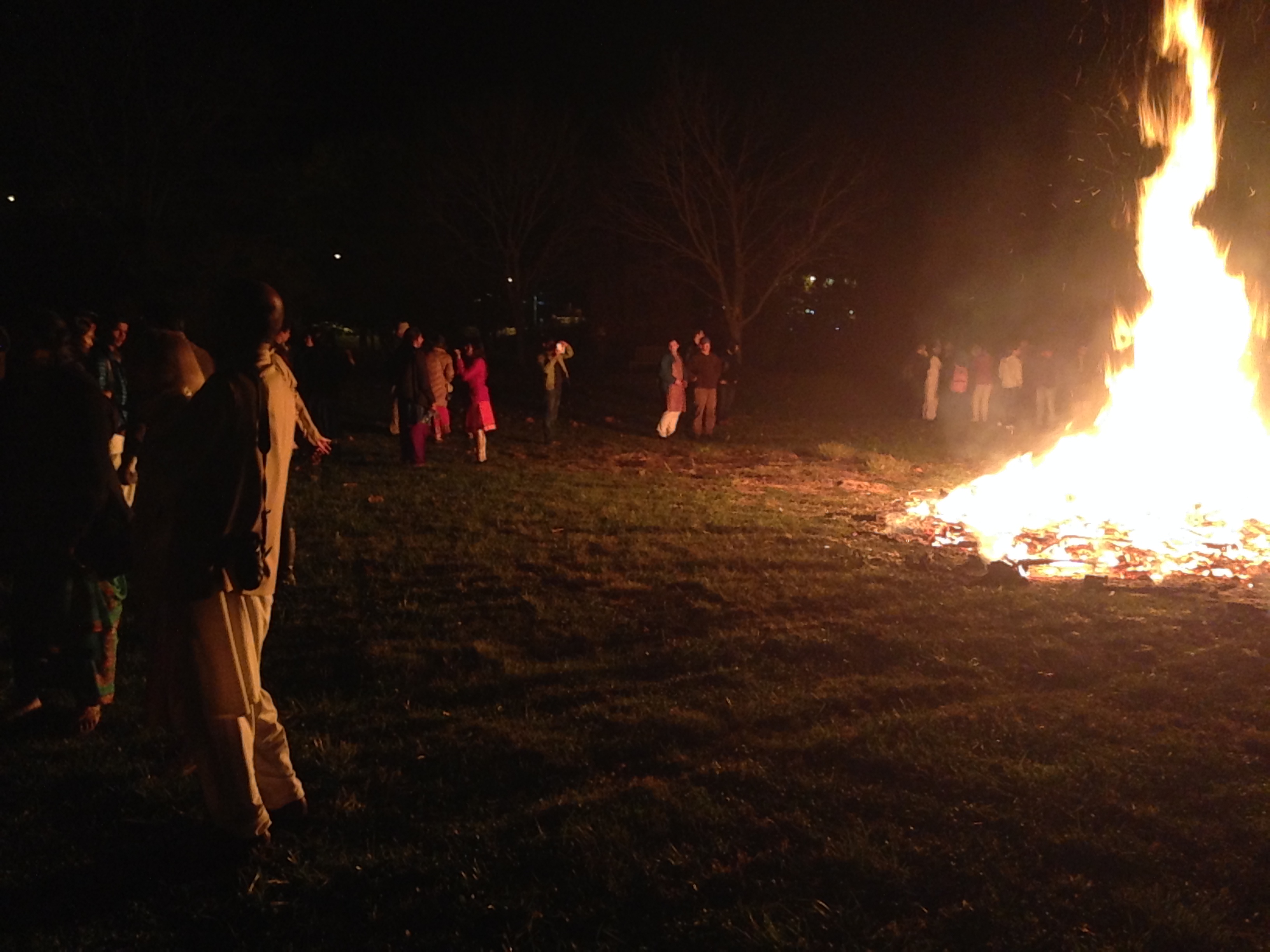
Holifunction in March 2014. We introduced the idea of a poetry recitation which is a Holi tradition in India. In this case, I did the recitation of a humorous old poem. We introduced the big idea of doing a large bonfire which is a Holi tradition: Students continued to sing and dance around the fire till midnight. We played with gulal (colored powder) in the night around the fire. We provided free munchies at the bonfire. We introduced the idea of a bhajan band, and this band continued playing at the bonfire also. The event was a super success.
Baisakhi/Ugadi/Indian-New-Year event in April 2014. Coming soon after the Holi event, it was a low-key event. We invited the visiting head of the Maharishi movement in India who was visiting the US at that time. My daughter performed at the event.
Krishna Janam Ashtami event in August 2014. This also worked as a welcoming event for all the new and returning students. We continued the ideas of a MC pair, free burfi Prasad, and a large bonfire. We introduced the idea of playing a Maharishi knowledge tape where he was talking of the significance and power of Lord Krishna. We invited the President of the university; he liked the event and said we needed more of such things to enliven the campus. The event was a house-full and standing room only performance.
Garba dance party in September 2014. This was a dance party for people to dance to traditional Indian garba music. We brought the Dandiya sticks for the dance. At this event we also discovered our new student president of the South asian club.
Diwalievent in October 2014. This event used many of our previous ideas. We had the usual Bollywood song and dance shows, an MC pair, a large bonfire, a fashion show that now included people from Africa also. We added a professional Gandharva performance to the event. I led a group bhajan performance. People stood up and joyfully sang the Aarti together. This event was so packed that latecomers could not find space to get into the auditorium.
The organizing of all these events followed a similar pattern, was but there were different challenges each time. Different people pitched in to help when things looked bleak. Through all this I persevered. Here are some of my lessons:
Commitment: Someone has to hold the flag high. Even when no one else is interested or seems to be ready to contribute, the key organizer must love the idea, and should have complete faith that the event will happen, and well. There were moments when there was no one else who came to the event planning meeting.
Self-sufficiency. One should be prepared to invest your own time and resources to make the event happen. One should have the talent to sing and dance, or have your friends and family participate as needed. One can usually find the talent, strength and resources within oneself.
Openness: Be open to surprises. Be open to what might actually happen at the event. Do not get stuck in a preconceived notion of a cultural event. Be open to new ideas from unexpected sources. Be open to support from unexpected sides. Totally different people, faculty or students, pitched in to support each of the events at crucial moments. Later in the year, we found consistent support from one like-minded person on campus.
Integrity: Make sure every event has integrity at a high level. The higher level idea should be to have fun, or whatever else. Do not get caught in the weeds of this item or that, this performer or that, this issue or that. Gradually the reputation will grow and people would love to attend the events.
Fire is a primal element. ‘Agni’ (or fire) is the first word of Rik Veda; and contains the structure of the entire universe within it. Fire is also a dangerous element. It can burn and destroy. It can reduce beautiful and valuable things into ashes in no time. It can change direction easily with the blowing of the wind. Fire can leave scars that last a lifetime. However, it can also create impressions that last a lifetime.
Fires are used for religious and cultural purposes. Sanatan dharma believes in using sacred fire (as havan or homa) to purify the spirit. Fire is used as a witness to an oath. Fires are burned for cultural activities, e.g. Holika Dahan. On Dusshera (or Vijayadashmi Day), fire is used to burn the effigy of the bad guys. Fireworks are used as celebration, as for Independence Day celebrations on the Fourth of July.
In modern times, the fire element has been completely contained and tamed. Something catching fire is usually in a bad connotation, e.g. wild fires that burn whole swathes of dry forests. Only occasionally is ‘catching fire’ used to describe some runaway social success. Children rarely get to experience fire. Fire can be seen mostly as a small contained fire in the stove to provide heat for cooking purposes. The role of fire as a source of light has been completely emasculated and been taken over by electric light. Fire has many other roles too. (See http://en.m.wikipedia.org/wiki/Campfire for a good exposition on what a campfire means). Fire even provides a psychological sense of security. Campfires create a strong sense of bonding.
There are very few university campuses that hold bonfires or campfires regularly. It is in this spirit that we created a new tradition of bonfires or campfires at MUM. Initially it started as a bonfire for Holi in March of this year. The response from the campus community was overwhelming. Almost 200 people came and stayed with the fire for hours. One could see the grimaces from snowy cold jacket-grabbing walk spontaneously melting into warm smiles of mysterious exhilaration as they walked from the parking lot towards the campsite and began to experience the warmth of the campfire. Even with snow flurries and an inch of snow accumulated, students wildly sang and danced in the light and warmth of fire for more than 2 hours, till past midnight. We provided some peanuts and sweets to eat. We also provided dry colors to play Holi with. It was a great success. Our head of security organized the fire for us, and he shared something very insightful. He said that we used to have these kinds of events earlier, and there was no student retention problem.
So we repeated the experience last August, partly to welcome a new batch of incoming students for the Fall semester. We held a bonfire after a beautiful dance-and-music celebration of Krishna Janamashtmi. The experience was similarly wildly exhilarating. It was not cold outside, and some people earlier wondered if campfire in the summer was a good idea. But the response from the students was overwhelming. They stayed on again till almost midnight.
We repeated the experience again this Diwali (celebrated just a few days ago). We had a nice colorful 90-minute song-and-dance celebration in our beautiful spacious auditorium. And then the bonfire was lit at 9:30 pm. Once again a couple of hundred people walked over to the fire. Many newcomers to the bonfire said they had planned to spend just about 5 minutes at the fire just to get a taste of it. But then they stayed on for a couple of hours. They stayed because others were staying on, and it was warm and cosy there to begin with. It was a dark nearly no-moon night but the sky was lit up for us with this fire.
As education and learning becomes increasingly online, universities will need to find something special to attract and retain the students. One can create strong bonds with the students in many ways. Holding regular large bonfires is one such way. I recommend it with all my heart!
This long Labor Day weekend we attended our Indian ethnic community’s convention in Grand Rapids, Michigan. It was a beautiful 3-day affair with over 700 guests visiting from 27 states in the US and Canada, and some from India. This biennial event offered colorful environment, sumptuous food 5 times a day, nice bollywood entertainment, and 52 breakout sessions serving a variety of stuff from Yoga to financial advice to ‘rangoli’ competition. People greatly enjoyed the program and danced their hearts out. More importantly, they rebuilt old relationships and then built some new ones.
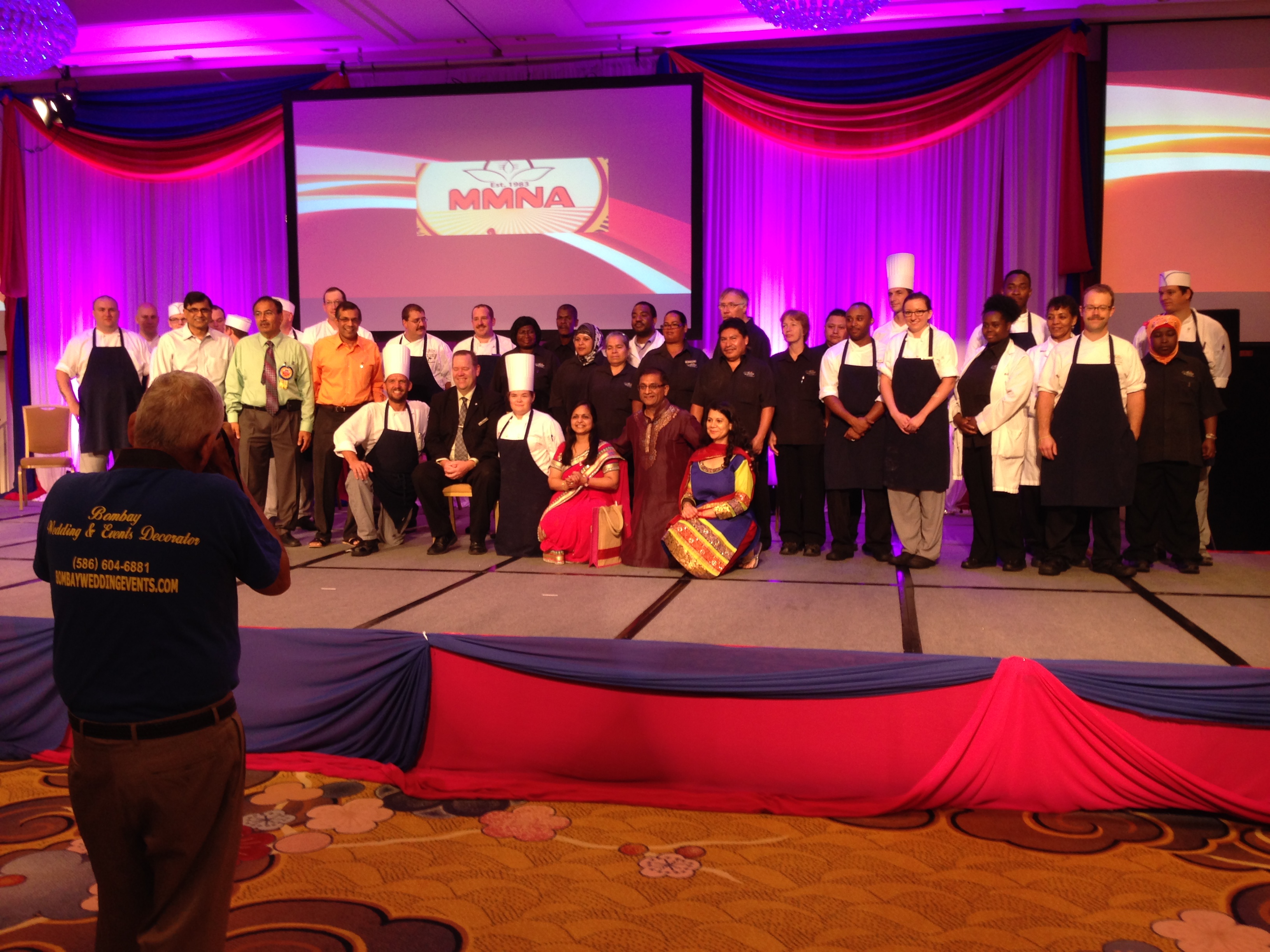
On the last morning of the event, many people behind the event were being thanked from the stage. A few named leaders were thanked for their vision, commitment and dedication. As is customary, the organizers called all of the almost 100 volunteers to the stage to thank them and take a nice group photo. That was a great moment of cheer.
However, the organizers did something even better. They called on stage all the hotel staff which included the servers and the chefs and many others who in their black and gray uniforms worked tirelessly behind the scenes to ensure our every wish was met. Their picture was taken with the leaders of the event. It was a touching moment, at least for me. I don’t recall having ever before seen the hidden army of servers and cleaners being brought to the fore and thanked in such a prominent way. It was the right thing to do. In one stroke it brought cheers to so many undervalued overworked people. By this action, we also taught our younger generation the value of respect for everyone.
This is the future of leadership. Everyone who performs their tasks in a conscientious and quality manner should be respected profusely. It does good to the spirit of the individuals, and it also builds a nice culture for the organization. It builds the thickness of connection in society that lubricates collaboration for success in the future.
Vedas for Ultra-modern Living … notes by Dr. Anil Maheshwari
Maharishi University of Management (MUM) hosted the 11th conference of WAVES (World Association for Vedic Studies) over the first weekend of August 2014. Over a hundred papers and presentations were made by speakers from around the world. Many scholars came from India, while many others were from the US including many professors from MUM itself. The range of topics covered was vast: covering entire Vedas, to specific topics like Ayurveda and Sanskrit, to specific concepts like maha-vakyas. The presentations were theoretical as well as empirical, intellectual as well as experiential. The event provided an extraordinary international Vedic experience.
Here are a few key observations.
MUM is a unique and powerful laboratory for ultra-modern Veda-based healthy living style. Speaking with several visiting scholars, I discovered that there seems to be no other place like this in the world. The visitors enjoyed being at MUM even if for a few days. They enjoyed the good sattvic vegetarian food, chanting by Vedic pundits, Gandharva veda music, and the overall high quality arrangements. There are indeed many villages in India where people still do Vedic practices like Rudra-abhishekham on a daily basis. However, they seem to do it because that is as an ancient family ritual, and not as a part of conscious Vedic living.
The founder of MUM, Maharishi Mahesh Yogi, is considered up there among the Vedic greats such as Sankara, Vivekananda, Ramana Maharishi, Gandhi, and the like. One after the other, the speakers extolled the greatness of Maharishi from the Vedic knowledge and practice perspective. It was a dream come true for many of the speakers to come to Maharishi’s place.
Not surprisingly, most of the Vedic scholars worldwide seem to be of Indian origin. The Vedic researchers at MUM are also Indians at heart, whom I affectionately call ‘white desis’. A lot of the Vedic scholars in India seem to be located in the Sanskrit departments in major Indian universities, and some in philosophy departments.
Many of the papers presented by visiting scholars were theoretical in nature, analyzing and synthesizing the Vedic texts. On the other hand, many of the presentations from MUM speakers were around experimentally validated applications of Vedic knowledge and experiential technologies (such as Transcendental Meditation® ) to human welfare … such as to physiology, psychology, neurology, sociology, business, and the like.
There were many engaging presentations, and some of them completely wowed everyone. One Indian scholar synthesized all the Vedas to present a guide to daily living. Another Indian scholar showed how the mahavakyas, esp ‘Tat Tvam Asi’, could be applied in the social context to promote cooperation. A visiting scholar from the US presented on how Ayurveda can be used for kaya kalpa. Another visiting scholar from the US enthralled the audience with many thought experiments at the intersection of Vedic legacies and new technologies. A powerful presentation from MUM showed a Unified-field based framework integrating the physical world and the world of Atman or Consciousness. Another MUM presentation showed how Transcendence is the effective path to human development after adulthood.
The conference created new possibilities for sharing of authentic Vedic knowledge around the world. It also gave the world a taste of how Vedic knowledge and practices could be adapted for living the ultra-modern life!
Pure witnessing is a key ability on the path to enlightenment, i.e. one should be not attached to anything but a witness to everything and every experience. Then there is no craving or aversion, no judgment of good and bad. One can be free from the clutches of the egoistic mind and make it a tool for doing the Self’s bidding. That is what one does in meditation. Vipassana meditation helps quiet the activities of the ‘monkey mind’ till the real mind shines like a laser beam with the power of a million volts battery. That laser mind then helps to overcome the many past experiences and sensations that condition our day-to-day behavior. Transcendental meditation technique helps to effortlessly transcend the mentally constructed sets of entities and relationships and enter the absolute self-referral world of unmanifest pure consciousness, the source of all creative activity. In the highest states of consciousness, even the witnessing goes away as there is no witness and nothing to witness, and one can reach a state of pure Samadhi, or oneness with the Divine.
In practical terms, in day to day living, witnessing every event without attachment requires a shift in perception. We can aim to witness and enjoy every experience. Events can be painful or pleasurable, and a host of other emotions. The painful experiences could be perceived a way of release of long suppressed emotions and stresses. Pleasurable experiences could be perceived as a reward on a path to evolution towards greater happiness and joy. Even emotions of jealousy and envy and anger can be dispassionately observed and witnessed till they pass. Ultimately, one can learn to perceive everything in terms of one’s own Self. Enjoying the experience thus becomes enjoying the Self, which can lead to pure bliss consciousness, or Enllightenment.
Total enlightenment is akin to becoming Brahm, the ultimate non-dual reality that is the source of all creation. Brahma is referred to in Vedanta as Aham Brahm-asmi, as the ultimate divine reality of every person. Brahm is unmanifest reality, that includes within itself silence and dynamism, and knowledge and action. Brahm includes within it all the states of consciousness including those represented by the five senses, as well as five basic elements of earth, water, fire, sky, and air.
The Brahm state can be experienced through constantly transcending the surface reality in a consistent and deep manner. Brahm can manifest itself in any number of ways. The descriptions of attaining Brahm state are diverse and infinite. They are described in many kinds of transcendental or sometime fantastic imagery that one see when one is floating in that state. The way to transcend is to ‘paschya’ or see; thus a seer is one that relentlessly tries to ‘see’ the ever-deeper reality, till one directly perceives the transcendent reality. The ancient seers were able to ‘see’ the totality of the universe in their own physiology, and they represented the sounds they saw in abstract but highly structured verses that formed the sacred scriptures.
Brahm is described in the Vedas, which are a structured representation of primordial sounds. The first sound of the first Veda, Rig Veda, is ‘Aa’. This sound contains within itself the totality of Brahm. Thus Brahm is as if coiled into a single primordial sound, like DNA and proteins are. The Aa sound is then elaborated into the first verse of Rig Veda, which is expanded into the mandala, and then into the other Vedas. Thus Vedas could be considered to be written in some sort of a recursive manner.
The literal representation of each sound is scientifically representative of the shape of the mouth when uttering that sound. Thus the vedic alphabet (Sanskrit) is highly phonetic, i.e. every sound is written just as it is spoken. Thus ‘Aa’ is spoken with the mouth wide open, and is represented as such.
There are primordial sounds in every language. The sound ‘Aa’ is found in every language. It is the easiest and the most natural sound. The first sounds coming out of a baby’s mouth as ‘aa’. It is the easiest and the most effortless sound to produce. When one is struck by wonder, the sound that comes out from the mouth is also the primordial sound ‘aah’. Other common primordial sounds are ‘ee’ and ‘oo’, and ‘um’. There are a few other such sounds like Ri and Lri also, but they are composites of these basic sounds: aa, ee, oo, um. Some of these sounds show up as vowels in languages.
The most sacred Vedic sound is ‘Om’. It is a composite of Aa, Oo, and Um. The sound ‘aa’ represents infinity value of reality, and the ‘um’ sounds represents a point value. Thus in chanting the sound of Aum in the right sacred manner, one begins with invoking the infinite unmanifest universe and ends with the collapse of the unmanifest universe to a point value. This point coincides with the beginning of the manifest universe and is represented by the letter ‘Ka’, the first consonant. The consonants are non-primordial sounds that take more effort and a more elaborate physiological arrangement to produce. Every language has vowels and consonants.
It takes wisdom to re-acquire one’s innocence after entanglement in the illusion of the maya-ic concept of external world as real. The most innocent of people, and babies, see wonder in many things, and are thus in divine or Brahm state. With constant practice of transcendence, and living a sattvic healthy life, one can begin to get glimpses of it. The Brahm state is all bliss all the time, and thus worthy of seeking with one’s full heart and mind.
I traveled to South Africa with my family (wife Neerja and daughter Nupur) for three weeks in June 2014. It was two parts work and one part vacation. The first two weeks we stayed in Johannesburg where I was mostly working, and the final week was spent sightseeing in two other cities, Durban and Cape Town. This was the first time we had traveled to the country of South Africa, to the continent of Africa, and to the Southern hemisphere. Feeling the winter in the month of June itself was a mind expanding experience for us. We rented a part of a house in an upscale neighborhood not too far from downtown Johannesburg.
Jozi, as Johannesburg is popularly called, feels just like Delhi. From the smell at the airport, to the smell on the roads, and the traffic patterns on the road, to the structure of the houses, it feels just like Delhi. Just like in India, here they drive on the left side of the road. There are swanky new cars, and more than their fair share of the luxury cars of the Audi, Mercedes, and BMW brands. There are some places of squatters alternating with high-valued beautiful housing areas. Weather patterns are similar to Delhi, except that it is winter in June. The big difference is security: houses have tall walls with iron railings, topped by electric fences. Security is an important aspect. The city is generally considered not too secure. Every house and building has layers of security. People lock their doors scrupulously during the day. Entry of cars into the house is carefully managed so the car and house cannot be hijacked. Security is big business, $8B per year. It is also a good source of employment for the South African youth.
There is a ‘Little India’ in Johannesburg. Close to downtown is the market of Fordsburg, where one can buy everything Indian. From vegetarian restaurant and grocery shops to sugarcane juice to ayurvedic doctor to oriental market, there are many reminders of the Indian culture and life style. We visited Fordsburg often to enjoy vegetarian Indian lunch or grocery shopping or just to enjoy the sugarcane juice.
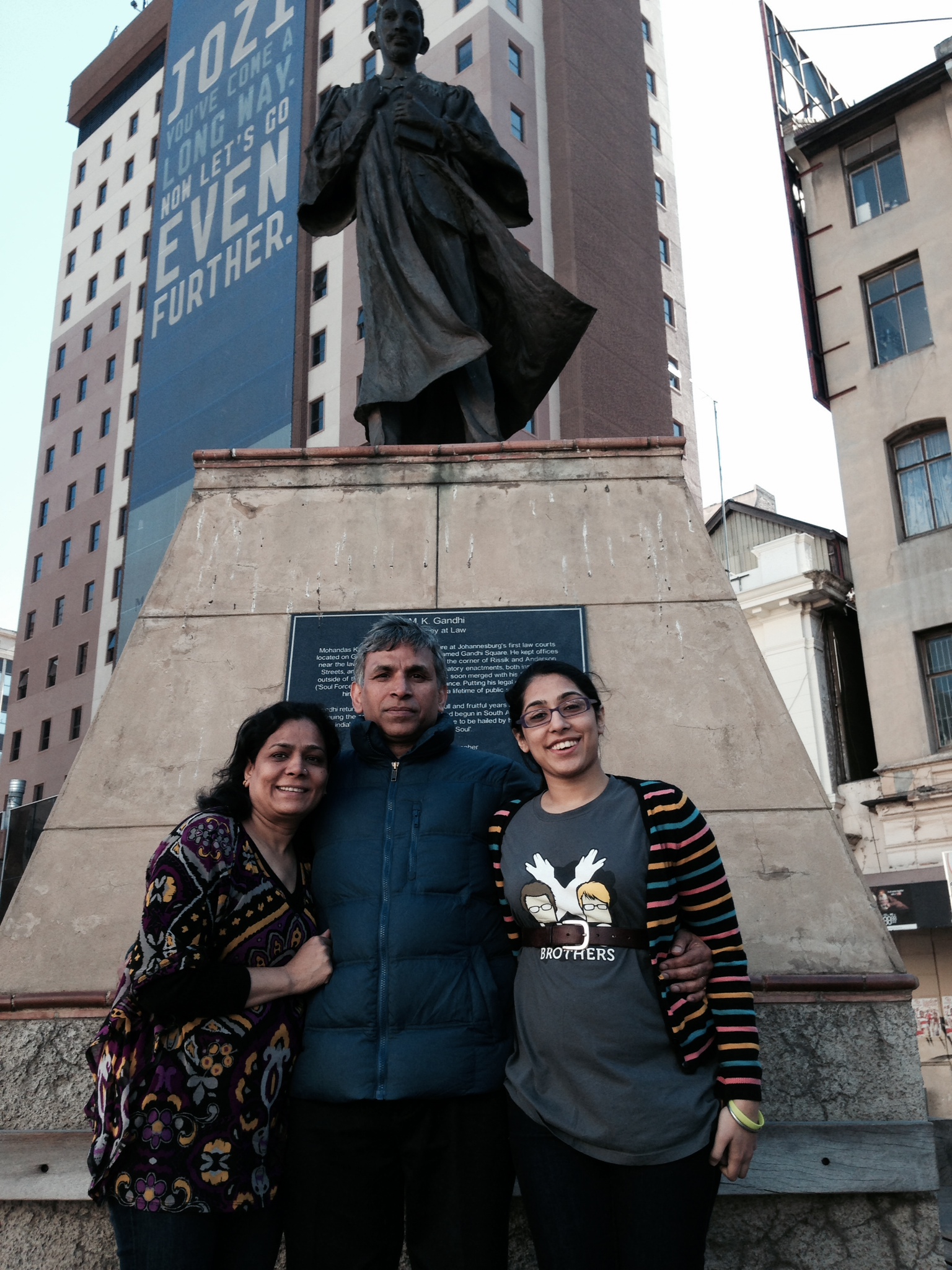
Also in downtown is Gandhi square at the intersection of Rissik Street and Anderson, at the location of the original offices of Mohandas Gandhi, the young barrister who later became Mahatma. There is a statue of Gandhi ji at the square. It was amazing to see this statue of the young Gandhi in full legal attire, which was unlike most Gandhi statues that showed the old Mahatma with round glasses.
Gandhi Statue at Gandhi Square in Johannesburg
Work
My main purpose to come here was to teach for an Executive MBA program run by our university here for the second-biggest telecom operator in South Africa. I taught IT Project Management here three evenings a week, traveling to their head office in a fast-growing Joburg suburb called Midrand. I liked very much the middle-level managers who were students in my course. The office buildings were nice, and I showed up three evenings a week for classes beginning at 5 pm. This happened for the first two weeks of my trip. I also got an opportunity to meet with the CEO of the company, a go-getter person of Indian origin, who is driving the company to rapid growth through investing big in people and infrastructure.
The second part of my work during these two weeks was to work with Maharishi Invincibility Institute (MII), a sister organization of our university, to help improve business processes. MII works out of a big clean donated building in downtown Joburg. Here students take courses at the bachelor’s degree level from my university, in a distance education mode. These are mostly disadvantaged black students who are nonetheless ambitious and want to improve their life and career prospects by getting a valuable education with an American degree. They practice Transcendental Meditation (TM), have glowing faces, and are very well-behaved and responsible individuals. The staff is very committed to the cause of Transcendental Meditation, and of spreading peace and harmony in the world. I worked with the director of MII, along with the other administrators to help them design information systems to improve delivery of distance education, and management of academic records. I really enjoyed working with them, and was glad to be of help.
Sightseeing- JoBurg
During the first full weekend in Joburg, we rented a nice Audi car and visited two safari and game parks. Pilanesburg is the 4th largest game reserve in SA, and is located about 2.5 hours away from Joburg. We spent a whole day, leaving house at 7 am and returning around 7 pm. We saw many kinds of animals. We saw two of the big five, the elephants and the rhinos. We could not see lions, leopards and buffaloes. We saw many zebras and giraffes at very close quarters, sometimes worried that they might attack us. But they were all quiet and calm and enjoyed their time in the sun, while we stopped the car and took pictures and videos.
African Elephant at the Pilansberg Natural Reserve
The next day we traveled to and spent the night at Ezemvelo, a huge picturesque and unspoilt nature reserve owned by MII. With no noise whatsoever except the crackle of the wood burning in the fireplace, we slept peacefully as never before.
Sightseeing- Durban
After the two weeks in Joburg, we rented another Audi car and drove to Durban. We drove down the 6 hour drive on the first day. As an indicator of things to come, we saw a predominantly Indian community at the midway point where we took a lunch break. The second day we went to an incredible Indian market called the Victoria Street market, in downtown Durban. Most of the shops and visitors there looked ethnic Indians. My family picked up all their souvenir jewellery items there. We could negotiate prices to our heart’s content.
At Victoria Street Market in Durban
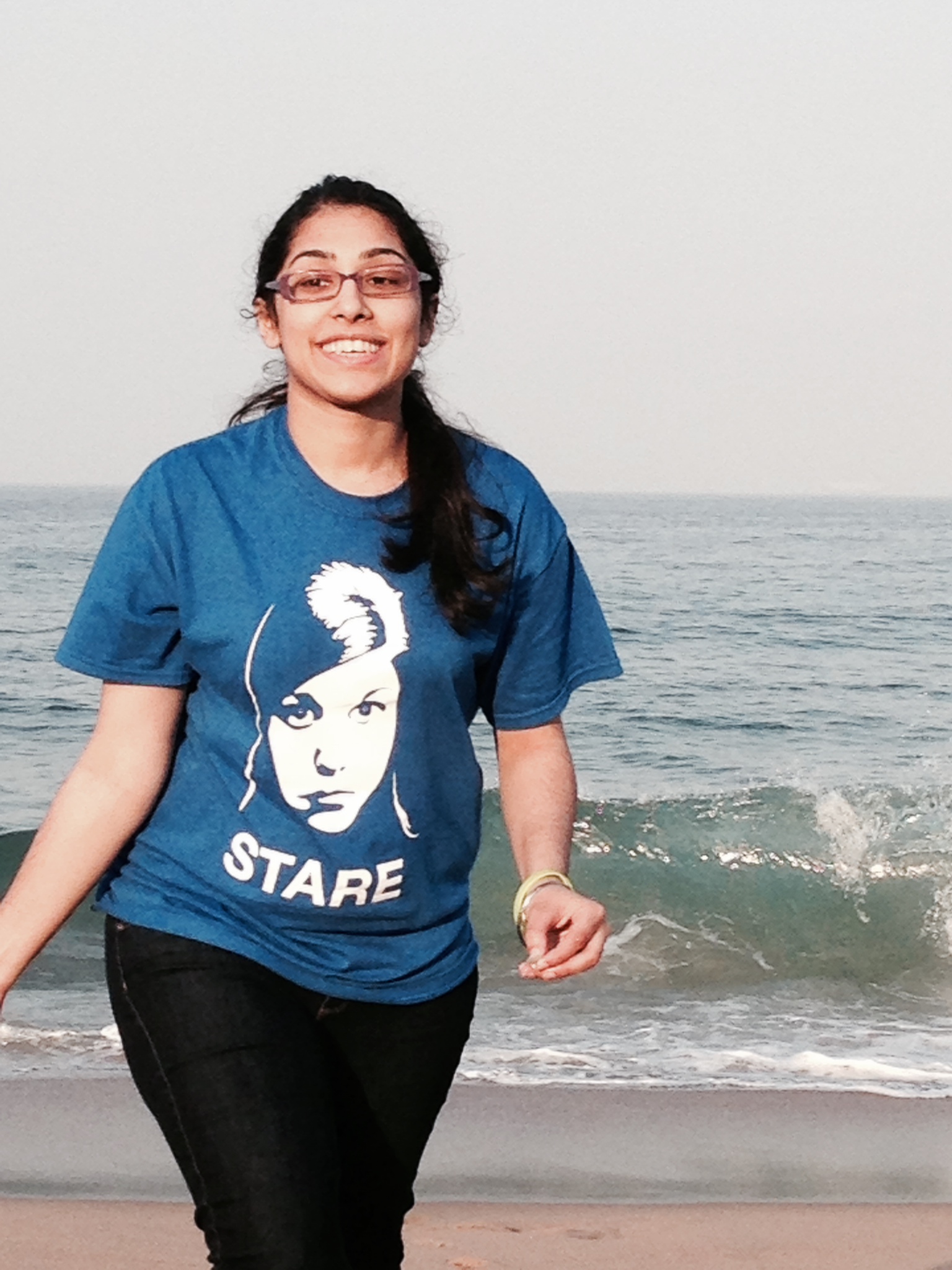
In the evening, we went to the beautiful beach on the Indian Ocean. We also enjoyed visiting Ushaka village, a nice shopping area in downtown Durban by the ocean.
Nupur at the beach in downtown Durban
The next day went to the Gandhi ashram, in the original Phoenix settlement. Gandhiji’s original structure had been rebuilt including his housing area and the printing press. The area around the settlement was still very poor with just squatters all around. We took pictures and videos, and also bought some momentos.
At the Gandhi Press in Phoenix, Durban
Later in the day, we visited the Umhlanga beach to the north of Durban, a very nice and clean beach close to our hotel. We played soccer on the beach with a couple of young black people, and it was a lot of fun.
Sightseeing- Cape Town
After three good days in Durban, we flew into Cape Town. This is a gorgeous city that opens up on two oceans, Atlantic and Indian. As soon as we landed at our hotel, we were met with our TM friends Elizabeth and her husband Barry. They took us to Camp’s Bay, and we dined at a very nice Indian restaurant called The Raj, which is frequented by Bollywood stars. The food was one of the best Indian vegetarian foods. The beach in front had white sand. We went on a gorgeous long drive along the coast line on the Atlantic Ocean side. We also visited the wineries and sat down for a cheese cake and rooibos tea.
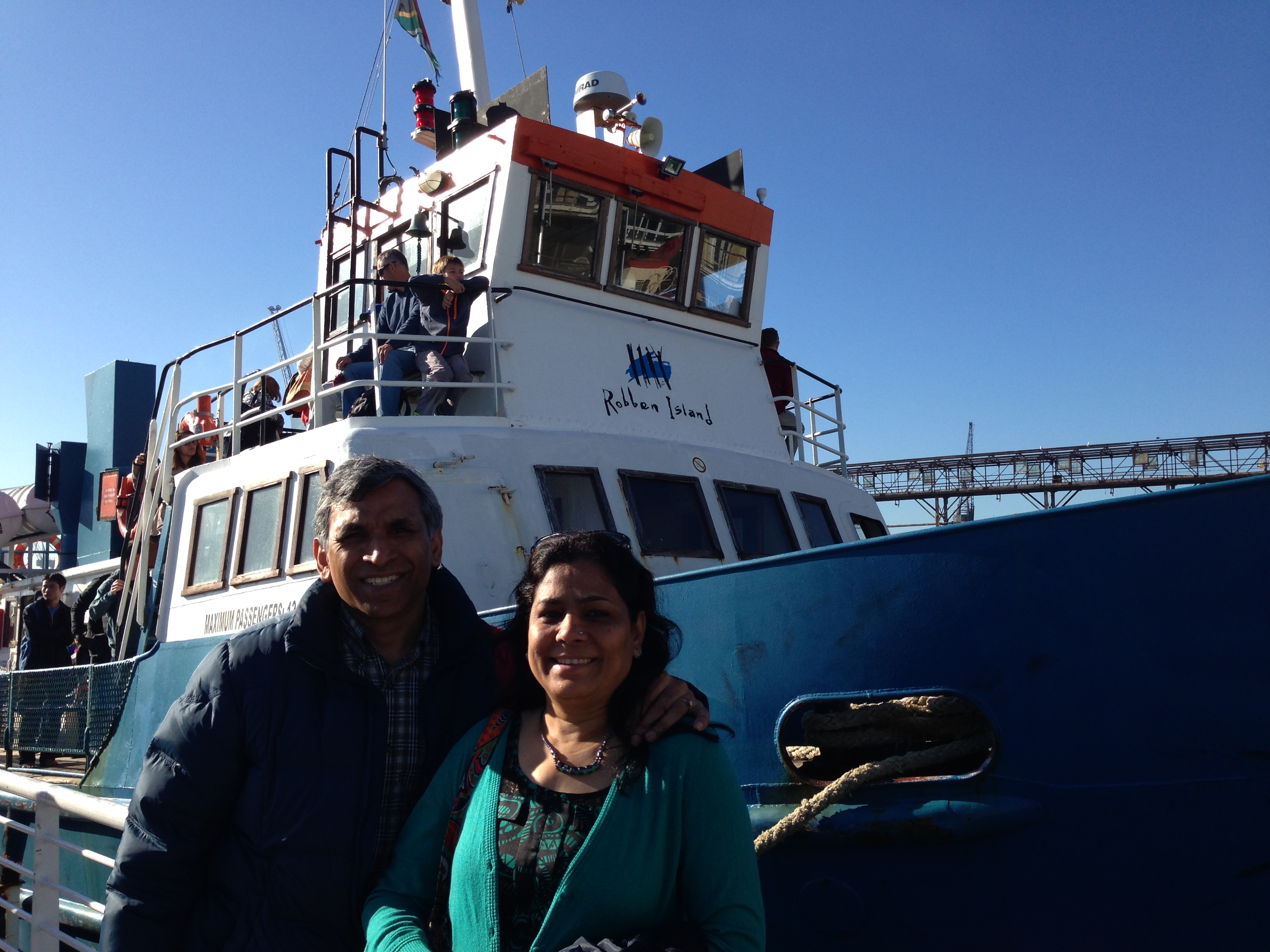
The next day was sunny, and we decided to make the most of it. In the morning we went to Robben Island, the high security prison where Mandela was imprisoned for more than two decades. In the afternoon we visited Table Mountain, a picturesque high and flat mountain by the sea. We took the ferry to Robben Island from the Victoria and Alfred Waterfront, which is a nicely done up shopping and entertainment area by the sea. It took almost an hour to be ferried the 11 k distance to the island by the old boat which used to ferry actual prisoners in the years gone by.
Ferried to the Robben island the old boat that used to ferry prisoners
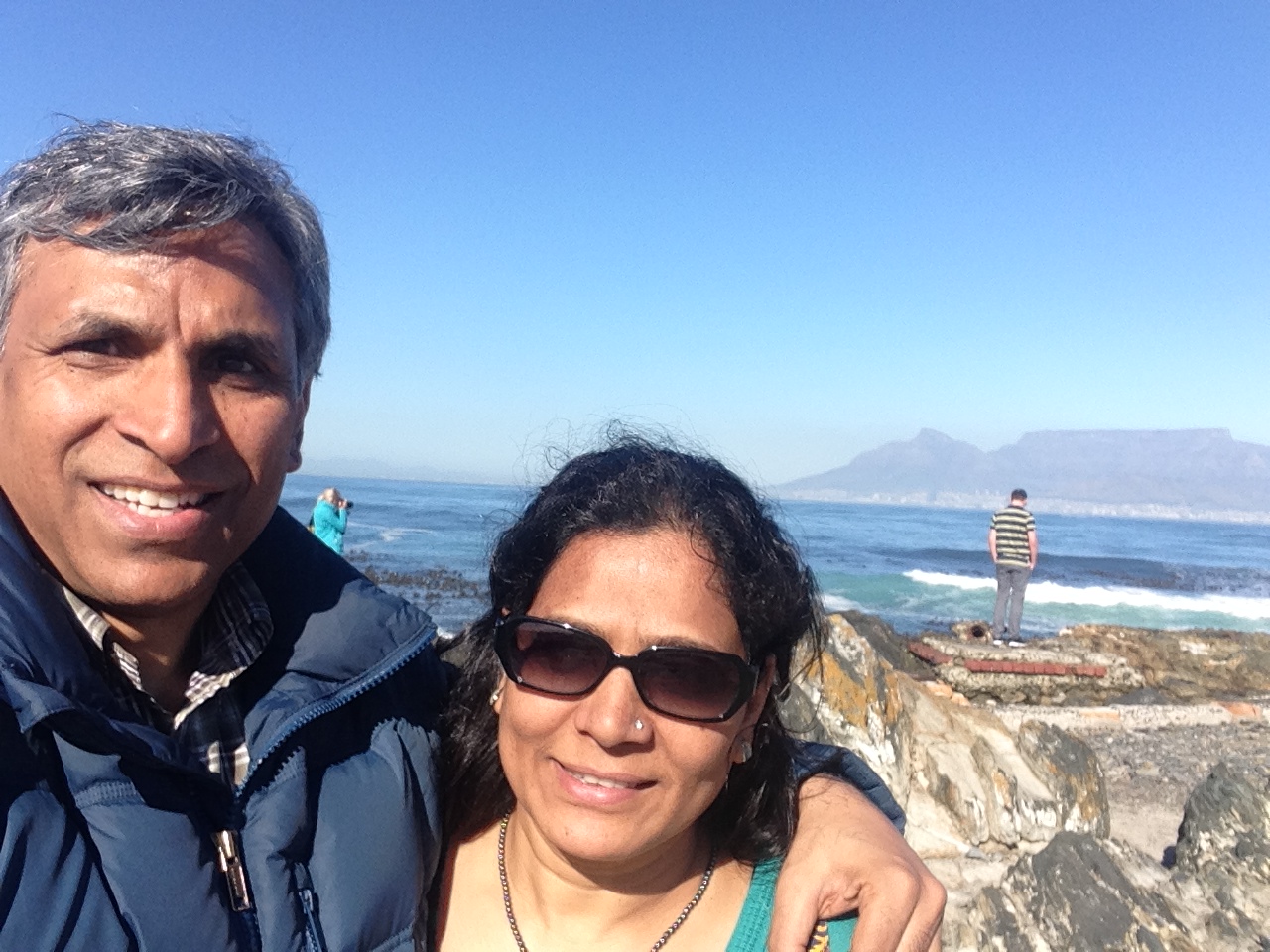
Robben Island was clean and nicely done up, evoking the experience of the prison, while not being to too dark and dingy. We were taken around the jail by a former prisoner in the jail. We got to visit the cell #7 in Wing B, the cell occupied by Nelson Mandela, often referred to by the former prisones as Father Mandela. One could see the Table Mountain from the island.
At Robben Island with the Table Mountain in the background
Upon returning to the mainland, we took a cab to quickly go to the Table Mountain cableway. We took the cableway to the top of the mountain. Initially we just sat towards the front and enjoyed lunch at the restaurant on the top of the mountain. However, when we went behind the restaurant, we discovered the huge expanse of the mountain. It was entirely walkable, just a tad more difficult than a garden walk. There were breathtaking views of the Atlantic Ocean on one side, and of the city of Cape Town and the Indian Ocean on the other side.
On top of Table Mountain
The next day we went to Cape Point, the southernmost tip of Africa. This is the point where the Atlantic and the Indian Oceans meet. The weather was not so good, and it rained off and on. However, our good friends Elizabeth and Barry took up the 65 km ride very nicely. We entered the Cape Point area, and then took a cableway to the top of a mountain. Then we climbed up some more stairs to see a lighthouse. This tall lighthouse stands elegantly as a beacon of hope to those perhaps stranded in ocean. We took pictures on both sides of Cape Point, of Indian and Atlantic Ocean sides. We ate some at the Two Oceans café up there.
Return
The next day, we flew back to Johannesburg. We took the time to visit Soweto, the famous large black colony, like the Dharavi slum of Bombay. This is where Mandela had lived for many years. We visited Mandela house, which is now a museum, and took pictures.
At Mandela House in Soweto
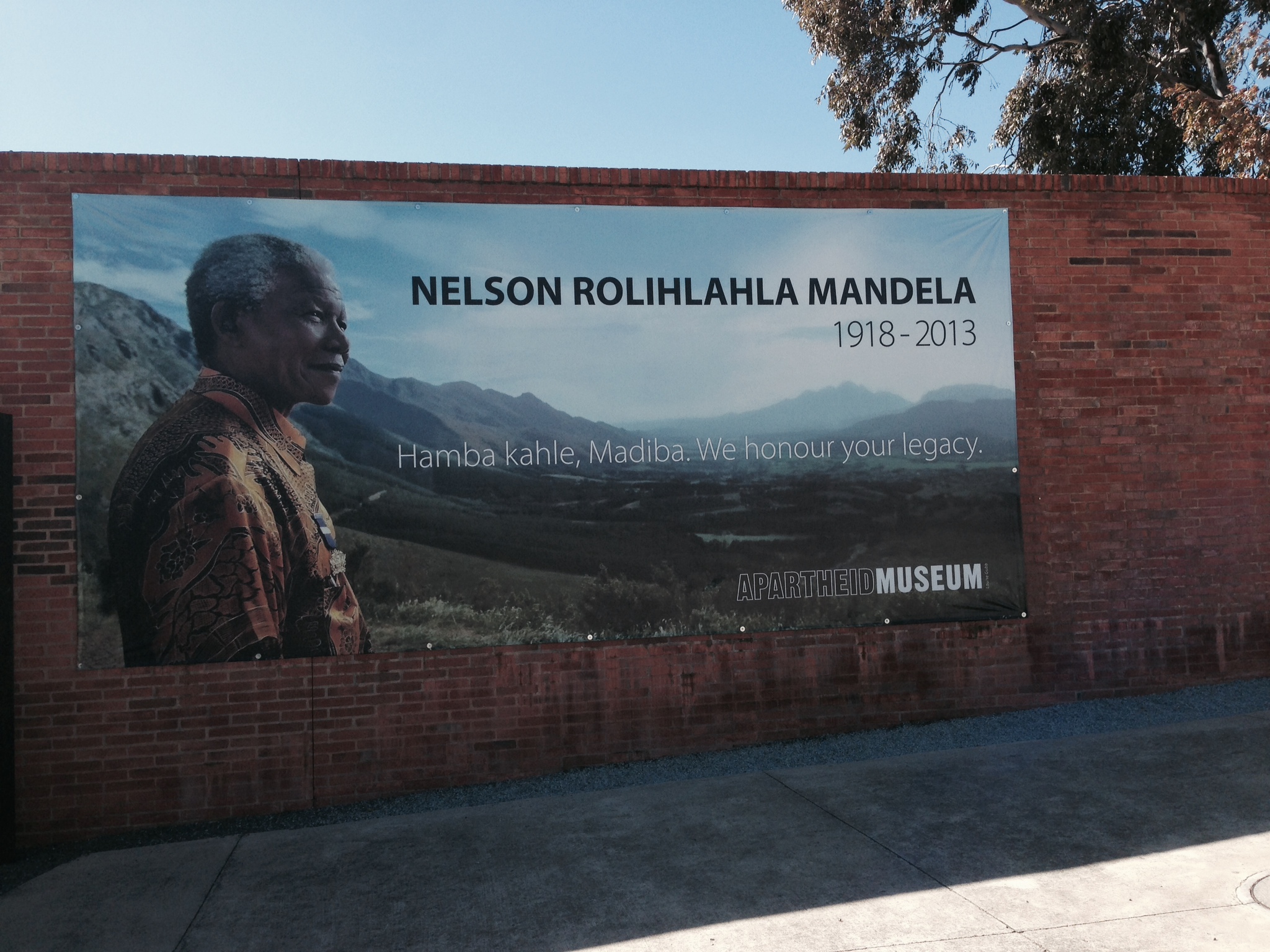
We also visited the Apartheid museum in the southwest side of Joburg. This museum stands as a monument to the dark period of human history in South Africa. The museum shocks the visitor into the experience of apartheid by assigning you to one of two entrances … for whites only, and for the colored. The paths are nice and wide and lighted for one case, and steel-caged, dark and narrow for the other. The museum is nicely done through images and videos from the struggle. There was also a permanent exhibit on the life and work of Nelson Mandela.
Mandela looms large at the entrance to the Apartheid Museum
We spent the weekend quietly organizing ourselves, and tying up some loose ends. Nupur and I watched a movie at the theater. ‘Miners Shot Down’ is a grim but gripping political documentary about the massacre of miners by the state police in August 2012, the worst massacre since the apartheid era. It spelled out the power of mining companies in South Africa, and how often the state and police apparatus work in collusion with the business interests. I followed it up with a nicer romantic movie, a Woody Allen movie called ‘Fading Gigolos’.
The next evening, we were dropped off at the Johannesburg airport by a friend from MII, and we left South Africa with very fond memories. I also thought that Cape Town might be a nice place to settle in, if the opportunity presented itself.
In the digital world you are defined by the data exhaust of your many activities. From your communication and movement activities, to your purchase and sales activities, there is a digital record of your actions that can be put together to collectively constitute your digital self.
The data about you can be analyzed and mined for patterns of behavior. Who you talk to, when you talk, what you talk about, and how you communicate … all these can be deciphered from analyzing the text and time-stamps of your conversations. Your pictures and comments and Likes on FaceBook tells a lot about what you do, what you like, and who you relate to. Your tweets are a veritable record of your many proclamations, jokes, and commentary. Smartphone apps like WhatsApp contain a complete record of much sharing among half-a-billion people across the globe.
For instance, a composite profile of a person was made using only 45 days’s worth of data from WhatsApp. It showed who the person talked to, what she talked about, when she talked most, and how she communicated. Advertising companies can perfectly understand her behavior patterns, and sell her what they can. The analysis showed that the person spoke a lot about food, desserts, and weight loss. And that she was online most often at 8 pm. Thus companies could sell her more food, sugary stuff, and then also sell her dreams and products for weight loss.
Our behaviors are far more patterned, and a lot less spontaneous, than we care to believe. Modeling the data about your activities can show that. How can we be better prepared to counter those who may be using many of our unconscious behavior patterns to fleece us? One way is to understand your own digital self better.
The first step is to be open to understanding yourself in a deep data-driven way. The example above shows the value of being self-aware of our behavior patterns.
The second step will be to obtain data about our digital self. Organizations like FaceBook and Google gather all the data, analyze it and then send targeted ads on behalf of businesses. However is is not very clear right now, how an individual can gather the data from the likes of FaceBook, LinkedIn, Twitter, Pinterest, and hundreds of other sites. If large organizations can obtain such data, individuals should also be able to do so. I found an application called http://givememydata.com/ that helps you get back your data from FaceBook.
Data about one’s own activities should be made available free of charge to every individual. The data should be made available in a pre-processed form that is easily understandable and manageable by the individual concerned. This should be similar to how all credit-rating agencies need to offer you annually a free record of all your financial profile.
Once the data has been collected, the third step is to analyze the data, along very simple lines to generate a composite dashboard of oneself. That will be our accessible digital self, seen through the digital mirror.
For more on data mining check out my book available on Amazon.
Enlightenment is bliss consciousness. It is sat-chit-anand. When you have tasted bliss, you can’t forget the experience.
How to explain the pleasures of winning your first customer to one how has not experienced it? How to describe the tastes and sounds of things that one has not experienced? Thus also about bliss. One can’t explain bliss. When bliss is experienced, everything else pales in comparison. There is nothing to worry about in bliss. There are no relative things with any gunas, that one needs to worry about. There is no distinction of head, heart or hands. It is not correct to say that everything comes together in bliss, because there is nothing separate to begin with. When one is in a state of non-separation, one feels bliss. There is the presence of emptiness. It is not a state of stupor or sleep. One is fully alert and can respond to a soft sound or request instantly, from a state that is established in consciousness.
Enlightenment is to get everything. Not more of this one thing or the other. Not more money, more fame, more health, more beauty, etc. Enlightenment is not to get more intellect, more bhakti, more accomplishments, or more energy. It is to get it all. It is to join (yog) at all levels with that source which cannot be named or described. It is the removal of darkness and turning the light on.
Why aspire for something that you already own? The truth and bliss are already within ourselves. There is no need to buy it. Others not give it to you. Others (through the agency of money) may transport you to some beautiful place, like Maui. However, they cannot give you bliss. It might be easier to feel the bliss in a beautiful environment. But ultimately, it is up to the person himself or herself to open up to connect with the bliss within.
So, why talk about enlightenment if it is already within everyone, and it has no property worth describing? Yet, we feel the urge and the impulse to share with others the inner joy so that they too may enjoy it. We want the best for everyone, whether or not they are aware of it. We want others to extend their vision beyond the immediacy of sense perceptions, and un-distort their perception which may have become distorted by their upbringing or other conditioning.
The perception of hunger is a powerful one. ‘One can’t pray on a hungry stomach’ goes an ancient Indian saying. It is possible to develop a sudden fear of going hungry and dying. Witnessing one physical death could scar someone for life, and one could build a determination that says ‘never again’. Family and society can instill and reinforce this fear like an inheritance. The consciousness of the body and the mind (ego) can temporarily overcome the awareness of our true nature.
One tries to understand and conquer the ‘world’ in many ways. With one foot firmly established in the relative world, one tries to reconnect with the nagging inner consciousness begging to free itself and reconnect with the infinite whole. A Gyana yogi is a man of great intellect and tries to reason his way towards it. A Bhakti yogi knows super-human gods and surrenders the little self to the whole self. Karma yogi works for what he wants, and tries to discover or create a more efficient path for happiness. And so on. But Enlightenment is not a race to the top. It is not an achievement to string into one’s resume. It is a light-ness, in many senses of the word. It is a state without a sense of heaviness (tamas, body consciousness), or darkness (rajas, ego consciousness). It is sattva, purity, consciousness aware of consciousness itself. It is a light that falls on light itself: the particles on the waves, the waves on the particles; the wholeness aware of its wholeness.
Just because this inner self-referral wholeness is not visible, that does not mean it is bereft of value. It is the inner life that enables the outer life. The inner life is the potential that causes the dynamic kinetics on the outside. It is the intelligence that creates forms and structures on the outside. It is the peace and unity that produces a roaring kaleidoscope of song and dance outside. It is the desire and the intention that produces focus and action on the outside.
The inner life just has to be ‘un-leashed’ or ‘re-leased’, as if it is some kind of a precious asset safe-guarded by fear. One has to overcome the fear that this great inner life force will somehow evaporate with the passing of the body. Preserving the body is not absurd. Carrying it to the extreme though is like preserving the box, but never tasting the chocolate inside. It is like never unpeeling the banana to taste the fruit.
The bliss is thus carefully hidden and protected within ourselves. To search for it is like looking for the eyeglasses that one has put on one’s head. A guru or teacher or coach can remind us of whether the glasses are. Once the awareness of our true nature dawns upon us, it should be almost impossible to be not aware of it. But one somehow gets sucked again in the seemingly limitless glittering world of the exterior, the psychedelic show of song and dance and form and structure, and begins to ignore the treasure that lies within.
As masters of nanoparticles, of things extremely subtle like cosmic particles whirling at the speed of light in giant particle colliders, we may find it absurd to imagine that we are ignorant of all that super-subtle treasures within. Where is the proof, we may ask? The proof is in direct experience, unmediated by any concepts or structures. The whole world is within us, and not the other way around. We are the whole, the Brahma. That is the simple shift in perspective that is required to become aware of our true infinite invincible creative nature.
Meanwhile, I must go and find something to eat. Till next time … be the bliss that you truly are!
Recently I completed writing my first book called Business Intelligence and Data Mining Made Accessible. It is available on Amazon. This book came after 30 years of work experience, after 3 years of my thinking about it, and then the book almost completed itself effortlessly in just 30 days. I like the book, and I enjoyed the process. There are some lessons in this for creative writing projects. Here is a four-step model for making a DENT in the world.
D is for Desire. One needs to have a strong and clear intent to write. There can be an urge to make a difference in the world. People write for many reasons, including recognition, money, and the sheer pleasure of contribution. The desire can come from being pressed, or encouraged, by others; it can come from watching friends become successful authors; or it can just be something that one badly wants to do.
E is for Expertise. One can develop certain areas of expertise over a period of time. It could be scientific knowledge about an area; or it could be a fertile imagination and a way of expressing it in fiction. One can hone one’s talents over a long period of time. This expertise could be self-evident when one is helping others out just for fun; or doing something by oneself in a playful spirit.
N is for Need. There should be a need out there to be satisfied. The need could be a general one, such as a continuous need for good fiction, or a need for a comprehensive reference book on a topic. The need could also be specific, for example addressing the needs of a particular audience known to you, including friends and family, and your students. The now famous Khan academy emerged from Sal Khan creating small video lessons to educate his niece on mathematics.
T is for Timing. The timing too has to be right for it to happen. The writer must find the time to create the content; there should be access to the right channels for expression; and the intended audience should be ready and receptive to the content.
Finally, of course, there is no substitute for hard work … just sitting down and making it happen.















 Blissful Living