Acupuncture Treatment for Ulcerative Colitis

Can-Acupuncture-Treat-UCAcupuncture Treatment for Ulcerative Colitis

Many people suffer from auto-immune diseases. Ulcerative Colitis (UC) is one such auto-immune disease. It is characterized mostly by an inflammation of the colon leading to constant bleeding from the rear end. Medical science calls it as part of Inflammatory Bowel Disease (IBD). There is no definitive cause assigned to it. There is no cure for the disease. Medicines like Mesalamine are designed mostly to contain the disease, i.e. to avoid its flaring up. I was able to obtain great success for myself in this disease with Acupuncture form of therapy. This piece below is to share my story with a wider audience so they can have a path to hope and success.

I first suffered from UC more than a dozen years ago. I was going through a particularly job-related stressful period in my life. I ignored the problem, till I could clearly see blood in my stool. I went to the emergency room and had colonoscopy done. I was prescribed steroids (Prednisone), which stopped the bleeding within a few days. I was also prescribed a Mesalazine formulation designed for long-term maintenance. I am against taking medicines for life. I immediately sought the help of Meditation, and went for a 10-day Vipassana course. I felt much relieved and happy, and in a few months, I let go of the maintenance medicine.

About 5 years after the first occurrence, I had another flare-up of the condition of UC. There was another job-related stress and some kind of a sinking feeling. After colonoscopy, the usual steroid and Mesalazine regiment was prescribed. However, this time the medicines were ineffective and the bleeding continued. My Gastro-Enterologist (GE) doctor now wanted to prescribe an immuno-suppresive medicine which worked on a different mechanism. After noticing its side effects including a form of cancer, I decided to obtain second opinion. Then I also consulted a tertiary GE specialist at a teaching hospital who had spent his life studying just UC. He also told me that there is no definite cause for this. He recommended that I should continue to take the maintenance regimen, as that is the best bet. I did another course of Vipassana meditation, which gave much relief but still did not completely stop the bleeding.

A chance encounter with an Acupuncturist set me on a different course. He said that they have no problem in curing UC. I was intrigued. I found a nice acupuncturist nearby and consulted her. She spent a whole hour listening to my symptoms in great detail. She also said that I will be cured soon. I was impressed. With two weeks of acupuncture treatment, with some herbs, my bleeding completely stopped. I repeat: bleeding completely stopped with acupuncture in 10 days, when it won’t stop for the previous six months. This looks like magic but it is completely true. I continued to do maintenance sessions with the acupuncturist at reduced frequencies, finally just once a month. My body and mind felt healthier. After an year I was completely cured.

A couple of years later, we relocated to another city for work. Again, because of job-related stress, UC reared its head. After colonoscopy I was prescribed the usual regimen of medicine, which did not help in stopping the bleeding. I lost a lot of weight. I called my previous acupuncturist and planned to fly out to her for treatment. However, she completely assured me that if I found a good acupuncturist in my new city, I will be able to get the same benefit. I followed her advice and selected an acupuncturist in my new city. He also said that the chances of success were excellent. Once again, with just two weeks of acupuncture treatment and herbs, my bleeding completely stopped. That was magic, repeated again.

I wanted to understand how this thing works. I was told that a good place to start was ‘The Web that has not Weaver’. It is a good book, but it is difficult to understand their language beyond the introductory chapters. They speak in terms of Chi and meridians. The reader can read this book on their own.

It has been several years since my last UC flare-up. Even now, I go to acupuncturist if my body begins to feel even a little bit uneasy. And I feel instantly better. Others are free to try.

I believe that the permanent solution lies within ourselves. We should be mentally strong and positive. There is nothing that we cannot do if we put our minds to it. We should prepare for the worst and hope for the best in every situation. We should lower our expectations. Being alive is great. We should be grateful for our life and everything else we have. We should take the time to thank all the beings that make your life livable and enjoyable. Our family, friends, customers, employers, suppliers, colleagues, restaurants, snow-removers, pets, and everyone else.

Auto-immune disease means that the body turns on itself. i.e. our body’s defense mechanisms like Adrenal glands get into overgear to protect against some imagined or real enemy. We exhaust ourselves in some time, run on fumes for a while, and then we get into a downward spiral from which it becomes difficult to escape. The best preventive method is to not feel negative at all in the first place. Try to be positive, always. Try to see something good in everything. Once negative feeling arises, it will have its effect on us. We can try to deny or suppress it, but it will come out some time or the other, in some way or the other.

We should try to see the world as sunny. There are many people who have lost their limbs or vision, but have not given up their dreams. Keep dreaming of a great future ahead. Then keep working towards it. Once life has a lofty purpose, then everything else, gain or loss, seems small and insignificant. Nothing bothers us and our bodies anymore. We can be as happy as we want to be.

2014: A Transformational Year

2014 was a transformational year for me. With my first book published (business intelligence and data mining), this new blog (anilmah.com), new travel (South Africa), a new talk (personal development through transcendence), and more, it was a productive year for me. The next year will surely bring its own joys!

Book: I wrote a well-received book on business intelligence and data mining. It was launched as an ebook on Amazon in May. It has consistently sold a couple of copies every day. At the end of the 2014, it was published by Business Expert Press (BEP), a NY-based publisher, in both print and e-book edition. (See the page on My Book).

Blog: This blog started in May of the year. There are quite a few posts on it. The topics range from travel to information technology to enlightenment to Vedas to good old Leadership, and more . My first post was a travelogue of my amazing trip to Kumbh Mela last year, and it was a big hit with the readers. My recent post on leadership lessons from organizing community events brought me more followers than all others previous posts combined. I continue to post from lived experiences.

Travels: I also had two major international travels this year, to South Africa and to India. The main purpose of the South African trip in June was to teach a course as part of an Executive MBA program. However, it also included visits to Gandhian monuments in Johannesburg and Durban. It also included sightseeing including the gorgeous city of Cape Town. (see my blog post on SA visit). The main purpose of my trip to India In November-December was to deliver a talk on personal development through transcendence at a conference in IIT Roorkee. After that I went to Yog gram for a week-long naturopathic detoxing retreat, and to Rajasthan to see my extended family (See my posts on the visits to Yog Gram and Pushkar).

Talks: I have delivered a talk on ‘Personal Development through Transcendental Meditation’ four times during the year 2014, three times in the US and once in India. Each time the talk was very well received. I essentially talk about how Transcendence is an orthogonal dimension to Intellect. For intellectually smart people, transcendence can open up new infinite avenues for creativity and fulfillment. I also share about how transcending using TM and TM-Sidhis over the last 2 years helped release my inner stresses and set me up for writing creatively from the heart and getting a great reception.

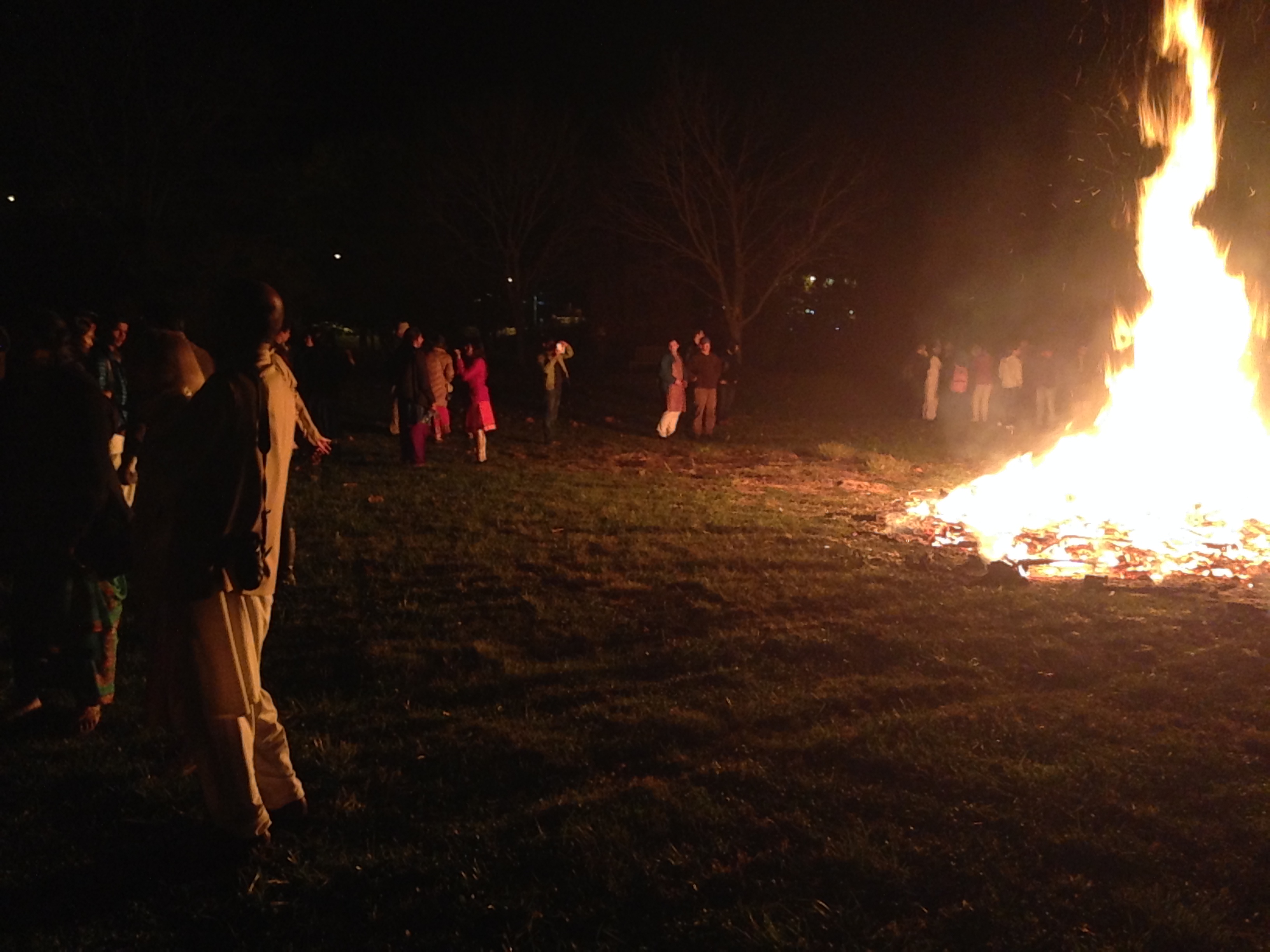
In addition, I led our South Asia community at our university into celebrations for six major festivals. Three of the celebrations included large bonfires. (See my blog posts on bonfires, and on leadership lessons from holding these events).

I am sure 2015 will bring its own joys!

Leadership Lessons from Organizing Cultural Events

Leadership Lessons from Organizing Cultural Events  …. By Anil Maheshwari

Certain good ideas lead to properly-organized and well-attended ‘successful’ cultural events. This could be applicable to creating good organizations also. I write below from my experience of organizing a few big house-full South-Asian cultural events at MUM over the last 12 months. All the events had the customary song and dance elements. However, they also had new innovations. And they all brought in new challenges, opportunities, surprises and joy. It takes a certain gut-strength to manage it all.

Here is a list of the events we organized and the innovations we incorporated:

  1. Diwali function in November 2013. We created a beautiful innovative poster to promote the event. We introduced the idea of including participants from all South Asian countries including not only India, but also Nepal, Bangladesh, SriLanka, Pakistan, and others. We introduced the idea of a fashion show where all students could showcase their traditional dresses. We introduced the idea of a boy-girl pair of MCs, where the MCs were from different nationalities. We invited the Mayor of the city to the event, and he got the flavor of how important Diwali is for the entire South asian community. We introduced the idea of giving free organic Burfi Prasad to all the attendees. Last but not the least, we kept the event free to the public. The program was wonderful, and the event was a big success. (Pictures courtesy: Craig Shaw). Diwali at MUM 2013
  2. Holi function in March 2014. We introduced the idea of a poetry recitation which is a Holi tradition in India. In this case, I did the recitation of a humorous old poem. We introduced the big idea of doing a large bonfire which is a Holi tradition: Students continued to sing and dance around the fire till midnight. We played with gulal (colored powder) in the night around the fire. We provided free munchies at the bonfire. We introduced the idea of a bhajan band, and this band continued playing at the bonfire also. The event was a super success.
  3. Baisakhi/Ugadi/Indian-New-Year event in April 2014. Coming soon after the Holi event, it was a low-key event. We invited the visiting head of the Maharishi movement in India who was visiting the US at that time. My daughter performed at the event.
  4. Krishna Janam Ashtami event in August 2014. This also worked as a welcoming event for all the new and returning students. We continued the ideas of a MC pair, free burfi Prasad, and a large bonfire. We introduced the idea of playing a Maharishi knowledge tape where he was talking of the significance and power of Lord Krishna. We invited the President of the university; he liked the event and said we needed more of such things to enliven the campus. The event was a house-full and standing room only performance.
  5. Garba dance party in September 2014. This was a dance party for people to dance to traditional Indian garba music. We brought the Dandiya sticks for the dance. At this event we also discovered our new student president of the South asian club.
  6. Diwali event in October 2014. This event used many of our previous ideas. We had the usual Bollywood song and dance shows, an MC pair, a large bonfire, a fashion show that now included people from Africa also. We added a professional Gandharva performance to the event. I led a group bhajan performance. People stood up and joyfully sang the Aarti together. This event was so packed that latecomers could not find space to get into the auditorium.

AKM Diwali 2014MUM campfire picture Oct2014

The organizing of all these events followed a similar pattern, was but there were different challenges each time. Different people pitched in to help when things looked bleak. Through all this I persevered. Here are some of my lessons:

  1. Commitment: Someone has to hold the flag high. Even when no one else is interested or seems to be ready to contribute, the key organizer must love the idea, and should have complete faith that the event will happen, and well. There were moments when there was no one else who came to the event planning meeting.
  2. Self-sufficiency. One should be prepared to invest your own time and resources to make the event happen. One should have the talent to sing and dance, or have your friends and family participate as needed. One can usually find the talent, strength and resources within oneself.
  3. Openness: Be open to surprises. Be open to what might actually happen at the event. Do not get stuck in a preconceived notion of a cultural event. Be open to new ideas from unexpected sources. Be open to support from unexpected sides. Totally different people, faculty or students, pitched in to support each of the events at crucial moments. Later in the year, we found consistent support from one like-minded person on campus.
  4. Integrity: Make sure every event has integrity at a high level. The higher level idea should be to have fun, or whatever else. Do not get caught in the weeds of this item or that, this performer or that, this issue or that. Gradually the reputation will grow and people would love to attend the events.