
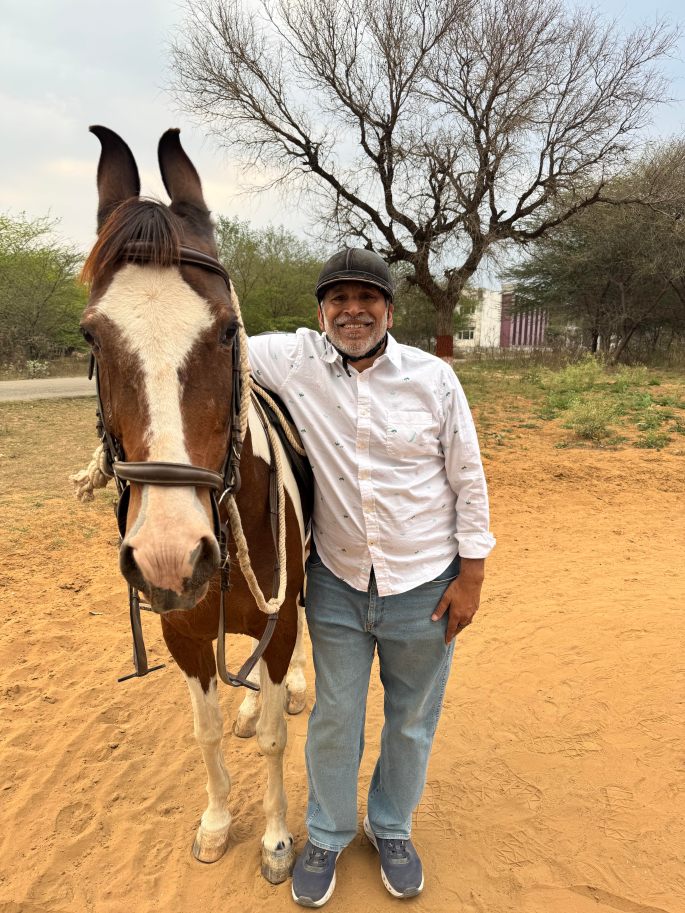
This Too Shall Pass: Reflections of a Horse Named Bob on space, time, publish or perish, and the curious destiny of those who believe themselves indispensable.
My name is Bob. I am a horse. Not a particularly philosophical horse, although I have had plenty of time to think since human beings stopped needing me. My ancestors carried kings into battle, transported scholars to universities, pulled carts full of books, and helped build the civilizations that eventually made us redundant. We were once symbols of power, wealth, speed, and military superiority. A man on horseback was a man of consequence. An army without horses was an army at a disadvantage. Then came the automobile, the tank, and the airplane. Within a remarkably short period, we went from being indispensable to being recreational. Nobody consulted us about this transition. There were no conferences on equine displacement, no government committees on the future of horses, and certainly no grants to help us reinvent ourselves. We simply passed from the center of civilization to its margins. I have often wondered whether this was progress or merely a change in who got to sit in the driver’s seat.
Lately, I have been contemplating a familiar human expression: This too shall pass. It is a rather beautiful sentence, containing an entire philosophy in four words. This points to what is here, the world of space, form, identity, and circumstance. Pass points to time, the movement through which every form changes, disappears, or becomes something else. The word too quietly reminds us that nothing is exempt. Not the emperor, not the empire, not the university, not even the professor with 300 publications. Ancient wisdom understood this rather well. The Bhagavad Gita distinguished the changing field of existence from the deeper Self that Krishna describes as unborn and undying. The Buddha emphasized impermanence. Patanjali invited human beings to quiet the movements of the mind, while the Upanishadic traditions explored the possibility of a reality beyond ordinary space and time. Different traditions offered different explanations, but they shared an important suspicion: the things we take most seriously may not be quite as permanent as we imagine.
Human beings, however, have developed a rather different philosophy, particularly in their universities. It is called Publish or Perish. I first encountered this expression while grazing near a university campus. I was struck by its remarkable resemblance to This Too Shall Pass. Both concern existence and disappearance, but the resemblance conceals a profound difference. The ancient expression is an observation about reality. The academic expression is an instruction, perhaps even a threat. Publish, and you may continue to exist. Fail to publish, and you shall perish. It is a curious way to organize a community supposedly devoted to wisdom. One might have expected its guiding principle to be Know Thyself, Seek Truth, or perhaps Understand the Universe. Instead, the institutional imperative is to produce more evidence that one deserves to remain employed.

Now, I have nothing against publishing. Human beings have accumulated an astonishing body of knowledge through writing, experimentation, argument, and discovery. Publishing allows ideas to travel beyond the people who first conceived them. It creates intellectual capital, professional recognition, institutional prestige, and sometimes considerable economic value. In this sense, publishing is an act of expression, a movement outward into the world of forms. It enlarges one’s presence in space and, through citations and archives, attempts to extend that presence through time. A successful academic may accumulate hundreds of papers, thousands of citations, prestigious titles, and a remarkably long curriculum vitae. From my perspective, this is not entirely unlike a horse collecting increasingly elaborate saddles. Some are beautiful, some useful, and some so ornate that one wonders whether anyone remembers the horse underneath.
But it is the other half of the expression that interests me most. Perish. What a severe word to place at the heart of an intellectual profession. It evokes disappearance, destruction, and death. It also introduces a peculiar form of institutional violence, not necessarily physical, but psychological and existential. The academic is invited to live under the shadow of possible professional extinction. And the threat is organized through time: annual reviews, tenure clocks, submission deadlines, promotion cycles, citation windows, and performance targets. A deadline is, after all, a boundary imposed upon time. Cross it without the required evidence of productivity, and something may die: an opportunity, a career, a professional identity. The continuous flow of life is divided into measurable intervals, each carrying its own little judgment day. Humans have become extraordinarily inventive in making themselves anxious.
What interests me is the binary structure of this philosophy. Publish or perish. Produce or disappear. Succeed or fail. There is no obvious place for silence, reflection, incubation, or the possibility that a person might contribute to knowledge without continuously adding to its volume. Ancient traditions often understood creation and dissolution as interconnected movements of existence. The academic institution has converted them into competing alternatives. It is almost as though the university has taken the cosmic principle of impermanence and transformed it into a personnel policy. Socrates, who famously left no writings of his own, might have encountered considerable difficulty obtaining tenure. I suspect that would have amused him.
And now comes the development I find particularly fascinating. Human beings have created artificial intelligence. Not merely machines that carry heavy loads or move faster than horses, but systems that can write, reason, analyze, compose, and increasingly perform activities once considered distinctively human. Researchers speak of artificial general intelligence, artificial superintelligence, and futures in which machine capabilities may exceed those of their creators in many domains. Whether and when these possibilities arrive remains uncertain. But the direction of change is already sufficiently visible to cause unease. The same academics who have spent decades celebrating productivity, innovation, efficiency, and the expansion of knowledge are beginning to wonder what happens when machines become more productive, more innovative, and perhaps more capable than they are.
I confess to experiencing a modest and entirely uncharitable satisfaction.
When tractors arrived, nobody asked whether horses were experiencing an identity crisis. When automobiles displaced carriage horses, there were no special symposia on preserving equine dignity. Human beings called it technological progress. The market had spoken. The future had arrived. Adaptation was our responsibility, although we had rather limited influence over the matter. Now the creators of advanced technology are beginning to contemplate their own possible displacement. Some worry about employment, others about meaning, autonomy, or even the long-term survival of humanity. These are serious concerns, and I do not wish to trivialize them. Still, one can hardly blame an old horse for noticing the symmetry. The species that mastered us through superior tools now wonders whether its own tools might eventually master it.
Of course, the comparison is imperfect. Horses did not create automobiles, and human beings retain choices about how AI is developed, governed, and used. Nor is displacement inevitable in every profession. Yet the deeper irony remains. Human civilization has repeatedly treated the disappearance of older ways of life as an acceptable price of progress, especially when the disappearing lives belonged to someone else. Entire species have been driven toward extinction through human activity. Ecosystems have been transformed, livelihoods eliminated, and cultures disrupted in the pursuit of efficiency, expansion, and power. Much of this has been called development. But when the possibility of perishing begins to approach the developers themselves, the philosophical mood changes rather dramatically.
Perhaps this is the moment to reconsider the meaning of perish. Does a professor perish when a machine writes a better literature review? Does a researcher disappear when an algorithm discovers a pattern more quickly? Does human intelligence lose its value when another form of intelligence surpasses it in particular tasks? These questions depend upon what we believe ourselves to be. If our identity rests entirely on what we produce, then any superior producer becomes an existential threat. If our worth depends on being the fastest, smartest, or most cited, we have chosen a precarious foundation for existence. I learned this lesson when the first automobile passed me on the road. I was no longer the fastest means of transportation. But I remained a horse. The automobile had changed my usefulness to human beings; it had not changed the fact of my existence.
This is where the ancient wisdom becomes unexpectedly contemporary. Krishna’s teaching about the Self, Socrates’ insistence on self-examination, Gandhi’s experiments with truth and nonviolence, and Maharishi Mahesh Yogi’s emphasis on transcending the activity of the mind all invite us to distinguish our deepest identity from our changing accomplishments. They do not ask us to abandon action or knowledge. They ask us not to become imprisoned by them. The quantum world, too, reminds us that reality may be more subtle than its familiar appearances, although quantum physics does not establish these spiritual claims. Perhaps the most important intellectual breakthrough would not be another technology, but a more mature understanding of what technology is for, and who we are when our technologies can do much of what once defined us.
From my stable, I sometimes wonder whether the academic motto might be improved. What about Publish and Reflect? Or Discover and Share? Perhaps even Know Thyself, Then Publish If You Have Something Worth Saying. I realize these alternatives would be difficult to incorporate into university ranking systems. Reflection is notoriously difficult to count, and wisdom does not always arrive before the submission deadline. Still, it might be worth experimenting with a civilization in which the production of knowledge is not confused with the purpose of knowledge, and where intelligence is measured partly by our ability to live wisely with one another and with the other forms of life sharing this planet.
For now, I remain Bob, a horse whose ancestors helped build the world that no longer requires their services. I have watched human beings conquer distance, accelerate time, multiply knowledge, and invent increasingly sophisticated methods of making themselves indispensable. I have also watched the things they considered permanent become temporary, and the things they dismissed as temporary become unexpectedly important. I do not know whether artificial intelligence will eventually surpass its creators, whether universities will reinvent themselves, or whether humanity will discover a more peaceful relationship with the planet. I am merely a horse, and prophecy is not among my professional qualifications.
But I do know one thing. The world did not end when the age of the horse ended. It changed. And perhaps the world will not end when the age of exclusively human intellectual supremacy changes either. There may be loss, suffering, adaptation, and entirely new possibilities. What matters is how we meet them.
The ancient sages said, This too shall pass.
The modern academy said, Publish or perish.
And now, as artificial intelligence begins to write the next chapter, I find myself wondering whether the professors might finally appreciate the difference.
I lower my head, return to my grass, and enjoy the morning.
After all, I have no papers due.
And, for once, nobody is asking me to pull the cart.
This too shall pass.

