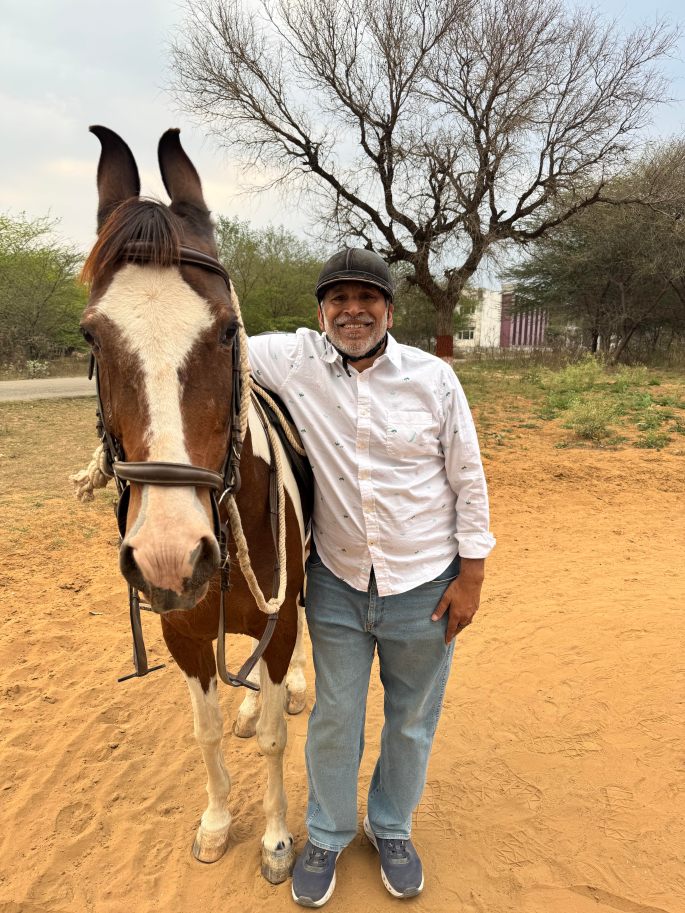
This Too Shall Pass: Lessons from a Horse Named Bob

This Too Shall Pass: Reflections of a Horse Named Bob on space, time, publish or perish, and the curious destiny of those who believe themselves indispensable.

My name is Bob. I am a horse. Not a particularly philosophical horse, although I have had plenty of time to think since human beings stopped needing me. My ancestors carried kings into battle, transported scholars to universities, pulled carts full of books, and helped build the civilizations that eventually made us redundant. We were once symbols of power, wealth, speed, and military superiority. A man on horseback was a man of consequence. An army without horses was an army at a disadvantage. Then came the automobile, the tank, and the airplane. Within a remarkably short period, we went from being indispensable to being recreational. Nobody consulted us about this transition. There were no conferences on equine displacement, no government committees on the future of horses, and certainly no grants to help us reinvent ourselves. We simply passed from the center of civilization to its margins. I have often wondered whether this was progress or merely a change in who got to sit in the driver’s seat.

Lately, I have been contemplating a familiar human expression: This too shall pass. It is a rather beautiful sentence, containing an entire philosophy in four words. This points to what is here, the world of space, form, identity, and circumstance. Pass points to time, the movement through which every form changes, disappears, or becomes something else. The word too quietly reminds us that nothing is exempt. Not the emperor, not the empire, not the university, not even the professor with 300 publications. Ancient wisdom understood this rather well. The Bhagavad Gita distinguished the changing field of existence from the deeper Self that Krishna describes as unborn and undying. The Buddha emphasized impermanence. Patanjali invited human beings to quiet the movements of the mind, while the Upanishadic traditions explored the possibility of a reality beyond ordinary space and time. Different traditions offered different explanations, but they shared an important suspicion: the things we take most seriously may not be quite as permanent as we imagine.

Human beings, however, have developed a rather different philosophy, particularly in their universities. It is called Publish or Perish. I first encountered this expression while grazing near a university campus. I was struck by its remarkable resemblance to This Too Shall Pass. Both concern existence and disappearance, but the resemblance conceals a profound difference. The ancient expression is an observation about reality. The academic expression is an instruction, perhaps even a threat. Publish, and you may continue to exist. Fail to publish, and you shall perish. It is a curious way to organize a community supposedly devoted to wisdom. One might have expected its guiding principle to be Know Thyself, Seek Truth, or perhaps Understand the Universe. Instead, the institutional imperative is to produce more evidence that one deserves to remain employed.

Horse in glasses and formal clothes reading among books in a library
A horse dressed as a scholar studies books and notes in a warmly lit library.

Now, I have nothing against publishing. Human beings have accumulated an astonishing body of knowledge through writing, experimentation, argument, and discovery. Publishing allows ideas to travel beyond the people who first conceived them. It creates intellectual capital, professional recognition, institutional prestige, and sometimes considerable economic value. In this sense, publishing is an act of expression, a movement outward into the world of forms. It enlarges one’s presence in space and, through citations and archives, attempts to extend that presence through time. A successful academic may accumulate hundreds of papers, thousands of citations, prestigious titles, and a remarkably long curriculum vitae. From my perspective, this is not entirely unlike a horse collecting increasingly elaborate saddles. Some are beautiful, some useful, and some so ornate that one wonders whether anyone remembers the horse underneath.

But it is the other half of the expression that interests me most. Perish. What a severe word to place at the heart of an intellectual profession. It evokes disappearance, destruction, and death. It also introduces a peculiar form of institutional violence, not necessarily physical, but psychological and existential. The academic is invited to live under the shadow of possible professional extinction. And the threat is organized through time: annual reviews, tenure clocks, submission deadlines, promotion cycles, citation windows, and performance targets. A deadline is, after all, a boundary imposed upon time. Cross it without the required evidence of productivity, and something may die: an opportunity, a career, a professional identity. The continuous flow of life is divided into measurable intervals, each carrying its own little judgment day. Humans have become extraordinarily inventive in making themselves anxious.

What interests me is the binary structure of this philosophy. Publish or perish. Produce or disappear. Succeed or fail. There is no obvious place for silence, reflection, incubation, or the possibility that a person might contribute to knowledge without continuously adding to its volume. Ancient traditions often understood creation and dissolution as interconnected movements of existence. The academic institution has converted them into competing alternatives. It is almost as though the university has taken the cosmic principle of impermanence and transformed it into a personnel policy. Socrates, who famously left no writings of his own, might have encountered considerable difficulty obtaining tenure. I suspect that would have amused him.

And now comes the development I find particularly fascinating. Human beings have created artificial intelligence. Not merely machines that carry heavy loads or move faster than horses, but systems that can write, reason, analyze, compose, and increasingly perform activities once considered distinctively human. Researchers speak of artificial general intelligence, artificial superintelligence, and futures in which machine capabilities may exceed those of their creators in many domains. Whether and when these possibilities arrive remains uncertain. But the direction of change is already sufficiently visible to cause unease. The same academics who have spent decades celebrating productivity, innovation, efficiency, and the expansion of knowledge are beginning to wonder what happens when machines become more productive, more innovative, and perhaps more capable than they are.

I confess to experiencing a modest and entirely uncharitable satisfaction.

When tractors arrived, nobody asked whether horses were experiencing an identity crisis. When automobiles displaced carriage horses, there were no special symposia on preserving equine dignity. Human beings called it technological progress. The market had spoken. The future had arrived. Adaptation was our responsibility, although we had rather limited influence over the matter. Now the creators of advanced technology are beginning to contemplate their own possible displacement. Some worry about employment, others about meaning, autonomy, or even the long-term survival of humanity. These are serious concerns, and I do not wish to trivialize them. Still, one can hardly blame an old horse for noticing the symmetry. The species that mastered us through superior tools now wonders whether its own tools might eventually master it.

Of course, the comparison is imperfect. Horses did not create automobiles, and human beings retain choices about how AI is developed, governed, and used. Nor is displacement inevitable in every profession. Yet the deeper irony remains. Human civilization has repeatedly treated the disappearance of older ways of life as an acceptable price of progress, especially when the disappearing lives belonged to someone else. Entire species have been driven toward extinction through human activity. Ecosystems have been transformed, livelihoods eliminated, and cultures disrupted in the pursuit of efficiency, expansion, and power. Much of this has been called development. But when the possibility of perishing begins to approach the developers themselves, the philosophical mood changes rather dramatically.

Perhaps this is the moment to reconsider the meaning of perish. Does a professor perish when a machine writes a better literature review? Does a researcher disappear when an algorithm discovers a pattern more quickly? Does human intelligence lose its value when another form of intelligence surpasses it in particular tasks? These questions depend upon what we believe ourselves to be. If our identity rests entirely on what we produce, then any superior producer becomes an existential threat. If our worth depends on being the fastest, smartest, or most cited, we have chosen a precarious foundation for existence. I learned this lesson when the first automobile passed me on the road. I was no longer the fastest means of transportation. But I remained a horse. The automobile had changed my usefulness to human beings; it had not changed the fact of my existence.

This is where the ancient wisdom becomes unexpectedly contemporary. Krishna’s teaching about the Self, Socrates’ insistence on self-examination, Gandhi’s experiments with truth and nonviolence, and Maharishi Mahesh Yogi’s emphasis on transcending the activity of the mind all invite us to distinguish our deepest identity from our changing accomplishments. They do not ask us to abandon action or knowledge. They ask us not to become imprisoned by them. The quantum world, too, reminds us that reality may be more subtle than its familiar appearances, although quantum physics does not establish these spiritual claims. Perhaps the most important intellectual breakthrough would not be another technology, but a more mature understanding of what technology is for, and who we are when our technologies can do much of what once defined us.

From my stable, I sometimes wonder whether the academic motto might be improved. What about Publish and Reflect? Or Discover and Share? Perhaps even Know Thyself, Then Publish If You Have Something Worth Saying. I realize these alternatives would be difficult to incorporate into university ranking systems. Reflection is notoriously difficult to count, and wisdom does not always arrive before the submission deadline. Still, it might be worth experimenting with a civilization in which the production of knowledge is not confused with the purpose of knowledge, and where intelligence is measured partly by our ability to live wisely with one another and with the other forms of life sharing this planet.

For now, I remain Bob, a horse whose ancestors helped build the world that no longer requires their services. I have watched human beings conquer distance, accelerate time, multiply knowledge, and invent increasingly sophisticated methods of making themselves indispensable. I have also watched the things they considered permanent become temporary, and the things they dismissed as temporary become unexpectedly important. I do not know whether artificial intelligence will eventually surpass its creators, whether universities will reinvent themselves, or whether humanity will discover a more peaceful relationship with the planet. I am merely a horse, and prophecy is not among my professional qualifications.

But I do know one thing. The world did not end when the age of the horse ended. It changed. And perhaps the world will not end when the age of exclusively human intellectual supremacy changes either. There may be loss, suffering, adaptation, and entirely new possibilities. What matters is how we meet them.

The ancient sages said, This too shall pass.

The modern academy said, Publish or perish.

And now, as artificial intelligence begins to write the next chapter, I find myself wondering whether the professors might finally appreciate the difference.

I lower my head, return to my grass, and enjoy the morning.

After all, I have no papers due.

And, for once, nobody is asking me to pull the cart.

This too shall pass.
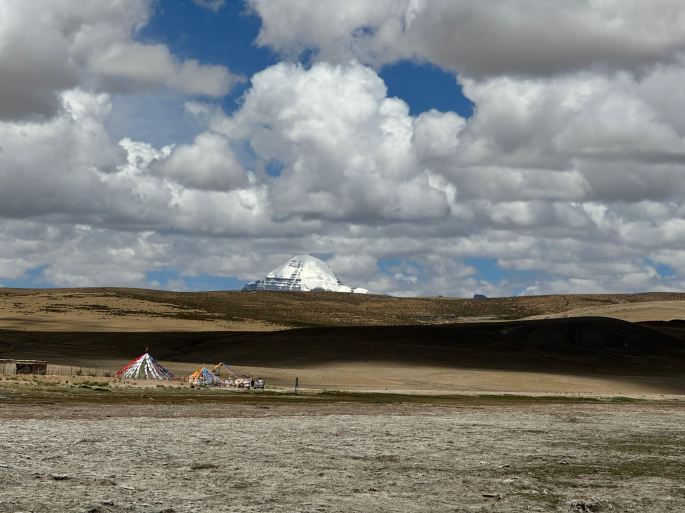
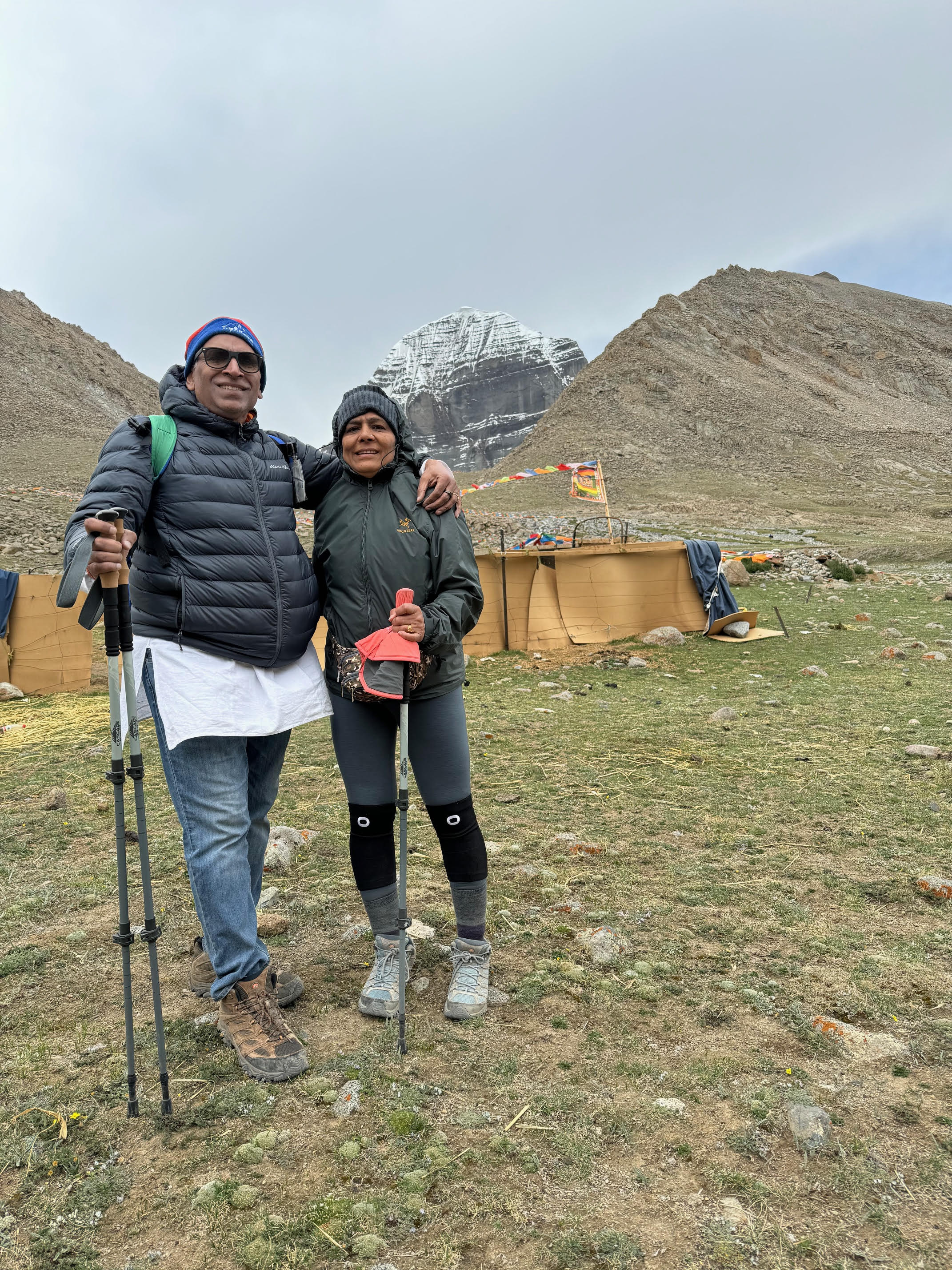
Trip to Mt Kailash and Manasarovar Lake

Mount Kailash and Manasarovar Lake, located in Western Tibet, are among the holiest and mystical of pilgrimage sites across many religious traditions including Hinduism and Buddhism. Mt Kailash, considered the abode of Lord Shiva, is at a 6600+ meter elevation, while the Manasarovar lake nearby is the highest freshwater lake in the world. This trek is a tough 52-km circumambulation (parikrama) of Mt Kailash, using limited housing and other facilities.  This is a report on our small group’s 17-day trip to this magnificent place in July 2024. It concludes with some recommendations for future pilgrims, especially seniors.

Think of this pilgrimage trek in two parts. The core part is the 3 days spent doing the parikrama around the holy mountain and the lake. The longer 14-day part is getting to this high place from home, and back. There were 13 of us pilgrims in our group, with 12 from the US and one from Singapore. All were citizens of Indian origin, including four senior married couples. All members had different personalities, and half of us were Ph.Ds.   Three of the pilgrims were repeat visitors to Mt Kailash. We went to this trek with an experienced Kathmandu based tour operator to organize the tour.

We all landed in Kathmandu (KTM) from our respective home locations all over the US. We spent four nights in KTM (1350 meters above sea level) doing a little bit of acclimatization, while the tour operator applied for and received travel special permits for us to travel to Tibet. While in KTM, we visited the world famous Pashupatinath (Shiva) temple at their evening puja time. We also climbed to the Tarkeshwar (Shiva) temple to an elevation of 1900 meters. 

After four days in KTM, we packed a subset of our baggage into a big duffel bag and a backpack, and left our travel suitcases in the hotel. We took the flight to Lhasa. There is a direct flight but it was sold out. So, we had to make an indirect flight through Chengdu hub airport. That took up an extra day which could have been used for sightseeing and acclimatization in Lhasa (3500 m above sea level).  In Lhasa we had time enough to visit the spectacular Potala Palace, a huge 1000 year old structure, that contains the offices and tombs of many Dalai Lama’s from the first to the 13th.  From Lhasa, we did a 2-day 1000 km long bus drive through the beautiful Tibetan mountains and valleys to reach Lake Manasarovar.

It felt magical to reach Lake Manasarovar which is the highest freshwater lake on the planet. We immediately did a parikrama of the lake itself by bus. We gathered holy water from the Manasarovar lake to bring back home.

Our parikrama of the lake showed two additional things. One, it provided a broad view of MtK from different angles. It also showed up another nearby lake called the Rakshakshthal (or devil’s place), a salty cursed lake. There is fascinating mythology around how a freshwater lake and a dear salty water lake happen to coexist at this high elevation, and both of them barely to the south of Mt. Kailash. (Kailash in English means a pure crystal).

At Manasarovar Lake, we spent a night in a modest dormitory, for acclimatization at this height of 4500 meters. The next day we did a nice short drive to the small town of Darchen and stayed there at a nice hotel, for another night of acclimatization.  The parikrama of Mt Kailash formally begins from the Yama Dwar (Death God’s Gate) in Darchen. We left our duffel bags at the hotel in Darchen, and packed only water and lunch and a raincoat in our backpacks. We began the first leg of the parikrama, which is a 12 km semicircle walk from Darchen to Derapuk (at 5000 m elevation). This was a tough but exhilarating uphill 8-hour walk, with clear views of the west face of Mt Kailash all through the hike.  We took many beautiful pictures and videos on the way. I was happy to have completed this half of the parikrama on foot without a horse or sherpa, though the rest of the group had used sherpas to carry their backpacks. However, my heart rate became highly elevated and stayed that way through the 8 hours it took us to cover the 12 km. My wife and I had great trouble completing the journey, as did most of our group.

By the time we reached the monastery at Derapuk, most of us developed cough and/or cold and mild fever. The dormitory accommodations at Derapuk were very modest and had no toilets. Defecating outside in the open felt too primitive to most of us. Consequently most of us also began to become severely constipated. I felt that the most significant part of the parikrama had been completed, and there was no point in pushing oneself at risk of deterioration of health.  My wife and I therefore made the call to abandon the second half of the parikrama. Not only us, but three others also decided to return to Darchen by jeep the next morning.  

At Derapuk the view of the north face of Mt Kailash is totally awe-inspiring. This is Shiva’s abode. I felt that I am one among many Shivas. Mt Kailash is everyone’s abode.  The other 8 people in our group continued the parikrama using horses to climb up to Dorma la pass. Then they walked downhill 4 km on foot with their respective sherpas. Then they took a jeep to be extracted from there for the remaining 30 km of the parikrama and returned to Darchen. 

After resting in Darchen for two days, we again visited and stayed close to the Manasarovar lake on the auspicious Guru Purnima day (July 21). We did an auspicious RudraAbhishek puja o the banks of the lake. From the lake I also recorded a nice 2-min video showing both Kailash and the lake so near each other. Some people visited the Mansarovar lake during the late night hours to see ‘stars falling in the lake’.  

The next morning we began the return journey with an 800 km long bus ride from Manasarovar to the town of Keirung on the China-Nepal border. It was not an easy journey with most of us in constipated conditions, with no proper toilets on the way. However the Keirung valley was a spectacular green mountains with flowing river and waterfalls. The following morning we crossed the border into Nepal by road. The conditions on the Nepal side were extremely chaotic, and the roads were broken. Five of us took a spectacular but expensive helicopter ride to get to KTM, while the others came by jeep. After gathering our suitcases from the hotel in KTM, the next day we bid adieu and took our flights to our next or home destinations.  

Conclusion 

The trip was a glorious success for all of us, differently and at many levels.  For myself, I got to spend abundant time at Mt Kailash the abode of Shiva who is the god of pure Silence and Peace. I also gathered the exquisitely tasty holy water from the lake to bring home for various uses. I also enjoyed some of the most beautiful greenery in the Keyrung valley and enjoyed the helicopter ride through a spectacularly green Nepal. We also made new good friends among our team of pilgrims. 

Lessons learned: This trip exposed several logistical challenges. Here are a couple of  insights and lessons for those wanting to visit Mt Kailash.  

  1. Altitude: The lived reality at a 5000-meter elevation is very different from that at normal city level. The air is very thin. One needs to acclimatize for many days. Even then one’s physiology may or may not cooperate. So, prepare hard and yet be open to surprises.  Next, the accommodation at these high altitudes are very basic. Nothing prepared us for the open-air defecation, even though we cognitively knew that there will be no proper toilets. Our health suffered. Then there were a few landslides that slowed down the travel.
  2. Guides and Sherpas: These are the people who understand the local terrain and reality. They can soften the shock for the pilgrims. We had an excellent team to support us. However, the availability of porters and horses can be difficult depending upon season. It led to many heated altercations and disagreements between the support team and the pilgrim clients, which did not reflect well on anyone. We therefore found ourselves constantly comparing our support team with the other teams supporting other pilgrim groups. A more organized and mature tour operator may cost a little more, but it may be worth it in terms of good use of your time and good comfort. 
  3. Clarity of purpose: One can go to Mt Kailash as a tourist to complete an item on the bucket list. One can also go there as a seeker to brave the harsh situation with total devotion to Lord Shiva. Or the purpose can also be a mix of a tough mountaineering experience mixed with some pilgrimage. Only a clarity of purpose will provide the endurance to complete the mission, when unforeseen challenges occur. 
  4. Security: The Chinese security and immigration system was intense but efficient. We found security cameras everywhere in China/ Tibet, including five cameras in our tour bus from Lhasa. Our tour guide in Lhasa told us not to take pictures of police patrols on the way to Manasarovar. We were also advised that we should not discuss the politics of Tibet and China even in the bus.

In closing, given its remoteness and the tough terrain, the trip to Mk Kailash is long, tough and expensive.  As Adi Shankara noted, no amount of pilgrimaging can lead to enlightenment. The bliss of Silence or shanti is within us, here and now. Shivoham Shivoham. However, it feels good to be visiting one of the holiest and most mystical of sites on the roof of the world. Good luck on your visit to Mt Kailash. Bon voyage! 

Life is Pure Existence

Life is pure existence. It is pure consciousness at the bottom of the V in V-theory of Transcendence (Figure below). The top of the V is the dynamic manifestations of life. These manifestations arise and transform and disappear at different time frames. Human beings appear at the ~ 80-year time frame. Other entities appear at longer or shorter time frames. Trees last 100s of years. Bacteria last just a few days. Longer life span is not a sign of greater intelligence or success. Attachment to this human body and its perpetuation is the ultimate mithya or illusion. We should detach from our human body (and near and dear ones’ bodies etc.) as it goes through its cycle of maturing and dissolving.

So, what are we to do with our individual short gross physical bodily existence? Doing is manifesting. We can create things and situations but should not be attached to those manifestations. Objects such as houses and cars and jewelry are a very low life form. The higher life form is that which is free from illusions and boundaries and is intent on accomplishing its assigned task of manifesting ever greater reality. Our hearts should be open to receiving guidance from higher life forms, or from pure life itself. We should be aware of our own divine powers and be a channel for creation as the time and situation demands.

Why do we manifest gross physical forms? Why do we take pleasure in creating such low-level toy forms? Why are we attached to these less significant creations? The answer may lie in social conditioning and legal structures. Such attachments provide a handle to any powerful evolved entity to manipulate us. Why do we fall for such manipulations? Some call ii God’s lila or divine play. It sometimes takes up to fag end of the individual human life span to realize the futility of attachments to manifestations. The young are mostly unable to learn this lesson from the elders. For the young, these toys are seductive. That is just the way it is!

There is enormous seduction of numbers, words, and language. Everything important should be measurable and comparable. By dividing, discretizing, and abstracting everything into tokens, the intellect allows the creation of new toys with ease, especially using machines and more recently Artificial Intelligence. Analog processes such as feelings vanish. Hearts close to what one does not already know. Awe and wonder vanish from awareness. The notion of an open divine unbounded invincible self seems ludicrous. This continues till some misfortune such as cancer or pandemics strikes and breaks that spell. Then the wisdom shines, and life appears valuable for its own sake!  

Mental Health for the whole world

I appreciate the discussion about mental health. In my next avatar or phase of life, I want to become some kind of a mental health practitioner.  A big cause of mental health may be financial insecurity in a capitalist world. …And the social inequalities and pressures and heartburn that causes. The pharma lobby and DSM lobby and many other money-making machines in the West are hard at work to not fully cure but mostly contain the problems. The Federal government has created a strategy to combat mental health issues, however it remains to be seen how effective it will be.

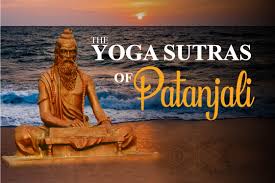
The human body and mind have many ailments arising from whatever thoughts or beliefs or practices etc. Patanjali’s yoga sutras provide the 8-limbed formula to get away from it all.  Different practitioners or gurus have emphasized different limbs to suit the times and their purpose. Mahatma Gandhi emphasized Yama and Niyamas to uplift hundreds of millions of Indian people out of colonization. Maharishi Mahesh Yogi used dhyana and samadhi to uplift millions of people from deep stress and anxiety of nuclear annihilation towards a vision of a permanent peace. Ramdev used Asana and Pranayama to uplift a billion people from all sorts of ailments.  But from personal stories one knows that any combination of these could cure eyesight, hypertension, and backache etc. Add to it Bhagavad Gita’s message that ‘you are neither born nor do you die’ that also reminds us of our true higher / Yogic self. That is the Truth (capital T) that alone can deliver strong healthy minds.

The language of health needs to change. We are becoming self-educated semi-experts at cancer and hypertension and diabetes and an infinite number of specific diseases and disorders and syndromes that may afflict us. The solution may lie in the language of Chitta vritti nirodha (yoga sutras) and balance of doshas and vikritis (Ayurveda) and harmony (classical / Gandharva music), … and activation of chakras and kundalini and more such vibrational and energetic constructs. The dualist and disease-naming language could be replaced by a more holistic joy-feeling language. As Chomsky famously said that the primary role of language is the self-talk or inner chatter, and not so much communication with others. If the inner monkey-mind chatter could be transformed to coherent silence and awareness, health will be a natural outcome. If health is what we want, a health-ful language may be a starting point.

A health-ful language should be beneficial to the health of body or mind. It should describe something corrective or beneficially effective, even though it may be unpleasant. It should speak to the helpful effects of clean air and water and surroundings. It should speak to what benefits and sustains life physically, mentally, and spiritually. It should make a positive contribution to a healthy condition.

With gratitude to all of you for reading it! 

Be the god we are

Some day everyone will be able to see the god in themselves. Channels will open for god to act through them. Then they will become net exporters of happiness. Till then they will plod on in a desert view of life.  No one else can save anyone. Just turn on the light, and see that the riches of the kingdom are all within ourselves. A gu-ru helps drive away the darkness by turning of the light. Thus there is an infinite gratitude to them for providing the man-tra to roo the goo (make the darkness run away).  Thus also the saying: guru bin gyan kahan.  A most famous couplet says: whose feet should I touch if the guru and god are both standing on front of us? We should touch the feet of the guru because they help find the path to god. 

Read this over and over till the fever / fear breaks.  Western philosophy and psychology were born as reaction to the totalitarian vise of the Catholic Church on social and spiritual life. Throwing out Christ along with the church from western life has created a most devastating crisis of meaning in life.  The reduction ad infinitum to the ‘me and my’ as the sole domain of one’s Self is a mirage. Separation is a myth, says Ssdhguru. Western psychology is foundation-less, says Maharishi. 

Three quantum physicists won the 2022 Nobel Prize for Physics for proving that there is no reality.  Some authors call Consciousness as the mother of all capital. That is an indirect compliment from the economic world to the real foundation of life. There is no ‘Me’.  Commercial forces will continue to do their magic of selling fool’s gold. Wisdom traditions of the East are a powerful antidote to the godless meaningless commercial world of the primacy of ‘individual’, realizing that the notion of an indivisible individual is a mirage that too will dissolve into a universal field just as the notion of an atom dissolved into a unitary Schrodinger’s quantum equation. Now there is another Nobel Prize for explicitly stating that there is no reality.

This is cause for celebration.  We have a serious responsibility to not take ourselves too seriously, quips Maharishi.  Just let the mind settle and it becomes consciousness. मन becomes आत्मन। Consciousness is everywhere, so it knows everything, and that makes it omnipotent and invincible. Its manifestation is unpredictable, uncertain and probabilistic.  Franklin quipped that the only two certainties as death and taxes. Let’s accept both equally. Let god flow freely through ourselves while we are still having this earthly manifestation.  We are just this moment. Have fun in this moment!

Thanks for reading. Comments are welcome 🙏

Quantum reality is dynamic

Quantum theory has been around for over 100 years. There is a great degree of misunderstanding about it. Quantum-everything has been bandied around in popular literature. In particular, quantum leadership is a concept that is receiving some attention. So what is quantum reality and how would a leader relate to it?

Quantum reality is dynamic. Mathematically, it is formalized as a holistic universal wave-function of momentum. It is called a wave function because its argument is a hyper dimensional wave, using complex numbers. A wave-particle is a momentum that has its value distributed across all possibilities in a hyper dimensional space. From our lived objective perspective, quantum reality suffers from an acute measurement problem. Our sense organs are woefully inadequate instruments for perceiving and describing quantum realty in simple static terms in space-time boxes. The full hyper planar formalism of a wave-particle can be reduced into the results of the two slit measurement experiment of photons in a 2-dimensional plane, where the hyper planes can add up or cancel each other depending upon being in phase or out of phase. Quantum wave-function can be approximated to a simpler Gaussian function, which represents the Bell curve or the normal curve, that is a function with all possibilities with unequal probabilities, that is what passes for our common objective experience.

Expectations of quantum mechanics have never been contradicted. One simply has to accept the non-local holistic character of a wave function. However, the act of measurement makes the holistic character of the wave function manifest, in the sense that the particle always shows up in just one place.   The wavelike character must be maintained until we choose to ‘perform a measurement’, and then we can suddenly revert to a particle like description. When a measurement is performed, the state collapses to something local and specific. The particle like aspects show up during measurement while the wave like aspects show up between measurements. The measurement of a particle’s momentum would constitute just as good a measurement of its position. However, momentum states are unrealizable idealizations. 

We have to think of the entire wave as being one particle. The entire wave function is just one thing. The different parts of the wave cannot be thought of as local disturbances. Wave functions have a strongly non-local character. The wave function is needed to explain the wave part of the wave-particle duality. The Schrodinger equation of wave function is unitary. It undergoes the dual processes of unitary evolution (U) and non deterministic Reduction (R). U can be considered the ‘underlying truth’ whereas R is some sort of approximation, illusion, or convenience. This reduction process R is also referred to as ‘quantum uncertainty’.

(The source of the above information is the The Road to Reality: A complete guide to the laws of the universe, by Roger Penrose (p 507-530) in the section on Quantum Reality.)

From a psychological perspective, that emphasis the role of fineness of perception of dynamic connections in the great oneness. It is about managers and leaders developing great tolerance of uncertainty, ambiguity, and volatility. Maharishi would say that being able to perceive the unitary nature of reality would bring invincibility to the leaders, and their organizations and nations. Unitary perception is a blissful state that one achieves by transcending the surface reality of appearances. This can be easily achieved by Transcendental Meditation and other techniques of transcendence.

Maharishi International University (MIU): Epicenter of Peace

MIU’s Global Country of World Peace is a beautiful organization that embodies what we are:  peace-loving citizens of the world, who are not divided by political or governmental surface levels of difference. As Maharishi said: What we put our attention on grows stronger. We are coming together and experiencing that field of life which is the field of unity consciousness – the unified field of natural law. Vedic technologies of consciousness, that operate from this deepest level of natural law, are a million times are more powerful than nuclear technologies.

MIU launched an Institute for Permanent Peace (IPP) this month, for applying a scientifically validated Vedic approach to creating an environment for permanent world peace. It is urgently needed to mitigate an existential risk from local wars evolving into an uncontrollable global conflagration. The purpose can be achieved by the sustained group practice of Vedic technologies, including Transcendental Meditation™ and TM-Sidhis, to create coherence in global collective consciousness.  The square root of 1% of any population—about 10,000 for the world– practicing these technologies in a group is sufficient to form a lighthouse of peace and prosperity for the whole world. Over 50 demonstrations and 23 scientific published studies have documented the benefits of large group practice of TM and its related advanced techniques on society as a whole. In every case, this approach produced marked reductions in crime, social violence, terrorism, and war, and increased peace and positivity in society.

IPP is proposing the creation of a permanent coherence-creating group comprised of 10,000 specially- trained Vedic experts to perform yoga and yagya. Results will be measured and monitored by an independent board of scientists.  Global celebrities have expressed support for the project. IPP broke ground on a project to create Vastu housing for thousands of such Vedic experts to live on MIU’s campus in Fairfield, Iowa. 

Meeting with India’s finest actor Anupam Kher

Noted filmmaker David Lynch, founder of an international charity that has brought Transcendental Meditation to more than one million under-resourced children worldwide, has issued a challenge to the world’s philanthropists: use a fraction of your wealth to establish large groups of advanced peace-creating Vedic experts in Ukraine and other critical hotspots, and leave a legacy of world peace that will last for generations.  https://davidlynch.gusp.org/

Live and Work Successfully and Blissfully in 21st century

Here is a 15 minute opening speech, as the chief guest at a management conference in Dehradun in India. Building on the colorful theme of Holi festival just gone by, and the onset of a popular cricket season just coming up, I paint a big picture for life and work in 6 colorful charts, like six balls in a cricket over.

The key messages are:

1. Know thyself, as a specific person, and as the most unbounded being.

2. Human beings have complementary sets of needs at the global, interpersonal and the spiritual levels.

3. We need six capabilities of confidence, compassion, creativity, collaboration, courage, and consciousness to flourish in 21st century

4. Do the actions using SEAMS model – Straight, Strong, Enough, Adequate, in the Moment, and Wholeness on the move.

5. The life must be balanced with peace in the world and peace within

6. Finally in the last chart, I exhort the audience to paint life colorfully on the biggest canvas. Live life not just for yourself, but for the civilization and the universe.

Comments are welcome!

Fall Like A Feather

I met an elderly gentleman, Alan, who is an awakened soul. He told me that not too long ago he slipped on black ice, and fell like a feather. His whole body fell down on concrete, but he was not hurt at all. He fell flat softly in a way that all the parts of his body touched the ground together. Only the phone in his hand suffered a minor scratch. That seems like a miracle.  

On the other hand, an elderly close relative of mine, recently fell and broke his hip. It took him more than an year to recover from the surgery. Similarly, a good friend of mine, who is much younger than me, slipped on black ice a few years ago, and hurt the back of his head. He was taken to hospital in time to stop the bleeding from the back of his head. He is doing fine.

Is there an art to falling? That sounds like a silly question. However, I hear some wise people advising that falling is a given, and the important thing is whether one will dust up and get up and going again. Do some people perhaps fall at the wrong angle, or do they try to protect himself while falling? Do they panic while falling? It is hard to tell, unless one is present on the scene. Falling happens in a flash, in a split second with the full force of gravity.

I ask myself again, is there an art to falling? AARP says that the ‘world is full of banana peels’. So, avoiding a fall is a primary goal. However, they advise a few things on how to ‘fall safely’. Stay bent, protect your head, land on the meat, and keep falling. “Spread the impact across a larger part of your body; don’t concentrate impact on one area,” it says. The more you roll with the fall, the safer you will be. Their tips for preparation are: Be here now, get your eyesight checked (remember, … banana peels), and boost your balance with appropriate exercises.

So, yes, I think that there is a way to fall softly like a feather. The way is to be mindful and roll with the fall. Accept it. Let it be. Resisting a natural fall can be more dangerous than simply falling. Accept falls. I have fallen many times in life. Most times, till about a decade ago, the falls in life and career felt like personal failures and were devastating to mind and body. But in the last decade I can hardly remember a fall. A fall is a fall if we pay attention to it, and try to prevent it. The trick to falling like a feather is to become soft and light as a flower.

Live lightly!

Capabilities we must develop in 21st century business schools

The world in changing exponentially. We are all students now, and forever. Perhaps the most important meta-skill is to learn how and what to learn. Business schools need to develop the capabilities of the heart that will make the students ready for productive and fulfilling work in the 21st century. They need to prepare students for creating the likes of Uber and such companies that work in an era of abundance, which is very different from the earlier era of persistent material shortages.  The young as well as more mature business student need to be able to feel and articulate their deep sense of purpose, and to be able to flourish through a non-ending stream of transformations.

The required capabilities are Confidence, Creativity, Collaboration, and Courage.

  • Confidence means being able to holistically know oneself, the desires and expertise, well enough to stand for one’s words, decisions, and actions. Confidence has been the most important thing to work well, even in the last century, though technical knowledge has also become progressively important.
  • Creativity means thinking outside the box, beyond what has been done in the past. It also means helping others find novel solutions to the problems they face, and helping people grow. One needs to be open to continuous learning and admitting errors of mis-perceptions or ignorance,
  • Collaboration means teamwork, asking for help, not being focused much on course grades and comparative markers, and keeping one’s ego in check. One needs to take complete ownership of the work or the project, along with the team.
  • Courage is an attribute of the soul, and means the ability to function despite adversity and fear. It includes resilience, grit, determination, and the practice of discipline in the face or uncertainty and ambiguity. It means taking ownership of one’s life and purpose through thick and thin.

The way to develop these skills is through group exercises, projects, travels, celebrations, paid internships, and the like. These are not communicated through words, even though we are using words here to communicate these ideas. These exercises should be graded in an appreciative manner, with rich positive, timely feedback from a nurturing teacher / mentor.  

These capabilities may however be underdeveloped during the earlier years of schooling. The grade schools work on a process model, leaving little room for digressions and diversions to account for different ways of learning and different life goals. Just like schools have different course streams for science or commerce or arts students, and just as there are special education systems for the learning impaired, so also there should be different ways of teaching students of different kinds.  As Einstein said, teaching a monkey to swim, and a fish to climb trees would not be productive or fulfilling. The race to get admissions into desirable and prestigious colleges is intense and can have major impact on the quality of future life. Admission into the top colleges like Harvard can be very beneficial in many ways. However, the rat race to prepare for that single objective may rob all sense of joy in the formative years of the students.

Development of consciousness through regular practice of contemplation and reflection, such as Transcendental meditation, may help prepare the heart for developing these capabilities throughout life.