Be Here Now: Art of Happiness

Be Here Now: Art of Happiness


I watched this well-presented video on the new science of happiness by a professor from Harvard medical school. It showed that neither wealth nor accomplishment nor fame nor beauty nor youth makes a person healthy. Living constantly in a sunny weather or on a beach will not bring happiness either.

Not surprisingly, what makes people most happy is to be present, to be here now! We are happy when we are fully engaged in whatever we are doing at the moment. Whether we are washing dishes or teaching a class, we should be aware of and pay full attention to what we are doing in the moment. There is no need to hold on to any experiences, whether pleasant or unpleasant, of the present or of the past. ‘This too shall pass’, Buddha said. Holding on to positive feelings is just as counterproductive as holding on to negative feelings. Just let go, and enjoy life every moment!

Gratitude and Forgiveness are other habits that bring happiness.  We should be grateful for what we have: our functioning body, sane mind, caring family and friends, …everything. I am grateful to the people who invented the internet and manage it, for making available a platform where to share this message with all. I am grateful to those who raise the food and deliver it so we may nourish our body. And so on.

Forgiving others also makes us happy; it releases us from the unnecessary burden of holding on to grudges. Forgiving them makes us not suffer. Forgive them because they may not even be aware that they have done any harm to us, while we may be stewing in anger and hate and thus wasting our time and energy and life-force.

Compassion for others also brings happiness. Happiness has that paradoxical quality: the more we chase it, the more it will flee from us. The more we care about others’ well-being and happiness, the more we are likely to become happy.

May all Beings be happy!


Vedas for Ultra-modern Living

Vedas for Ultra-modern Living   … notes by Dr. Anil Maheshwari

Maharishi University of Management (MUM) hosted the 11th conference of WAVES (World Association for Vedic Studies) over the first weekend of August 2014. Over a hundred papers and presentations were made by speakers from around the world. Many scholars came from India, while many others were from the US including many professors from MUM itself. The range of topics covered was vast: covering entire Vedas, to specific topics like Ayurveda and Sanskrit, to specific concepts like maha-vakyas. The presentations were theoretical as well as empirical, intellectual as well as experiential. The event provided an extraordinary international Vedic experience.

Here are a few key observations.

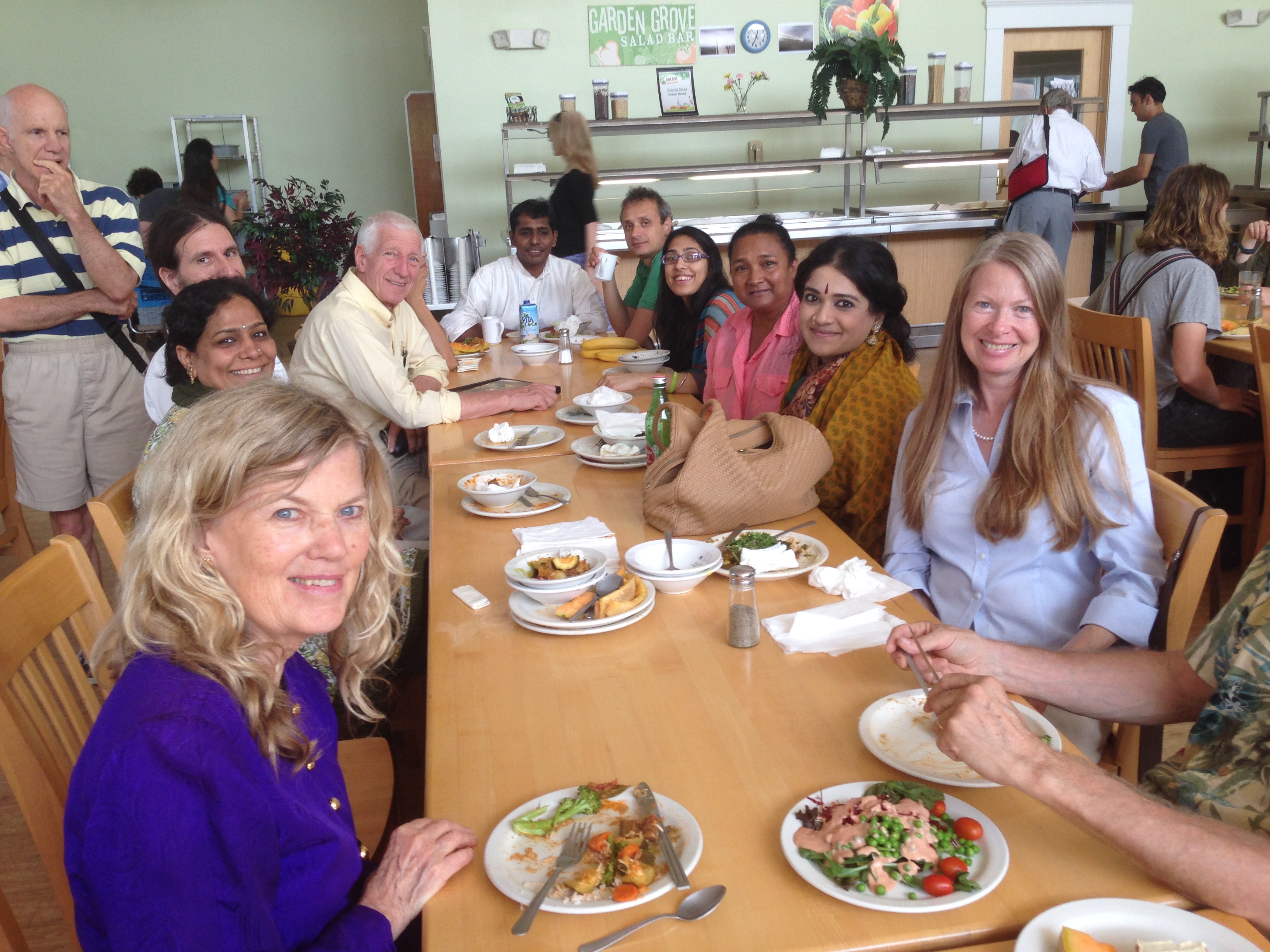
  1. MUM is a unique and powerful laboratory for ultra-modern Veda-based healthy living style. Speaking with several visiting scholars, I discovered that there seems to be no other place like this in the world. The visitors enjoyed being at MUM even if for a few days. They enjoyed the good sattvic vegetarian food, chanting by Vedic pundits, Gandharva veda music, and the overall high quality arrangements. There are indeed many villages in India where people still do Vedic practices like Rudra-abhishekham on a daily basis. However, they seem to do it because that is as an ancient family ritual, and not as a part of conscious Vedic living. WAVES-2 WAVES-1
  2. The founder of MUM, Maharishi Mahesh Yogi, is considered up there among the Vedic greats such as Sankara, Vivekananda, Ramana Maharishi, Gandhi, and the like. One after the other, the speakers extolled the greatness of Maharishi from the Vedic knowledge and practice perspective. It was a dream come true for many of the speakers to come to Maharishi’s place.
  3. Not surprisingly, most of the Vedic scholars worldwide seem to be of Indian origin. The Vedic researchers at MUM are also Indians at heart, whom I affectionately call ‘white desis’. A lot of the Vedic scholars in India seem to be located in the Sanskrit departments in major Indian universities, and some in philosophy departments.
  4. Many of the papers presented by visiting scholars were theoretical in nature, analyzing and synthesizing the Vedic texts. On the other hand, many of the presentations from MUM speakers were around experimentally validated applications of Vedic knowledge and experiential technologies (such as Transcendental Meditation® ) to human welfare … such as to physiology, psychology, neurology, sociology, business, and the like.
  5. There were many engaging presentations, and some of them completely wowed everyone. One Indian scholar synthesized all the Vedas to present a guide to daily living. Another Indian scholar showed how the mahavakyas, esp ‘Tat Tvam Asi’, could be applied in the social context to promote cooperation. A visiting scholar from the US presented on how Ayurveda can be used for kaya kalpa. Another visiting scholar from the US enthralled the audience with many thought experiments at the intersection of Vedic legacies and new technologies. A powerful presentation from MUM showed a Unified-field based framework integrating the physical world and the world of Atman or Consciousness. Another MUM presentation showed how Transcendence is the effective path to human development after adulthood.

The conference created new possibilities for sharing of authentic Vedic knowledge around the world. It also gave the world a taste of how Vedic knowledge and practices could be adapted for living the ultra-modern life!

Brahm Vidya

Brahm Vidya … by Dr. Anil Maheshwari

Total enlightenment is akin to becoming Brahm, the ultimate non-dual reality that is the source of all creation. Brahma is referred to in Vedanta as Aham Brahm-asmi, as the ultimate divine reality of every person. Brahm is unmanifest reality, that includes within itself silence and dynamism, and knowledge and action. Brahm includes within it all the states of consciousness including those represented by the five senses, as well as five basic elements of earth, water, fire, sky, and air.

The Brahm state can be experienced through constantly transcending the surface reality in a consistent and deep manner. Brahm can manifest itself in any number of ways. The descriptions of attaining Brahm state are diverse and infinite. They are described in many kinds of transcendental or sometime fantastic imagery that one see when one is floating in that state. The way to transcend is to ‘paschya’ or see; thus a seer is one that relentlessly tries to ‘see’ the ever-deeper reality, till one directly perceives the transcendent reality. The ancient seers were able to ‘see’ the totality of the universe in their own physiology, and they represented the sounds they saw in abstract but highly structured verses that formed the sacred scriptures.

Brahm is described in the Vedas, which are a structured representation of primordial sounds. The first sound of the first Veda, Rig Veda, is ‘Aa’. This sound contains within itself the totality of Brahm. Thus Brahm is as if coiled into a single primordial sound, like DNA and proteins are. The Aa sound is then elaborated into the first verse of Rig Veda, which is expanded into the mandala, and then into the other Vedas. Thus Vedas could be considered to be written in some sort of a recursive manner.

The literal representation of each sound is scientifically representative of the shape of the mouth when uttering that sound. Thus the vedic alphabet (Sanskrit) is highly phonetic, i.e. every sound is written just as it is spoken. Thus ‘Aa’ is spoken with the mouth wide open, and is represented as such.

There are primordial sounds in every language. The sound ‘Aa’ is found in every language. It is the easiest and the most natural sound. The first sounds coming out of a baby’s mouth as ‘aa’. It is the easiest and the most effortless sound to produce. When one is struck by wonder, the sound that comes out from the mouth is also the primordial sound ‘aah’. Other common primordial sounds are ‘ee’ and ‘oo’, and ‘um’. There are a few other such sounds like Ri and Lri also, but they are composites of these basic sounds: aa, ee, oo, um. Some of these sounds show up as vowels in languages.

The most sacred Vedic sound is ‘Om’. It is a composite of Aa, Oo, and Um. The sound ‘aa’ represents infinity value of reality, and the ‘um’ sounds represents a point value. Thus in chanting the sound of Aum in the right sacred manner, one begins with invoking the infinite unmanifest universe and ends with the collapse of the unmanifest universe to a point value. This point coincides with the beginning of the manifest universe and is represented by the letter ‘Ka’, the first consonant. The consonants are non-primordial sounds that take more effort and a more elaborate physiological arrangement to produce. Every language has vowels and consonants.

It takes wisdom to re-acquire one’s innocence after entanglement in the illusion of the maya-ic concept of external world as real. The most innocent of people, and babies, see wonder in many things, and are thus in divine or Brahm state. With constant practice of transcendence, and living a sattvic healthy life, one can begin to get glimpses of it. The Brahm state is all bliss all the time, and thus worthy of seeking with one’s full heart and mind.


What is Enlightenment?

Enlightenment is bliss consciousness. It is sat-chit-anand. When you have tasted bliss, you can’t forget the experience.

How to explain the pleasures of winning your first customer to one how has not experienced it? How to describe the tastes and sounds of things that one has not experienced? Thus also about bliss. One can’t explain bliss. When bliss is experienced, everything else pales in comparison. There is nothing to worry about in bliss. There are no relative things with any gunas, that one needs to worry about. There is no distinction of head, heart or hands. It is not correct to say that everything comes together in bliss, because there is nothing separate to begin with. When one is in a state of non-separation, one feels bliss. There is the presence of emptiness. It is not a state of stupor or sleep. One is fully alert and can respond to a soft sound or request instantly, from a state that is established in consciousness.

Enlightenment is to get everything. Not more of this one thing or the other. Not more money, more fame, more health, more beauty, etc. Enlightenment is not to get more intellect, more bhakti, more accomplishments, or more energy. It is to get it all. It is to join (yog) at all levels with that source which cannot be named or described. It is the removal of darkness and turning the light on.

Why aspire for something that you already own? The truth and bliss are already within ourselves. There is no need to buy it. Others not give it to you. Others (through the agency of money) may transport you to some beautiful place, like Maui. However, they cannot give you bliss. It might be easier to feel the bliss in a beautiful environment. But ultimately, it is up to the person himself or herself to open up to connect with the bliss within.

So, why talk about enlightenment if it is already within everyone, and it has no property worth describing? Yet, we feel the urge and the impulse to share with others the inner joy so that they too may enjoy it. We want the best for everyone, whether or not they are aware of it. We want others to extend their vision beyond the immediacy of sense perceptions, and un-distort their perception which may have become distorted by their upbringing or other conditioning.

The perception of hunger is a powerful one. ‘One can’t pray on a hungry stomach’ goes an ancient Indian saying. It is possible to develop a sudden fear of going hungry and dying. Witnessing one physical death could scar someone for life, and one could build a determination that says ‘never again’. Family and society can instill and reinforce this fear like an inheritance. The consciousness of the body and the mind (ego) can temporarily overcome the awareness of our true nature.

One tries to understand and conquer the ‘world’ in many ways. With one foot firmly established in the relative world, one tries to reconnect with the nagging inner consciousness begging to free itself and reconnect with the infinite whole. A Gyana yogi is a man of great intellect and tries to reason his way towards it. A Bhakti yogi knows super-human gods and surrenders the little self to the whole self. Karma yogi works for what he wants, and tries to discover or create a more efficient path for happiness. And so on. But Enlightenment is not a race to the top. It is not an achievement to string into one’s resume. It is a light-ness, in many senses of the word. It is a state without a sense of heaviness (tamas, body consciousness), or darkness (rajas, ego consciousness). It is sattva, purity, consciousness aware of consciousness itself. It is a light that falls on light itself: the particles on the waves, the waves on the particles; the wholeness aware of its wholeness.

Just because this inner self-referral wholeness is not visible, that does not mean it is bereft of value. It is the inner life that enables the outer life. The inner life is the potential that causes the dynamic kinetics on the outside. It is the intelligence that creates forms and structures on the outside. It is the peace and unity that produces a roaring kaleidoscope of song and dance outside. It is the desire and the intention that produces focus and action on the outside.

The inner life just has to be ‘un-leashed’ or ‘re-leased’, as if it is some kind of a precious asset safe-guarded by fear. One has to overcome the fear that this great inner life force will somehow evaporate with the passing of the body. Preserving the body is not absurd. Carrying it to the extreme though is like preserving the box, but never tasting the chocolate inside. It is like never unpeeling the banana to taste the fruit.

The bliss is thus carefully hidden and protected within ourselves. To search for it is like looking for the eyeglasses that one has put on one’s head. A guru or teacher or coach can remind us of whether the glasses are. Once the awareness of our true nature dawns upon us, it should be almost impossible to be not aware of it. But one somehow gets sucked again in the seemingly limitless glittering world of the exterior, the psychedelic show of song and dance and form and structure, and begins to ignore the treasure that lies within.

As masters of nanoparticles, of things extremely subtle like cosmic particles whirling at the speed of light in giant particle colliders, we may find it absurd to imagine that we are ignorant of all that super-subtle treasures within. Where is the proof, we may ask? The proof is in direct experience, unmediated by any concepts or structures. The whole world is within us, and not the other way around. We are the whole, the Brahma. That is the simple shift in perspective that is required to become aware of our true infinite invincible creative nature.

Meanwhile, I must go and find something to eat. Till next time … be the bliss that you truly are!

Comments are welcome!