Sudden Death of a Dear Friend – Lessons Learned

A live-wire dear friend, a classmate from Delhi now living in Australia, died suddenly of a heart attack. The news shocked all our classmates as he was not only very popular, social, thoughtful, musical, athletic and fit, he was the life of our WhatsApp conversation group. Friends reflected very fond memories of conversations and time spent with him. However, it also jolted us all to take better care of ourselves through preventive measures before an event occurred. I am writing this so all can benefit from the lessons from this sad episode.

Bimal Mahendroo was a gem of person!  He grew up in Delhi, and went to the well-known Delhi Public School, and then went on to do Engineering at the prestigious Indian Institute of Technology (IIT) Delhi. We were batchmates, and also in the same hostel, at IIT. He was a good student. He lost his father while still in college. He had the rare distinction (in those days) of having a girl friend while still in college. He is now survived by his wife (then girlfriend) and two adult children. Bimal also became a homeopathy expert and cured friends on chronic medical issues with homeopathic medicines.

One year ago, 35 years after graduation, our IIT class of 250 students decided to organize through a WhatsApp group. Bimal jumped into it with full gusto. Soon, there were hundreds of messages posted every day, with almost half of them written by him alone. With a delicious mix of music, humor and serious social commentary, he would hold everyone’s attention and respect. He could keep multiple conversations going simultaneously with different people. With that intensity and hunger to connect, the batch held a well-attended get-together in Gurgaon. Another get-together followed a few months later, incidentally at my parents’ house in Gurgaon. Bimal was the catalyst for many other mini-get-togethers, in Mumbai, in Dubai, in Singapore, and elsewhere. We were planning on one in the US in the summer. He was working on organizing one in Sydney, his hometown in Australia.

Bimal was very energetic. He did no smoking, no alcohol, and was a light eater. He had a passion for coffee, and had started a coffee shop in Sydney. He may have been a bit worried about reviving his career.  Bimal also engaged in 1-1 conversations online with many many people. Everyone saw him as their personal friend. He often fondly talked about his family.

Yesterday, he was returning from playing badminton, and in the car itself had a massive heart attack. He died before reaching the hospital.  A friend wrote that Bimal came into our lives like hero of the movie Anand …of course without the illness …he connected with ease. For a dear lady classmate, he was more than even a brother!!  The light has gone out of our batch, I said. Bimal’s last words on WhatsApp were in response to something I had posted. He wrote:

  • ‘The folly of human conceits, demonstrated the best in our differentiated treatment of each other, the incessant need to compare, contrast and differentiate. Wonderful reminder, Anil, of our morality. And mortality.’

When someone so bubbly and social and athletic passes on so soon, it must be for a higher purpose!!!!  Here is my imagination of Bimal’s conversation w God.

God: Welcome home.

Bimal: thanks God. It is pretty nice here. But can I return for a moment?  This happened too fast.  Can I say hello to my friends?

God: tathastu (so be it). You can do it from here itself.

Bimal:  hello friends. Sorry had to leave like this. Miss you all so much. You were my life. But I am here now. Up there somewhere.  It is nice here.  Don’t worry about me. Hopefully you will remember me as a nice funny chap. Just keep having fun. I will watch from here.  Once in a while I might drop by through someone who can connect with me.  The heart-to-heart channel, you know.

God: (smiling). Very nice.  They love you and will love you forever.  Anything else you want?

Bimal: For my family too. Same message. Just keep living your life happily. Uxxx, sorry had to leave like this. Sorry.  You were the love of my life. We will meet again.

God: Yes, things will keep changing.

Bimal: thank you.  Please bless all my friends and family.  So they can enjoy every moment of their lives fully.

God: तथास्तु।

It is also a stark reminder that life can be so unpredictable. This is a wake-up call for all of us. I am sure some of us have managed their health better and others can benefit from their experience. Here were a few key suggestions shared by friends:

  1. One suggestion is to be disciplined in diet, nutrition and exercise. One of Bill Clinton’s Doctors is Dr. Dean Ornish and he has a book on “Reversing Heart Disease”. Dean Ornish’s book was helpful for another friend when he underwent a coronary angioplasty recently. There is also a vegan-diet plan from a group called freedomfromdiabetes.org. Both of these conditions, cardio and diabetes, go hand in hand. Regular exercise and movement is also required to manage body weight.
  1. Another suggestion was to do an annual comprehensive medical checkup. Many people could thus get the diagnosis in time so they could do something about it. Personally, I get a comprehensive checkup done almost every year when I visit India.
  1. Please meditate. Saying differently, in life s**t will happen! We just don’t want it to stick to us.  We wash our bodies everyday with soap and water.  We should also cleanse our minds everyday with meditation. Try TM, Vipassana, or another other well-tested technique you like. Choose carefully, as just like all diets and medications are not the same, so also all meditations are not the same.

Wish you the fastest growth to enlightenment!!!!  And the resultant freedom from stress.  And great health!

Vastu House in a Vedic City

Today we moved into a beautiful Vastu house in Maharishi Vedic City. A Vastu design follows a branch of the Vedas called Sthapatya Veda. Vastu houses are supposed to be completely aligned with all the laws of nature, and are considered health- and fortune-giving. Vastu is named after Vastu Devata (god) who is supposed to give health and wealth. Vastu houses are distinctive in how they strictly align with nature, and with the movement of the Sun, with East being the most favored direction.

1746 Joy ave

Maharishi Vedic City was incorporated in Iowa by Maharishi Mahesh Yogi as a township in about 2001, with the express purpose of establishing a Vedic way of living. Said to be the first Vedic village since the Vedic times, it is a small city with its own mayor. It is an experiment in government by natural law. The layout of the town is designed completely according to Vastu guidelines.  Most of the residents of the city are white. These white desis, as I call them, are completely Vedic at heart. They are all long-standing practitioners of Transcendental Meditation and TM-Sidhi techniques.

We are a rare family of Indian origin living in this Vedic city. It will be a nice experiment for us to discover the health and wealth giving power of Vastu homes, and Vastu devata! Stay tuned!

An eternal love story …

A love story that began in the 1940s…

Earlier this month, both parents of my close friend in Delhi died within a span of just 12 days. It is a big shock to their entire family. The mother passed away first. My parents and I had known her for a long time. We visited my friend’s house to offer our condolences. At the time of our visit, my friend’s father was not in good health. However, he regaled us with stories of their love story. He said that they had a love marriage in 1949. Love marriages were not acceptable in India even a couple of decades ago, and this was much before that!

image1.png

The boy and the girl both lived in Lahore (now in Pakistan) in pre-partition India. There were neighbors and knew each other. The girl would daily take surplus buttermilk to that neighbor’s house, and they kinda fell in love. After partition of India, both the girl’s and boy’s families independently moved to India. The boy found out the family, and took up some work in the shop of one of the girl’s uncles. Two years later they were married with full approval of families of the boy as well as the girl. They were just about getting to be 18 at the time. He also said that they had never had a fight with his wife in the 67 years of their marriage; she always got whatever she wanted.

This story fascinates me since love marriages were frowned upon while I was growing up in the 1960s and 70s. India is far more tolerant that what we give it credit for. India also has a lot more variety of life styles than the canonical media would like us to believe. Another interesting thing is that the man passed away immediately after the successful completion of the 12th day rites of his wife’s death. He had told his children that he will not go before their mother’s 12th day rites were over. What a fascinating chemistry between the two spouses!

Vedic Technologies for Moksha

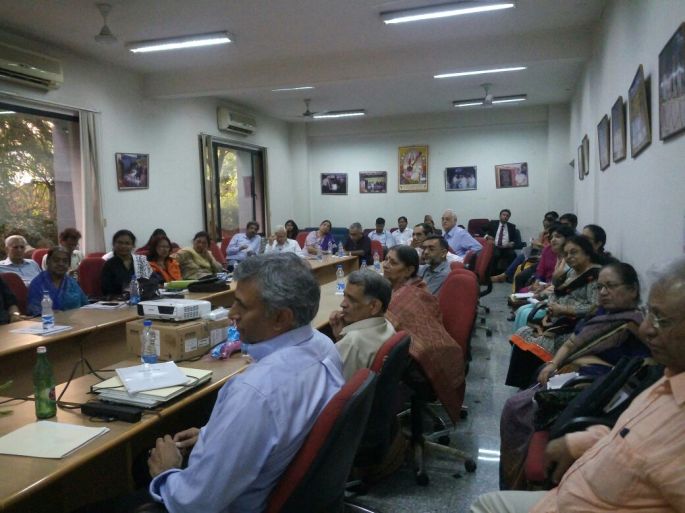
I made a presentation on Moksha, in Delhi last weekend. It was a heavily attended event.  There were dozens of scholars from Sanskrit, Philosophy, Physics, Law, and many other fields. A retired Supreme Court Justice presided over the meeting. Many emeritus professors from Delhi Universities also attended. Many supportive comments made, and many questions were asked. Many points of view on achieving Moksha were expressed. This presentation may become the spark for a new multi-day national seminar on Moksha.


I made the following points.

  • Moksha is total liberation, from everything.
  • That Enlightenment and moksha is everyone’s birthright.
  • That I had achieved a Moksha moment from witnessing an Ati-Rudra-Abhishekam; and that others too can achieve it relatively easily and quickly.
  • That there are many Vedic technologies to facilitate that development of the deep awareness of one’s true Self.
  • Among them are meditation techniques like TM and yagyas like Rudra Abhishekam.
  • That there are over 700 scientific published studies that show the benefits of TM in human life.

The major objection was that Moksha is extremely difficult to achieve.

  • A major objection was a sense of disbelief that one can achieve Moksha without acquiring a full and detailed knowledge of Vedas.
  • Another related objection was that there are scores of meditation techniques and they have become commercial businesses. So how is one to determine which meditation technique to use.
  • Another question was about why waste time studying the whole of Vedas and thousands of mantras if the right mantra depended upon a person’s nature.
  • Another question was about the process of transcending to the unified field of the laws of nature.

Many people made supportive comments about the inclusive nature of research techniques today, which include objective and subjective ones. A new scientific paradigm is emerging. The combination of western scientific techniques, the sacred Vedic knowledge, and personal experience can all together help to discover and confirm the truth. That we are all divine beings, and can enjoy a blissful life.

Who are we: A perennial question

Who are we?

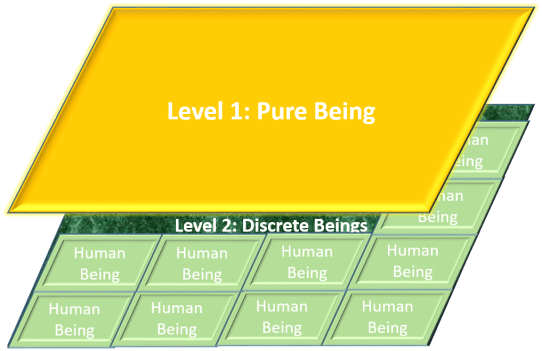
That is a perennial question asked by all philosophers and seekers of life. The question can be best answered at two different levels.

Who are we - two levels.png

At one level we are all Pure Being, the unbounded absolute infinite Consciousness that pervades the universe. At another level, we are all discrete and unique beings, differentiated by mind, body, ability, DNA, ethnicity, and so on.

  • At the first level we are pure unbounded existence while the second level we are doing and thinking machines or entities clothed in our physical bodily existence.
  • At the first level we see ourselves as living in bliss consciousness, while at the second level we seek happiness in exchanges of mental and physical products with other entities.
  • At the first level we are eternal spirit – unborn and undying. At the second level we are born and then we die. At this level, we can become afraid of death. So we worry about many things, become greedy, and save resources to better guard against death.
  • To live at the first level, we transcend our mind and senses using any of many techniques such as meditation. Living at the second level seems simple and easy, as we can access our mind and body through the use of our ordinary senses and supporting instruments.
  • At the second level we are all separate and each defined individually by our ego- consciousness, while at the first level we are all one together as nature and defined by our eco-consciousness.

This is a primary distinction in life. Ignorance of this basic piece of knowledge of who we are is a source of many challenges in living life properly. How we see ourselves depends upon our state of consciousness. From an ego consciousness, we appear to be this body and mind and others, just as others too have their own body and mind, and we interact with them to exchange materials ideas and so on. However, we all have a higher self. Not knowing it is the first and biggest fallacy. There are techniques to learn about the higher self just as there are techniques to learn the bodily and mental self. Our trained and disciplined mind is the biggest instruments for learning about the higher self. What we pay attention to grows in our consciousness.

However, this distinction may be of little interest to the poor who do not get even two pieces of bread every day. Meeting their basic physical needs becomes their primary challenge in life, and they do not have the time or energy to transcend. Similarly, this knowledge may be of little interest to the super rich for whom material abundance and physical pleasures have become intoxicating, and who do not believe in the transcendent. This knowledge is perhaps most useful for the middle-of-the-roader , the seeker of a blissful life, free from pain and miseries.  If interested, one can learn more at tm.org.

“Don’t give me this bliss s**t”

A good friend recently said,”do not give me this bliss s**t”. It is all a mind game, he said. Another good friend said, “you say you live in bliss, but I don’t see you so.” Both of these people are longtime friends from India, intellectuals with PhD degrees, who are comfortably settled in the US.

To the first friend, I said that there are over 700 scientific published studies that show the benefits of meditation, and that one can enjoy good health, happiness and bliss. That did not convince him. So, I spoke from personal experience, and how my moksha experience led me to write my book ‘Moksha’. That did not convince him. Come to our town and if you do not feel peace in your heart, I will pay you a substantial sum of money. That got him going. In essence, he said that Moksha is a very big thing, and it cannot be achieved by a simple process. He said he had been meditating off and on, and he did not get any benefit. His mom meditated all life and did not reach anywhere near there. I said it also depends upon the strength of desire, and one cannot will the desire. He said that desire alone cannot produce anything. So, I felt best to let go of the argument, and let him take his own time to be ready.

To the second friend, I said that bliss is an intensely subjective experience, and there is no way another person can experience it. One just have to believe it or feel it. Also, that bliss experience can come and go, depending upon continued practice of meditation. I also said that I was given the Maharishi award recently for bringing bliss to the community. I could see that he did not believe my story on Moksha and therefore had not bothered to read my book even though he had it.

Moksha book cover

I feel that most people are completely conditioned to no-pain-no-gain theory. If bliss is that good, it must take a lot of time and expertise and effort, they argue. However, bliss is an effortless accomplishment. Bliss is our true nature. One does not need a complicated process to achieve it. However, one does need a strong desire for it, which would overshadow other worldly desires. I feel that not everyone has the desire to escape the stresses of modern life, and reach out for  their god-given gift of bliss. The book is an attempt to inspire that desire in others.


Transformation of Self-Identity: Imagination and Transcendence

Identity (of the self) is a fundamental concept that one develops about oneself that evolves over time. A fixed identity composed of name, relationships, and belongings keeps one locked in small self.

How can one proactively evolve or transform one’s identity? First step would be to locate and unfreeze the current identity. Research has shown that there is a part in the brain that is responsible for one’s memory and identity. That part is hippocampus (seahorse-shaped) in the middle of the brain. To transform one’s identity is to change the flexibility of that part of the brain.

Yagyas such as AtiRudraAbhishekam when done properly are a great way for self-transformation. Ashwamdetha yagyas are another way to achieve that. Coming from the Vedic tradition, the Ashvamedha is a ritual used by great Indian kings to expand their imperial sovereignty. A stallion would be released to wander for a period of one year. Whatever area the horse would cover in a year, unless challenged, would belong to the king. Then the horse is sacrificed.

There are two ways to explain the change in identity: Imagination and Transcendence.

Ashwamedha yagyas lets the king’s horse roam freely to as far as it can. Similarly, if the mind is free to imagine itself in the most expansive terms, it could be the broadening or expansion of identity. All of that territory becomes the mind’s. That is the way to understand it from an object-referral method.

Ashwamedha yagyas is also seen as the sacrificing the horse. Sacrificing the specificity-oriented mind to give way to a wholeness-oriented self, is the self-referral way of explaining self-transformation. That identity of specificity has to be erased and identity of wholeness has to settle in.

Transcendence is the forgetting of specificity and stepping into wholeness.  Transcendental Meditation is an effective and proven method for self-transcendence. While both are complementary concepts, Self-transformation through transcendence may be more desirable than self-expansion through imagination.


Feel whole, feel blissful

Feel whole, feel blissful

Freedom of choice is key to joy and bliss. Loss of wholeness is the primary affliction. Choices made from a lack of wholeness can be wrong, leading to pain and suffering. However, that pain leads to self-correction in choice-making, bringing back towards balance and wholeness. One should return to the whole Self, and operate from there, i.e. “Yogastha Kuru Karmani.” (Bhagvad Gita, 2:40). One should be making fulfilling choices. These choices are all recorded at the level of consciousness. One can even overcome past karma by being wider and broader, and more wholesome.

Even the most evolved and enlightened person can occasionally ‘fall’ into specificity, and lose the wholeness. The feeling of ‘I am’ is that destructive specificity. Balance must be re-established at every moment. It is good to be energetic, powerful and growing. But it is good only when one maintains contact with wholeness. When that wholeness is lost, then that person becomes like a cancer cell. Healthy communication between human cells can inspire the development of healthier bodies, and healthier societies.

One should maintain a correct perspective for the experience of any objective reality. The perception and joy can be vastly different depending upon one’s state of consciousness. What we call ‘real’ is the three-fold dynamic interaction of the properties of the observer, the observed, and the process of observation. If the observer changes himself, there will be a different outcome in terms of experience. Even the experience of seeing a simple thing, such as an apple, in front of us can evoke a different structure of experience depending upon one’s state of consciousness. New connections in the nervous system and new patterns of consciousness emerge from new experiences, and they transform us.

Knowledge from the other fields can lead to progress in one’s field, and in one’s quality of choice-making. Nature’s intelligence is distributed across what we called ‘disciplines’. It is all one, and therefore applicable to all the fields, to some extent or the other. Instead of studying just one discipline, one should study the laws of nature, and operate from that level of wholeness. The Vedas embody that wholeness of knowledge, which can also be found in the body and mind.

The general principles of wholeness-based choice-making are applicable at any level and time. What is true at the individual level can also be true for the development of consciousness of countries and societies. Balanced development will lead to the evolution of societies in the right direction, towards greater happiness and prosperity.  It can take decades or even centuries for society to evolve to perfection. Ram Raj is the culmination of the evolution of societies into a perfect system of governance.


Indigestion: The Source of Maladies

Indigestion: The Source of Maladies

Undigested food in the body putrefies and leads to many ailments. Eating is easy and pleasurable. However, digesting all the ingested food is a task. Indigestion is the inability to reduce and assimilate all that food into the body. Ayurveda calls undigested food as ama. It is a toxin. Ama shows up on the tongue in the morning as a white coating. Removing ama with a tongue-cleaner is like removing ama (american medical association) from one’s life. i.e. detoxifying, and mitigating the possibility of disease and medical intervention.

Walt Whitman in his newly-found series on articles in 1860 on Men’s Health in the now-defunct newspaper ‘New York Atlas’ talks essentially about avoiding indigestion. Discussing “The great American evil: indigestion,” Whitman says, “It is doubtless here that four-fifths of the weaknesses, breakings-down, and premature deaths, of Americans begin.” Overeating, To combat this great evil, Whitman recommends eating “simple and hearty food, and no condiments” and avoiding “solid and liquid stimulants, artificial tastes, condiments” that have unfortunately become an integral part of the standard American diet.

(image source: stomachbloating.net)

Undigested food can also lead to increase in body weight. An effective way to lose weight is to eat early in the evening, as there is no undigested food in the stomach at the time of sleep.

Undigested information is the source of stress, confusion, and many mental maladies. Collecting facts and information is fun and pleasurable. However, analyzing and integrating all that information in one’s mind is quite a challenge. Mind needs deep rest, as in meditation, to rise above the din of random sets of information, to let the useless information float away and evaporate from the mind, and let one’s consciousness develop and expand blissfully with a greater integrated awareness of the Self and the world.


Ayurveda – a cellular view

‘The cost of good health is the cost of good food’ – Maharishi Mahesh Yogi.
For good health, please consider this image as a guiding metaphor; from my limited but growing appreciation of AyurVeda (literally meaning Knowledge of Life).

How many cells are there in the human body? …
It is 100 TRILLION!!
Is every cell alive?
YES.   Each cell has its own happy individual existence, and a life cycle. Each cell dances to its own tune, while also lovingly cooperating with all others in the body. All that a cell needs is some nutrients, oxygen, and removal of waste.
Now consider a flotilla of a few thousand boats going together on the ocean in a smooth way. There would be a certain degree of coordination, and every boat would move along nicely according to its capability. Now comes a particular disturbance or imbalance in that flotilla.  Suppose it is caused by a perceived or real attack from outside, on one side of the flotilla. The defense system is engaged.  The boats regroup and are re-purposed to deal with that event. Some drown, some gain power, etc. New configurations are created. The boats gaining power could be for the good of the flotilla, or it could be cancerous for the flotilla as a whole.
Now consider 100 TRILLION such partially autonomous, or interdependent, boats (cells) moving along. Who can coordinate such a flotilla (body). There could be many internal and external systemic sources of disturbances or imbalances. Each imbalance could be of a particular type. Too fast, call it VATA imbalance. Too angry and intense, call it PITTA imbalance. Too slow or sticky, call it KAPHA imbalance.
Thus Ayurveda looks for the dosha (literally means imperfection, fault, or imbalance) in the body as a whole. And then it brings the body back to balance, by some new generally helpful and herbs and practices. It does not heal the body by shocking the system, i.e. not by sudden chemical attacks or invasive surgeries. Those shocks have their own after-effects … such as the flotilla will have to reorganize if a certain collection of boats are removed enmasse from the flotilla.
In the absence of proper supplies and services, the cells will fight with each other for nutrition and cleanliness. Chaos and inflammation ensue. External help (allopathic medicines) only exacerbates the imbalance by correcting the problem of some cells of the body, and creating problems for the rest of the cells of the body.
Therefore, on a daily basis, we should give the cells good supplies of food and air, and take away the byproducts and toxins. That is all the cells/body want and need. When imbalances do arise, Ayurveda looks for root cause, and slowly brings the body back to harmonious and blissful flow through smooth and gentle intervention.
Yoga and meditation suitably support the practice of AyurVeda.