
Transformation of Self-Identity: Imagination and Transcendence

Identity (of the self) is a fundamental concept that one develops about oneself that evolves over time. A fixed identity composed of name, relationships, and belongings keeps one locked in small self.

How can one proactively evolve or transform one’s identity? First step would be to locate and unfreeze the current identity. Research has shown that there is a part in the brain that is responsible for one’s memory and identity. That part is hippocampus (seahorse-shaped) in the middle of the brain. To transform one’s identity is to change the flexibility of that part of the brain.

Yagyas such as AtiRudraAbhishekam when done properly are a great way for self-transformation. Ashwamdetha yagyas are another way to achieve that. Coming from the Vedic tradition, the Ashvamedha is a ritual used by great Indian kings to expand their imperial sovereignty. A stallion would be released to wander for a period of one year. Whatever area the horse would cover in a year, unless challenged, would belong to the king. Then the horse is sacrificed.

There are two ways to explain the change in identity: Imagination and Transcendence.

Ashwamedha yagyas lets the king’s horse roam freely to as far as it can. Similarly, if the mind is free to imagine itself in the most expansive terms, it could be the broadening or expansion of identity. All of that territory becomes the mind’s. That is the way to understand it from an object-referral method.

Ashwamedha yagyas is also seen as the sacrificing the horse. Sacrificing the specificity-oriented mind to give way to a wholeness-oriented self, is the self-referral way of explaining self-transformation. That identity of specificity has to be erased and identity of wholeness has to settle in.

Transcendence is the forgetting of specificity and stepping into wholeness.  Transcendental Meditation is an effective and proven method for self-transcendence. While both are complementary concepts, Self-transformation through transcendence may be more desirable than self-expansion through imagination.

 

Clash and convergence of paradigms

There are multiple paradigms of knowledge of reality. How can everyone be right?

The answer is that there is a dilemma in the waking state of consciousness. One can continue discussing from different points of view and be correct in some vital way, without being able to refute the other points of view. Only when one transcends the waking state that some unified realities become available and acceptable. From the transcendent level of consciousness one can experience the connectedness of the entire universe. Eventually one can potentially experience the Vedantic non-dual reality of ‘tat tvam asi’, or ‘Aham Brahmasmi’. From the waking state of consciousness these look like absurd words. Even reading the Vedas from a waking state of consciousness is meaningless, and brings no power. Vedas have to be experienced from a state of transcendental consciousness. After all the Vedas were cognized by the seers from that state of consciousness.

Another question often asked if body is hardware, and mind is software, what is soul?

The answer is: the soul would be like the natural laws of electromagnetism and computation and information theory. There are three fundamental gods: Brahma, Vishnu and Shiva. Lord Shiva represents form, or space, and thus the body. Lord Vishnu represents energy, or function, and thus the mind. Lord Brahma represents logic, the knowledge that binds form and function in the service of a purpose. This trinity together make up the entire universe. Consciousness is that which is aware of itself. Thus it is the knower, the known, and the process of knowing (the subject, object, and the verb, all in one). Thus the soul is the knower, the mind would be the process of knowing, and the body will be the known.


Feel whole, feel blissful

Feel whole, feel blissful

Freedom of choice is key to joy and bliss. Loss of wholeness is the primary affliction. Choices made from a lack of wholeness can be wrong, leading to pain and suffering. However, that pain leads to self-correction in choice-making, bringing back towards balance and wholeness. One should return to the whole Self, and operate from there, i.e. “Yogastha Kuru Karmani.” (Bhagvad Gita, 2:40). One should be making fulfilling choices. These choices are all recorded at the level of consciousness. One can even overcome past karma by being wider and broader, and more wholesome.

Even the most evolved and enlightened person can occasionally ‘fall’ into specificity, and lose the wholeness. The feeling of ‘I am’ is that destructive specificity. Balance must be re-established at every moment. It is good to be energetic, powerful and growing. But it is good only when one maintains contact with wholeness. When that wholeness is lost, then that person becomes like a cancer cell. Healthy communication between human cells can inspire the development of healthier bodies, and healthier societies.

One should maintain a correct perspective for the experience of any objective reality. The perception and joy can be vastly different depending upon one’s state of consciousness. What we call ‘real’ is the three-fold dynamic interaction of the properties of the observer, the observed, and the process of observation. If the observer changes himself, there will be a different outcome in terms of experience. Even the experience of seeing a simple thing, such as an apple, in front of us can evoke a different structure of experience depending upon one’s state of consciousness. New connections in the nervous system and new patterns of consciousness emerge from new experiences, and they transform us.

Knowledge from the other fields can lead to progress in one’s field, and in one’s quality of choice-making. Nature’s intelligence is distributed across what we called ‘disciplines’. It is all one, and therefore applicable to all the fields, to some extent or the other. Instead of studying just one discipline, one should study the laws of nature, and operate from that level of wholeness. The Vedas embody that wholeness of knowledge, which can also be found in the body and mind.

The general principles of wholeness-based choice-making are applicable at any level and time. What is true at the individual level can also be true for the development of consciousness of countries and societies. Balanced development will lead to the evolution of societies in the right direction, towards greater happiness and prosperity.  It can take decades or even centuries for society to evolve to perfection. Ram Raj is the culmination of the evolution of societies into a perfect system of governance.


The Primal Campfire Experience

The Primal Campfire Experience

Fire is a primal element. ‘Agni’ (or fire) is the first word of Rik Veda; and contains the structure of the entire universe within it. Fire is also a dangerous element. It can burn and destroy. It can reduce beautiful and valuable things into ashes in no time. It can change direction easily with the blowing of the wind. Fire can leave scars that last a lifetime. However, it can also create impressions that last a lifetime.

Fires are used for religious and cultural purposes. Sanatan dharma believes in using sacred fire (as havan or homa) to purify the spirit. Fire is used as a witness to an oath. Fires are burned for cultural activities, e.g. Holika Dahan. On Dusshera (or Vijayadashmi Day), fire is used to burn the effigy of the bad guys. Fireworks are used as celebration, as for Independence Day celebrations on the Fourth of July.

In modern times, the fire element has been completely contained and tamed. Something catching fire is usually in a bad connotation, e.g. wild fires that burn whole swathes of dry forests. Only occasionally is ‘catching fire’ used to describe some runaway social success. Children rarely get to experience fire. Fire can be seen mostly as a small contained fire in the stove to provide heat for cooking purposes. The role of fire as a source of light has been completely emasculated and been taken over by electric light. Fire has many other roles too.  (See http://en.m.wikipedia.org/wiki/Campfire for a good exposition on what a campfire means). Fire even provides a psychological sense of security. Campfires create a strong sense of bonding.

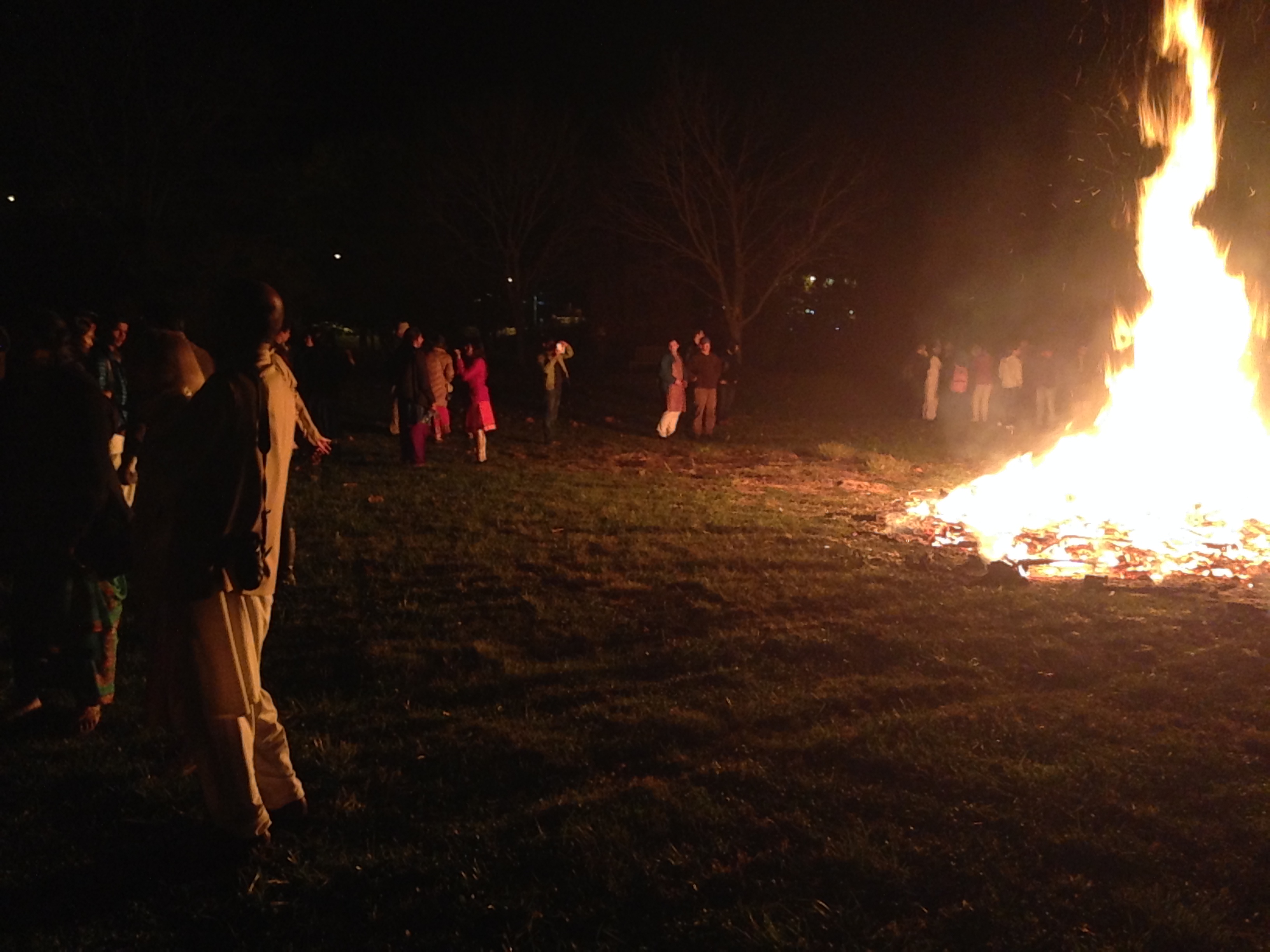
There are very few university campuses that hold bonfires or campfires regularly. It is in this spirit that we created a new tradition of bonfires or campfires at MUM. Initially it started as a bonfire for Holi in March of this year. The response from the campus community was overwhelming. Almost 200 people came and stayed with the fire for hours. One could see the grimaces from snowy cold jacket-grabbing walk spontaneously melting into warm smiles of mysterious exhilaration as they walked from the parking lot towards the campsite and began to experience the warmth of the campfire. Even with snow flurries and an inch of snow accumulated, students wildly sang and danced in the light and warmth of fire for more than 2 hours, till past midnight. We provided some peanuts and sweets to eat. We also provided dry colors to play Holi with. It was a great success. Our head of security organized the fire for us, and he shared something very insightful. He said that we used to have these kinds of events earlier, and there was no student retention problem.

So we repeated the experience last August, partly to welcome a new batch of incoming students for the Fall semester. We held a bonfire after a beautiful dance-and-music celebration of Krishna Janamashtmi. The experience was similarly wildly exhilarating. It was not cold outside, and some people earlier wondered if campfire in the summer was a good idea. But the response from the students was overwhelming. They stayed on again till almost midnight.
MUM campfire picture Oct2014
We repeated the experience again this Diwali (celebrated just a few days ago). We had a nice colorful 90-minute song-and-dance celebration in our beautiful spacious auditorium. And then the bonfire was lit at 9:30 pm. Once again a couple of hundred people walked over to the fire. Many newcomers to the bonfire said they had planned to spend just about 5 minutes at the fire just to get a taste of it. But then they stayed on for a couple of hours. They stayed because others were staying on, and it was warm and cosy there to begin with. It was a dark nearly no-moon night but the sky was lit up for us with this fire.

As education and learning becomes increasingly online, universities will need to find something special to attract and retain the students. One can create strong bonds with the students in many ways. Holding regular large bonfires is one such way. I recommend it with all my heart!

Enjoy the Experience

Enjoy the Experience!

Pure witnessing is a key ability on the path to enlightenment, i.e. one should be not attached to anything but a witness to everything and every experience. Then there is no craving or aversion, no judgment of good and bad. One can be free from the clutches of the egoistic mind and make it a tool for doing the Self’s bidding. That is what one does in meditation. Vipassana meditation helps quiet the activities of the ‘monkey mind’ till the real mind shines like a laser beam with the power of a million volts battery. That laser mind then helps to overcome the many past experiences and sensations that condition our day-to-day behavior. Transcendental meditation technique helps to effortlessly transcend the mentally constructed sets of entities and relationships and enter the absolute self-referral world of unmanifest pure consciousness, the source of all creative activity. In the highest states of consciousness, even the witnessing goes away as there is no witness and nothing to witness, and one can reach a state of pure Samadhi, or oneness with the Divine.

In practical terms, in day to day living, witnessing every event without attachment requires a shift in perception. We can aim to witness and enjoy every experience. Events can be painful or pleasurable, and a host of other emotions. The painful experiences could be perceived a way of release of long suppressed emotions and stresses. Pleasurable experiences could be perceived as a reward on a path to evolution towards greater happiness and joy. Even emotions of jealousy and envy and anger can be dispassionately observed and witnessed till they pass. Ultimately, one can learn to perceive everything in terms of one’s own Self. Enjoying the experience thus becomes enjoying the Self, which can lead to pure bliss consciousness, or Enllightenment.