Trip to Mt Kailash and Manasarovar Lake

Mount Kailash and Manasarovar Lake, located in Western Tibet, are among the holiest and mystical of pilgrimage sites across many religious traditions including Hinduism and Buddhism. Mt Kailash, considered the abode of Lord Shiva, is at a 6600+ meter elevation, while the Manasarovar lake nearby is the highest freshwater lake in the world. This trek is a tough 52-km circumambulation (parikrama) of Mt Kailash, using limited housing and other facilities.  This is a report on our small group’s 17-day trip to this magnificent place in July 2024. It concludes with some recommendations for future pilgrims, especially seniors.

Think of this pilgrimage trek in two parts. The core part is the 3 days spent doing the parikrama around the holy mountain and the lake. The longer 14-day part is getting to this high place from home, and back. There were 13 of us pilgrims in our group, with 12 from the US and one from Singapore. All were citizens of Indian origin, including four senior married couples. All members had different personalities, and half of us were Ph.Ds.   Three of the pilgrims were repeat visitors to Mt Kailash. We went to this trek with an experienced Kathmandu based tour operator to organize the tour.

We all landed in Kathmandu (KTM) from our respective home locations all over the US. We spent four nights in KTM (1350 meters above sea level) doing a little bit of acclimatization, while the tour operator applied for and received travel special permits for us to travel to Tibet. While in KTM, we visited the world famous Pashupatinath (Shiva) temple at their evening puja time. We also climbed to the Tarkeshwar (Shiva) temple to an elevation of 1900 meters. 

After four days in KTM, we packed a subset of our baggage into a big duffel bag and a backpack, and left our travel suitcases in the hotel. We took the flight to Lhasa. There is a direct flight but it was sold out. So, we had to make an indirect flight through Chengdu hub airport. That took up an extra day which could have been used for sightseeing and acclimatization in Lhasa (3500 m above sea level).  In Lhasa we had time enough to visit the spectacular Potala Palace, a huge 1000 year old structure, that contains the offices and tombs of many Dalai Lama’s from the first to the 13th.  From Lhasa, we did a 2-day 1000 km long bus drive through the beautiful Tibetan mountains and valleys to reach Lake Manasarovar.

It felt magical to reach Lake Manasarovar which is the highest freshwater lake on the planet. We immediately did a parikrama of the lake itself by bus. We gathered holy water from the Manasarovar lake to bring back home.

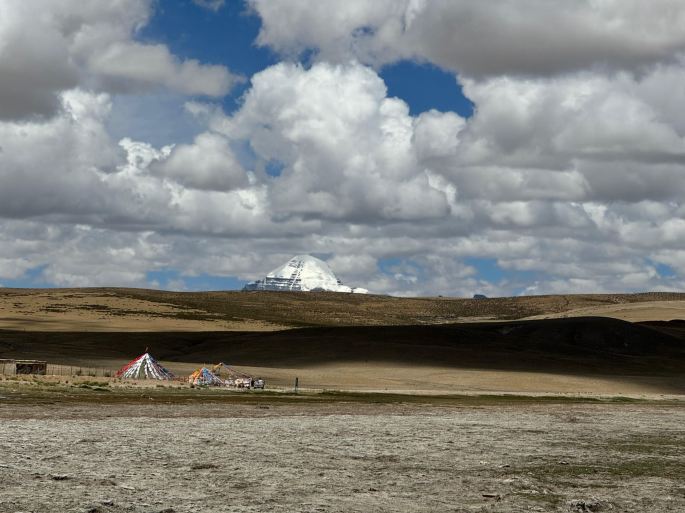
Our parikrama of the lake showed two additional things. One, it provided a broad view of MtK from different angles. It also showed up another nearby lake called the Rakshakshthal (or devil’s place), a salty cursed lake. There is fascinating mythology around how a freshwater lake and a dear salty water lake happen to coexist at this high elevation, and both of them barely to the south of Mt. Kailash. (Kailash in English means a pure crystal).

At Manasarovar Lake, we spent a night in a modest dormitory, for acclimatization at this height of 4500 meters. The next day we did a nice short drive to the small town of Darchen and stayed there at a nice hotel, for another night of acclimatization.  The parikrama of Mt Kailash formally begins from the Yama Dwar (Death God’s Gate) in Darchen. We left our duffel bags at the hotel in Darchen, and packed only water and lunch and a raincoat in our backpacks. We began the first leg of the parikrama, which is a 12 km semicircle walk from Darchen to Derapuk (at 5000 m elevation). This was a tough but exhilarating uphill 8-hour walk, with clear views of the west face of Mt Kailash all through the hike.  We took many beautiful pictures and videos on the way. I was happy to have completed this half of the parikrama on foot without a horse or sherpa, though the rest of the group had used sherpas to carry their backpacks. However, my heart rate became highly elevated and stayed that way through the 8 hours it took us to cover the 12 km. My wife and I had great trouble completing the journey, as did most of our group.
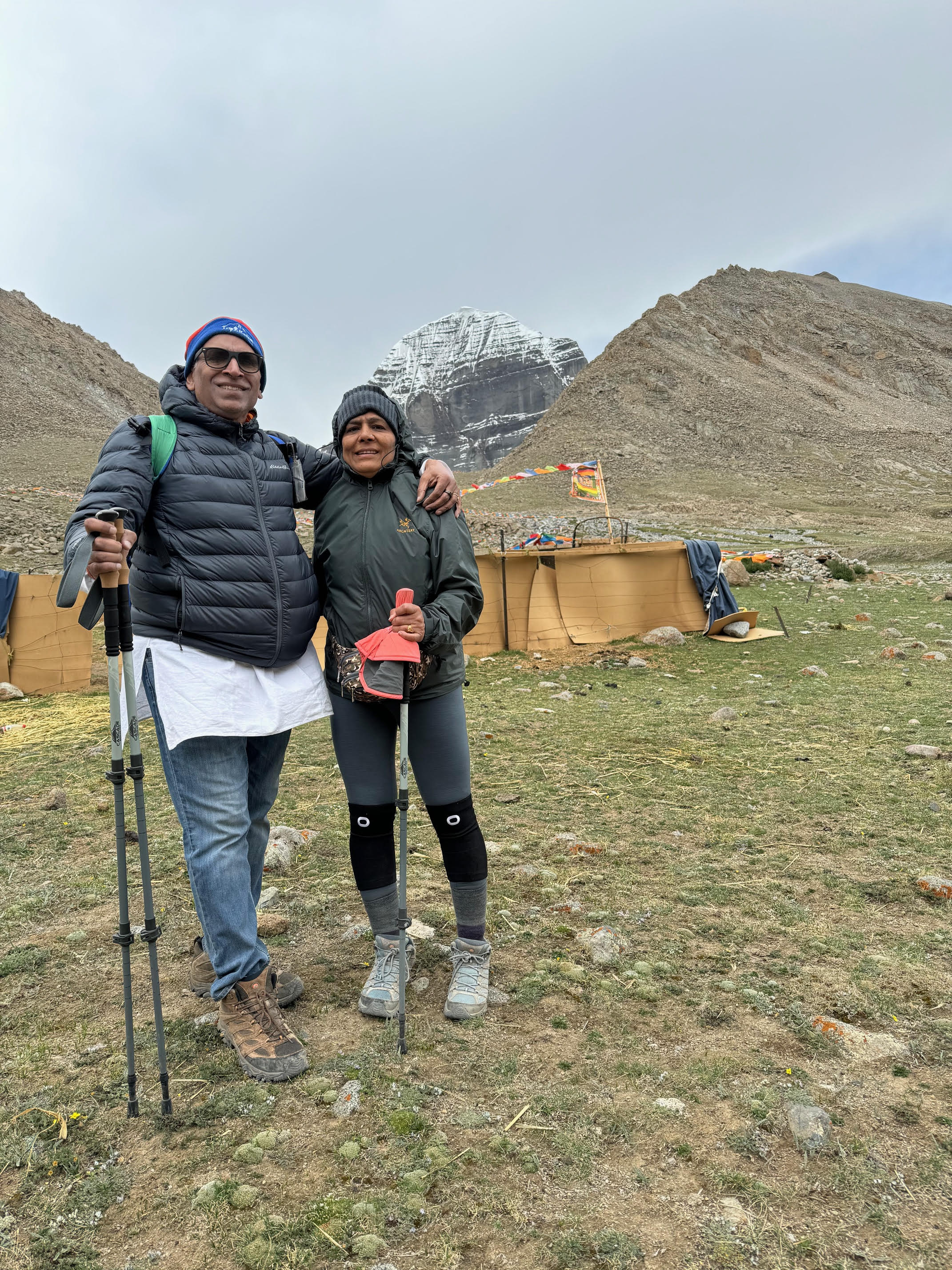
By the time we reached the monastery at Derapuk, most of us developed cough and/or cold and mild fever. The dormitory accommodations at Derapuk were very modest and had no toilets. Defecating outside in the open felt too primitive to most of us. Consequently most of us also began to become severely constipated. I felt that the most significant part of the parikrama had been completed, and there was no point in pushing oneself at risk of deterioration of health.  My wife and I therefore made the call to abandon the second half of the parikrama. Not only us, but three others also decided to return to Darchen by jeep the next morning.  

At Derapuk the view of the north face of Mt Kailash is totally awe-inspiring. This is Shiva’s abode. I felt that I am one among many Shivas. Mt Kailash is everyone’s abode.  The other 8 people in our group continued the parikrama using horses to climb up to Dorma la pass. Then they walked downhill 4 km on foot with their respective sherpas. Then they took a jeep to be extracted from there for the remaining 30 km of the parikrama and returned to Darchen. 

After resting in Darchen for two days, we again visited and stayed close to the Manasarovar lake on the auspicious Guru Purnima day (July 21). We did an auspicious RudraAbhishek puja o the banks of the lake. From the lake I also recorded a nice 2-min video showing both Kailash and the lake so near each other. Some people visited the Mansarovar lake during the late night hours to see ‘stars falling in the lake’.  

The next morning we began the return journey with an 800 km long bus ride from Manasarovar to the town of Keirung on the China-Nepal border. It was not an easy journey with most of us in constipated conditions, with no proper toilets on the way. However the Keirung valley was a spectacular green mountains with flowing river and waterfalls. The following morning we crossed the border into Nepal by road. The conditions on the Nepal side were extremely chaotic, and the roads were broken. Five of us took a spectacular but expensive helicopter ride to get to KTM, while the others came by jeep. After gathering our suitcases from the hotel in KTM, the next day we bid adieu and took our flights to our next or home destinations.  

Conclusion 

The trip was a glorious success for all of us, differently and at many levels.  For myself, I got to spend abundant time at Mt Kailash the abode of Shiva who is the god of pure Silence and Peace. I also gathered the exquisitely tasty holy water from the lake to bring home for various uses. I also enjoyed some of the most beautiful greenery in the Keyrung valley and enjoyed the helicopter ride through a spectacularly green Nepal. We also made new good friends among our team of pilgrims. 

Lessons learned: This trip exposed several logistical challenges. Here are a couple of  insights and lessons for those wanting to visit Mt Kailash.  

  1. Altitude: The lived reality at a 5000-meter elevation is very different from that at normal city level. The air is very thin. One needs to acclimatize for many days. Even then one’s physiology may or may not cooperate. So, prepare hard and yet be open to surprises.  Next, the accommodation at these high altitudes are very basic. Nothing prepared us for the open-air defecation, even though we cognitively knew that there will be no proper toilets. Our health suffered. Then there were a few landslides that slowed down the travel.
  2. Guides and Sherpas: These are the people who understand the local terrain and reality. They can soften the shock for the pilgrims. We had an excellent team to support us. However, the availability of porters and horses can be difficult depending upon season. It led to many heated altercations and disagreements between the support team and the pilgrim clients, which did not reflect well on anyone. We therefore found ourselves constantly comparing our support team with the other teams supporting other pilgrim groups. A more organized and mature tour operator may cost a little more, but it may be worth it in terms of good use of your time and good comfort. 
  3. Clarity of purpose: One can go to Mt Kailash as a tourist to complete an item on the bucket list. One can also go there as a seeker to brave the harsh situation with total devotion to Lord Shiva. Or the purpose can also be a mix of a tough mountaineering experience mixed with some pilgrimage. Only a clarity of purpose will provide the endurance to complete the mission, when unforeseen challenges occur. 
  4. Security: The Chinese security and immigration system was intense but efficient. We found security cameras everywhere in China/ Tibet, including five cameras in our tour bus from Lhasa. Our tour guide in Lhasa told us not to take pictures of police patrols on the way to Manasarovar. We were also advised that we should not discuss the politics of Tibet and China even in the bus.

In closing, given its remoteness and the tough terrain, the trip to Mk Kailash is long, tough and expensive.  As Adi Shankara noted, no amount of pilgrimaging can lead to enlightenment. The bliss of Silence or shanti is within us, here and now. Shivoham Shivoham. However, it feels good to be visiting one of the holiest and most mystical of sites on the roof of the world. Good luck on your visit to Mt Kailash. Bon voyage! 
Mental Health for the whole world

I appreciate the discussion about mental health. In my next avatar or phase of life, I want to become some kind of a mental health practitioner.  A big cause of mental health may be financial insecurity in a capitalist world. …And the social inequalities and pressures and heartburn that causes. The pharma lobby and DSM lobby and many other money-making machines in the West are hard at work to not fully cure but mostly contain the problems. The Federal government has created a strategy to combat mental health issues, however it remains to be seen how effective it will be.

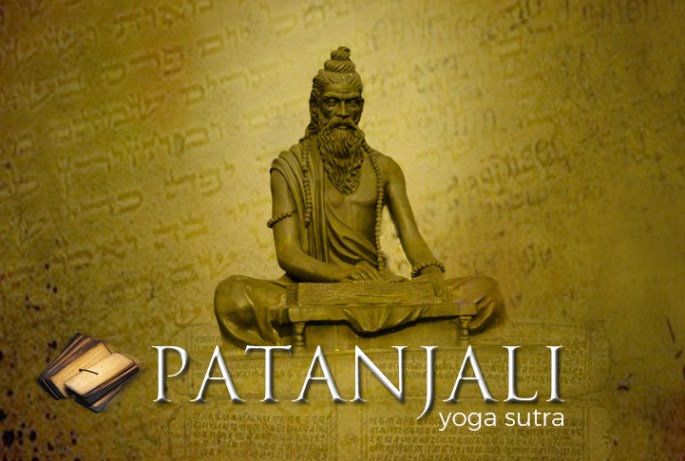
The human body and mind have many ailments arising from whatever thoughts or beliefs or practices etc. Patanjali’s yoga sutras provide the 8-limbed formula to get away from it all.  Different practitioners or gurus have emphasized different limbs to suit the times and their purpose. Mahatma Gandhi emphasized Yama and Niyamas to uplift hundreds of millions of Indian people out of colonization. Maharishi Mahesh Yogi used dhyana and samadhi to uplift millions of people from deep stress and anxiety of nuclear annihilation towards a vision of a permanent peace. Ramdev used Asana and Pranayama to uplift a billion people from all sorts of ailments.  But from personal stories one knows that any combination of these could cure eyesight, hypertension, and backache etc. Add to it Bhagavad Gita’s message that ‘you are neither born nor do you die’ that also reminds us of our true higher / Yogic self. That is the Truth (capital T) that alone can deliver strong healthy minds.

The language of health needs to change. We are becoming self-educated semi-experts at cancer and hypertension and diabetes and an infinite number of specific diseases and disorders and syndromes that may afflict us. The solution may lie in the language of Chitta vritti nirodha (yoga sutras) and balance of doshas and vikritis (Ayurveda) and harmony (classical / Gandharva music), … and activation of chakras and kundalini and more such vibrational and energetic constructs. The dualist and disease-naming language could be replaced by a more holistic joy-feeling language. As Chomsky famously said that the primary role of language is the self-talk or inner chatter, and not so much communication with others. If the inner monkey-mind chatter could be transformed to coherent silence and awareness, health will be a natural outcome. If health is what we want, a health-ful language may be a starting point.

A health-ful language should be beneficial to the health of body or mind. It should describe something corrective or beneficially effective, even though it may be unpleasant. It should speak to the helpful effects of clean air and water and surroundings. It should speak to what benefits and sustains life physically, mentally, and spiritually. It should make a positive contribution to a healthy condition.

With gratitude to all of you for reading it! 

Be the god we are

Some day everyone will be able to see the god in themselves. Channels will open for god to act through them. Then they will become net exporters of happiness. Till then they will plod on in a desert view of life.  No one else can save anyone. Just turn on the light, and see that the riches of the kingdom are all within ourselves. A gu-ru helps drive away the darkness by turning of the light. Thus there is an infinite gratitude to them for providing the man-tra to roo the goo (make the darkness run away).  Thus also the saying: guru bin gyan kahan.  A most famous couplet says: whose feet should I touch if the guru and god are both standing on front of us? We should touch the feet of the guru because they help find the path to god. 

Read this over and over till the fever / fear breaks.  Western philosophy and psychology were born as reaction to the totalitarian vise of the Catholic Church on social and spiritual life. Throwing out Christ along with the church from western life has created a most devastating crisis of meaning in life.  The reduction ad infinitum to the ‘me and my’ as the sole domain of one’s Self is a mirage. Separation is a myth, says Ssdhguru. Western psychology is foundation-less, says Maharishi. 

Three quantum physicists won the 2022 Nobel Prize for Physics for proving that there is no reality.  Some authors call Consciousness as the mother of all capital. That is an indirect compliment from the economic world to the real foundation of life. There is no ‘Me’.  Commercial forces will continue to do their magic of selling fool’s gold. Wisdom traditions of the East are a powerful antidote to the godless meaningless commercial world of the primacy of ‘individual’, realizing that the notion of an indivisible individual is a mirage that too will dissolve into a universal field just as the notion of an atom dissolved into a unitary Schrodinger’s quantum equation. Now there is another Nobel Prize for explicitly stating that there is no reality.

This is cause for celebration.  We have a serious responsibility to not take ourselves too seriously, quips Maharishi.  Just let the mind settle and it becomes consciousness. मन becomes आत्मन। Consciousness is everywhere, so it knows everything, and that makes it omnipotent and invincible. Its manifestation is unpredictable, uncertain and probabilistic.  Franklin quipped that the only two certainties as death and taxes. Let’s accept both equally. Let god flow freely through ourselves while we are still having this earthly manifestation.  We are just this moment. Have fun in this moment!

Thanks for reading. Comments are welcome 🙏

International Conference on Consciousness-Based Leadership and Management – summary report

Maharishi International University (Fairfield, Iowa, USA) organized a three-day International Conference on Consciousness-Based Leadership and Management, from May 21-23 2021, for mapping the path to Oneness and a flourishing humanity. The event was co-sponsored by the International Academy of Management through its Management, Spirituality and Religion (MSR) interest group. More than 1100 attendees from almost 400 cities around the world registered for the event. The event had 90+ speakers including Dr Tony Nader, Dr Robert Quinn, Dr. Subhash Kak, Dr. Anil Gupta, and other reputed professors from top institutions from the US, India, UK, Germany, Europe, Brazil, Australia, New Zealand, China, Japan, Indonesia, Equador, South Africa, and more. They also represented a wide range of fields including Management, Leadership, Music, Medicine, Computer Science, Quantum physics, Vedas, Ayurveda, Arts, Psychology, Consciousness, Sustainability, and more. They participated in 15 sessions of integral conversations and research presentations of 90 minutes each over three days. Our feedback surveys showed consistently high ratings and comments. Every session aimed to produce one or two principles towards a flourishing humanity.  We sincerely thank our board of advisors, which included Drs. Chris Laszlo, Judi Neal, Sharda Nandram, Satinder Dhiman, Kathryn Pavlovich, and Cathy DuBois, for their guidance and counsel in making this event a great success. We also wish to thank all the speaker and presenters for being a part of this journey.

There is a great demand for videos for replays and we have been working on editing them and making them available. Here is a wonderful playlist called Consciousness-Based leadership @ MIU, comprising of seven keynote and panel conversations, each of which is about 60-90 minutes long. https://www.youtube.com/playlist?list=PLs4GvULvBU44jIFWP4IaDCXb61lgLMk3Y

Here is a brief summary of the videos. The opening keynote conversation with Dr. Tony Nader lays out how consciousness is primary, which is a new paradigm with increasingly greater explanatory power. Then there is the transcendental keynote conversation where they lay out the benefits of transcendence, its neuroscience, and the path ahead.  Then there is the quantum and technological conversation where we discuss how quantum world leads us to different ways of leading and organizing, from an unboundarized and uncontainerized view of ourselves as the field of consciousness. Then there is the organizational cultural conversation where we discuss positive scholarship away from deficit and towards flourishing, and from workplace spirituality to global consciousness, as the organizing metaphors.  Then there is the panel conversation on Dialogic approaches where we begin with asserting that our words have more power than we think, in bringing about a harmonious world.  Then there is the panel conversation on the future of management education, where we agreed that the future is consciousness-based education, based on empathy and fairness and justice.  Then there is a panel on Vedic approaches to Oneness, beginning with Bhagavad Gita, and including other traditions towards unboundedness and self-transformation.

In addition, Here is the play list of about 25 pre-recorded short (7-8 minute each) research presentations by the authors themselves. https://www.youtube.com/watch?v=Io4mRLsEMjg&list=PLs4GvULvBU44ng3DX6qbDegNsS9lzzCCm

 Would appreciate if you could enjoy these videos, and post your comments.

Wish you a blissful and flourishing life!

Anil Maheshwari, Conference Organizer and Co-Chair

We are more than we think

Our thinking is limited to things one can think about. Some of those things are sense objects and some are mental objects. Our perceptions and feelings are difficult to think about. Our being is beyond thinking. 

We know more than we can tell. That is tacit knowledge. Our words have more power than we think. These could be words spoken with others or with oneself. This is our latent power. 

We exist in more ways than we can tell: The body, the mind, the intellect, the spirit, the soul. We are the unbounded Brahman.  At some level of thinking all these things vanish. We become no-thing. No-thing is actually everything. But there is no way to think about everything.

We have more than we know. We have all the laws of nature within us. We exist in conformance with, and are the manifestation, of all the laws of nature. We permeate every part of every galaxy. 

We are beyond qualities, beyond names, beyond words, beyond language. We transcend and include all of those. We are silence in dynamism, wholeness in motion. We are naturally blissful, like the earth is grassfull and the sky is starfull. 

We are naturally full, or fullness, or wholeness. We just need to be aware of it at every moment. We are a wave flowing and rising and falling. Particle wise, we are at best a little boat that rises and ebbs with the waves. The life force naturally flows through us in its own rhythm.

As Pascal said, the Heart has its reasons, that Reason has no knowledge of. Nurture your own heart. Be with those that nurture your heart. Let your heart swell with joy. Share the joy with the others. And you will get 10x in return. And the whole world will be one big happy family!

Yoga Sutras is Positive Psychology

Yoga means union or addition. Positive means on the growing side of the number line. Positive is represented by the same + (plus) sign as is addition or union. It is not a coincidence. Maharishi Patanjali’s Yoga Sutras is indeed Positive Psychology.

Positivity works on the principle of optimism about the future, and one’s confidence to grow and face any challenges in being able to enjoy life. Optimism comes from the implicit realization that the rest of the universe is working to guide us in the direction of growth and joy. Optimism is like finding a home in the inner Being, which is pure consciousness. This pure awareness is the unified field of all the laws of nature, which guides us through the principle of least action to do less accomplish more. The concept of inner strength comes from this self-realization of self as an unbounded invincible being.

Positive Psychology is the science of well-being. Dr. Martin Feldman of University of Pennsylvania started this field in 1997 with a speech as the president of American Psychological Association. He presents a five-factor model for wellbeing–  in the acronym of PERMA. The five letters stand for Positive Emotion, Engagement, Relationships, Meaning & purpose, and Achievements. Further research on positive psychology found that Self-discipline and Grit are more important than IQ or talent for achieving success and happiness. They also found that gratitude, hope and love are the most correlated with well-being. The single best predictor of well-being is gratitude, by far.

Yoga Sutras provide an eight-limbed path for union with unbounded pure consciousness. The first limb is yama. The relative world can be thought of in terms of the rules that govern relationships between individuals. The Yama, the master administrator, uses those rules to govern and see who has done how much good and should receive how much happiness. The five yamas are Satya (truth), Ahimsa (non-violence), Asteya (non-attachment), Brahmacharya (celibacy), and Aparigraha (non-possession). These five yamas structure the unity of natural laws to govern. The second limb of Yoga Sutras is niyama, or a set of rules for personal conduct. The five main niyamas are Shauch (cleanliness or purity), Santosh (contentment or satisfaction), Tapas (purification through strong effort), Swadhaya (self learning), and Ishawarpranidhan (bringing god into one’s awareness).

Yoga Sutras are a great path to developing the qualities for gratefulness and happiness. Gratitude directly maps to god-awareness, or appreciation for the gift of life. I wrote earlier on this blog that “what makes people most happy is to be present, to be here now! We are happy when we are fully engaged in whatever we are doing at the moment. Gratitude and Forgiveness are other habits that bring happiness.”   I believe that Positive Psychology is a secular version of Yoga Sutras.

What is Ultimate Reality and how do we know it

The ultimate reality is that there is no separate Me. We are It; or as Vedas say, Tat Tvam Asi (Thou Are That, the all-encompassing Totality)! How do we know that? We can begin with accepting it as a conjecture from the ancient scriptures, written by ancient seers and the numerous seekers that have come before us, when they say that Tat Tvam Asi or Aham Brahmasmi (I am Totality). We then verify this truth for ourselves by experiencing in our own subjective lives.

Why should we trust the cognitions of ancient seers? Why should we trust our fallible subjective experiences? Why should we trust an objective truth about our subjective selves? These are three primary ways of verifying truth claims, also called darshanas in Vedas. These are also very good questions. All logical chains must with some axiom(s).

We can start with the axiom that Consciousness is primary. Consciousness is simply conscious of itself. It is all-pervasive, like a quantum field of intelligence. It is matter and energy in an interchangeable manner. Consciousness is the unified field of all the laws of nature and all those laws can be experienced in one’s own subjective awareness. It is the knower, the known, and the process of knowing, all rolled into one. Thus ‘we’ can know ‘ourselves’ by ‘ourselves’. The way to know one’s self is by stilling one’s mind and refining one’s perceptual ability to directly see the subtler reality, just as one sees the depth and clarity of a lake when it is calm. Newton inductively discovered the laws of gravity within his own consciousness when his attention fell on the falling apples.

Subjective personal experiences are usually the most powerful ways of knowing at a personal level. This can be just as empirical and personal data based as the scientific method. If doing some action, such as waking up early or doing a certain meditation regularly, makes one feel healthy or blissful, one would want to do it again and again. One’s personal experiences can override the received wisdom as well as scientific research and develop into personally useful habits.

Scientific method also relies of an axiom, that of materialism, i.e. material reality is primary. There is no such thing as subjective consciousness except as an ephemeral emergent property of materials. Thus, scientific inquiry precludes the existence of any such thing as an independent self that has a body and a mind? The organizing logic is that of self-preservation. What is the self that is being preserved? There is no cogent scientific theory of life beyond physical existence. There is no realizing the self, only a process of actualizing the ‘hidden true potential of the self‘ without objectively defining that potential.

It is best when all three modes of knowing reinforce each other. It is good to read the scriptures, undergo scientific education, and then verify the received truths in one’s own experience.


Why Tulsi Gabbard is the best candidate in this 2020 Presidential race

Aloha! I believe that Ms. Tulsi Gabbard is the best candidate in this 2020 presidential race.

First, Tulsi holds the bigger picture in mind. She focuses on World Peace. She focuses on the global environment. Her message is about humanity as a whole, even though she focuses first and foremost on the health and welfare of the American people.

Second, she is against wasteful unending regime-change wars that serve mostly commercial interests of the military-industrial complex. She volunteered for two tours of active military duty. She is fearless and can meet just as calmly with foes as with friends. Those foes include the vested interests inside the country. She wants a government truly of, by, and for the people.

Third, she is determined and takes initiative with a fierce sense of urgency. She does not take anything for granted. Coming from the island state of Hawaii reminds her of the constant dangers of nuclear wars, environmental disasters, and the devastation of the local people and cultures. She introduced a comprehensive bill against use of fossil fuels, which can become a cornerstone of the Green New Deal!

Fourth, she is an excellent communicator. She is an active listener and, surprisingly and refreshingly, answers the questions that are asked of her. She speaks truth to power. She is a good debater and brings out the truth in the most accessible way while cutting through other people’s circumambulations.

Finally, as a person, she is remarkably talented and attractive. Tulsi Gabbard has the temperament of a centered and experienced leader, and the warmth and innocence of a girl next door. She is a friendly and compassionate person who hugs easily and warmly. She speaks of service with love. Her voice is measured, and her speech is to the point.

Truth will win, ultimately! Truth and Non-violence go together and win, as Mahatma Gandhi showed! Tulsi is committed to truth-telling and to promoting World Peace. No other candidate comes even close! That is why Tulsi IS the best candidate in this race.

One last thing …. she is very young and has a lot of time ahead of her. So, irrespective of what happens in 2020, she has a tremendous opportunity to make impact on this country and the world. Like the other young Hawaiian-born candidate before her, she is destined for the White House!!


Yoga and World Peace

Last week on International Yoga Day (June 21st), I was invited to participate in the First International Yoga Conference organized by the Consulate General of India, in New York. There were about 30 speakers in all – about 10 from the US and 20 from India, Singapore and Hong Kong.  The conference went very well. There was a wonderful group dinner too! On the 21st morning we headed out for yoga practice / demonstration in Central Park. Congratulations to the organizers! Here are a couple of pictures!


The gist of my own presentation was that Yoga is central to effective social transformation and world peace! Yoga has eight limbs, from the grosser limbs of Yama and Niyama, to the subtler limbs of Dhyana and Samadhi. The practice of transcendence or Dhyana, according to Maharishi Mahesh Yogi’s interpretation of Yoga Sutra is called Transcendental Meditation (TM). Maharishi Mahesh Yogi’s yoga-inspired, quantum-mechanics-compatible theory called the “Maharishi Effect” posits that small groups of trained TM meditators can create enough collective coherence to counter hostile and negative tendencies and generate peace and prosperity around the world. Tat Sannidhau Vaira Tyagah (Yoga Sutra: 2:35) has been translated by Maharishi as: “In the vicinity of Yoga (or unity) negative tendencies are diminished.” Over 50 research publications in top scientific journals over the last four decades have established the efficacy of Maharishi Effect beyond doubt. I presented a few of those studies from around the world, on how group practice of TM and TM-Siddhis led to higher coherence and lower crime and higher prosperity. It is incumbent upon governments and organizations to take advantage of this technology and solve the grand challenges such as climate change and social inequality, through a small investment in training their peoples in Maharishi’s technologies of transcendence.

There were no objections or major questions from the attentive audience.  One senior researcher from Mumbai said that they had always thought of yoga only from an individual perspective. She and her team want to learn more about this collective perspective. Another researcher from Mumbai said that they learned from my and other MUM presentations that one should always work from and present hard data. There is potentially an opportunity to present this research in more detail to them in India. Another professor from Uttarakhand asked in a reverent and friendly manner how to measure the performance on what I had called out as the subtle limbs of yoga … Dhyana and Samadhi. I said these are self-referral activities. Measuring them will change the nature of activity itself, citing quantum theory. However, its correlates can be measure through EEG etc. One has to become self-aware and self-referral, and radiate that energy to help others become so too!! That is the true import of Gandhi’s message of being the change.

Maharishi Effect is a paradigm change. The new paradigm is self-referral. Maharishi Effect perhaps hits at the very core, the dualistic core, of the Cartesian Enlightenment paradigm!  It does not go well with the powers-that-are in society today. Passionate young people feel that unless something is done proactively, the new generation too will sleepwalk into the existing dualistic paradigm.   Instead of looking around for other people who have transitioned to new paradigm, one should become self-referral oineself. And then look for other self-referral people. And more importantly, radiate to other people so they too can become self-referral. That was the import of Gandhi’s Be the Change message. This is easier said than done for those still caught in career and marriage and family narrative.

I am astonished at how few people in India practice meditation or other transcendental techniques. TM is perhaps the best, but I may be biased. Vipassana is Buddha’s own technique of enlightenment. There could be others too!! Grand challenges will be overcome only by people coming together from a transcendental level!! I also feel that the current rage of Mindfulness is a wonderful start for individual level benefit. However, it has no solution for grand challenges.

I will present this research again at the Academy of Management in Chicago in August, and will describe my experiences and the audience feedback later! I heard that India’s AYUSH ministry is interested in setting up centers of excellence in yoga at elite academic institutions in the US. I wonder if they would support a Yoga Research center at MUM, where our colleagues do research at the absolutely cutting edge. We want to organize a 2-day conference on ‘Collective Consciousness and World Peace’ on our campus in Fairfield next Spring.  The agenda would have a few big sub-themes, with a total of about 15-20 speakers. Half the presenters could be from Maharishi University of Management , and the other half would represent other organizations and traditions! More on that later!!

Have a Blissful Day!!


Quantum Mechanics and Bliss

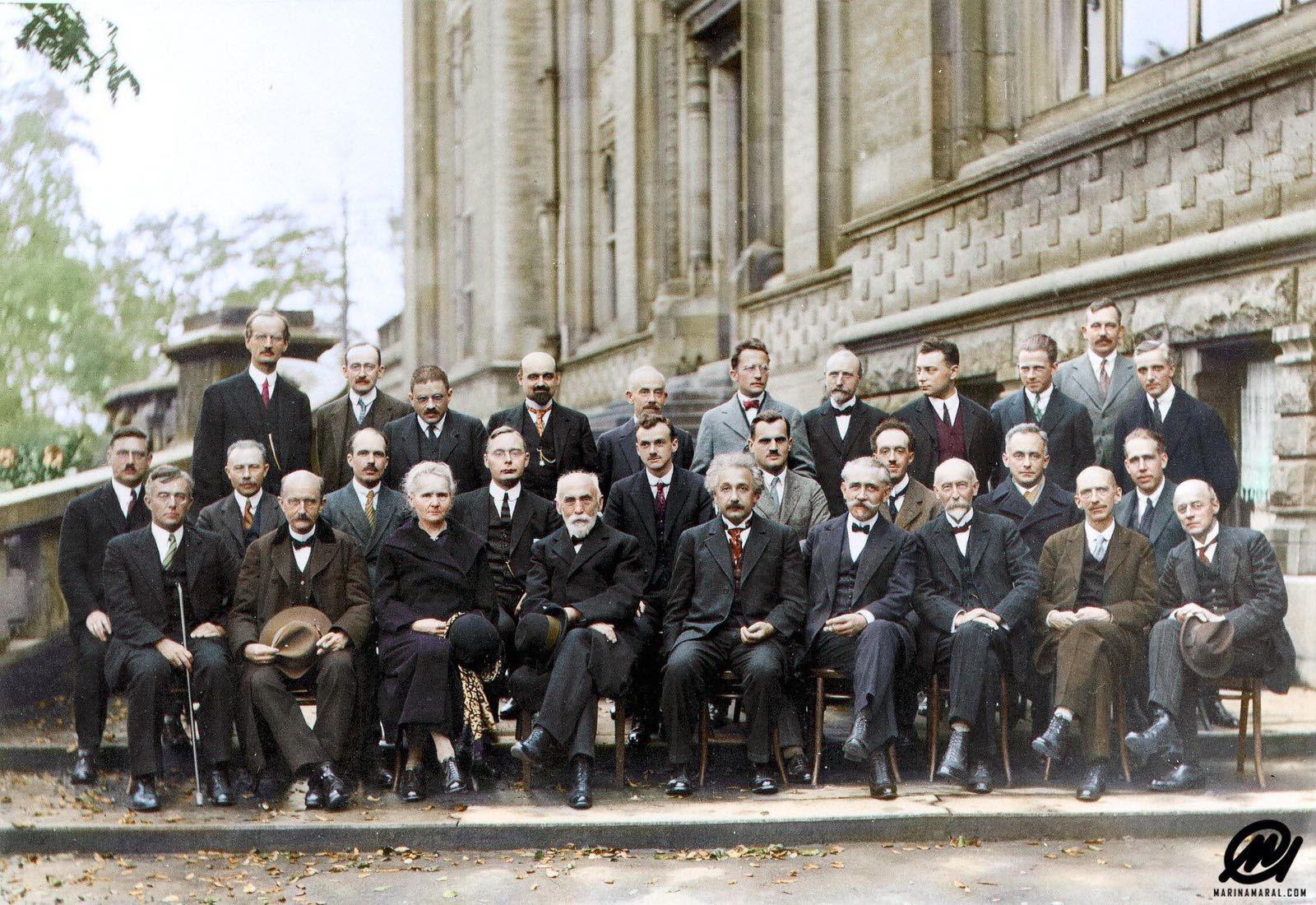
QuantumMechanicsConference1927

Here is one of the most high-IQ photographs ever taken. It is of the participants of the 5th Solvay Conference on Quantum Mechanics in 1927. They include, among others, Albert Einstein, Marie Curie, and Niels Bohr. 17 of the 29 attendees were or became Nobel laureates. This picture has obviously been around. However, I find it amazing that almost a century later, the world (us) still does not understand the significance of quantum mechanics.  We still live mostly by the ‘billiard ball’ classical Newtonian mechanics level of understanding, where every one of us is a discrete solid ball.

For me the first step in understanding Quantum Mechanics is to accept the ‘weird’ non-intuitive proposition that a thing can have two values of the same property at the same time, with each value having a certain probability.  The observed value depends upon the observer’s act of observation. It is almost like the game of having two different things in two fists: the value  one gets depends upon which fist the person chooses to open.  Imagine that the two fists are actually the same fist, at two different points in space-time. Quantum Mechanics uses the term ‘wave function’ for the distribution of probability of observing any one among a range of values. It calls ‘collapse of the wave function’ at the point of observation, for the fact an observation will reveal a certain discreet ‘particle’ value to the observer. This wave-particle duality, and its resolution by a sentiment being observing, is at the heart of consciousness and universal connectivity!

This means that we are all interconnected, just One! At the same time, we are also separate beings living our own separate lives. Both the values of the Self – unity and diversity – are simultaneously true.  What we see depends upon our consciousness!  Thus, the non-dual postulates such as Aham Brahmasmi (I am Totality) laid out in the Vedas are completely aligned with quantum mechanics. The rishis (seers) wrote Vedic treatises based on their deep perception of their own transcendent Self. The rishis meditated deeply and reached a pure physiology leading to the perception of these subtle and fine quantum laws of nature. They proved that all the laws of nature reside within one’s own consciousness, but it would take the finest level of self-awareness to perceive them!! We should honor their intelligence and believe in the great heritage they bequeathed upon humanity!!

What if one has no knowledge or interest in understanding quantum mechanics or the Vedas. Just remember that the more one can be in non-judgmental observational mode, the more this non-intuitive fact would become intuitive. The more we are able to get into a silent witnessing mode, the more this diverse world would look like a beautiful integrated whole. Meditation techniques such as Transcendental Meditation (TM) enable us to become a silent witness to the wholeness of our own infinite and invincible Self. And that wholeness is Blissful! From wholeness arises more wholeness, and the world gets ever more blissful!! Wish you an eternally Blissful Life!!!

For those interested: here is the wholeness mantra from the Vedas (in Sanskrit language and its English translation):

पूर्णमदः पूर्णमिदं पूर्णात्पूर्णमुदच्यते |
पूर्णस्य पूर्णमादाय पूर्णमेवावशिष्यते ||
“That (‘Brahma’) is infinite, and this (‘universe’) is infinite; the infinite proceeds from the infinite. (Then) taking the infinitude of the infinite (‘universe’), it remains as the infinite (‘Brahma’) alone.” – (Brihadaranyaka Upanishad V.i.1)