Trip to Mt Kailash and Manasarovar Lake

Mount Kailash and Manasarovar Lake, located in Western Tibet, are among the holiest and mystical of pilgrimage sites across many religious traditions including Hinduism and Buddhism. Mt Kailash, considered the abode of Lord Shiva, is at a 6600+ meter elevation, while the Manasarovar lake nearby is the highest freshwater lake in the world. This trek is a tough 52-km circumambulation (parikrama) of Mt Kailash, using limited housing and other facilities.  This is a report on our small group’s 17-day trip to this magnificent place in July 2024. It concludes with some recommendations for future pilgrims, especially seniors.

Think of this pilgrimage trek in two parts. The core part is the 3 days spent doing the parikrama around the holy mountain and the lake. The longer 14-day part is getting to this high place from home, and back. There were 13 of us pilgrims in our group, with 12 from the US and one from Singapore. All were citizens of Indian origin, including four senior married couples. All members had different personalities, and half of us were Ph.Ds.   Three of the pilgrims were repeat visitors to Mt Kailash. We went to this trek with an experienced Kathmandu based tour operator to organize the tour.

We all landed in Kathmandu (KTM) from our respective home locations all over the US. We spent four nights in KTM (1350 meters above sea level) doing a little bit of acclimatization, while the tour operator applied for and received travel special permits for us to travel to Tibet. While in KTM, we visited the world famous Pashupatinath (Shiva) temple at their evening puja time. We also climbed to the Tarkeshwar (Shiva) temple to an elevation of 1900 meters. 

After four days in KTM, we packed a subset of our baggage into a big duffel bag and a backpack, and left our travel suitcases in the hotel. We took the flight to Lhasa. There is a direct flight but it was sold out. So, we had to make an indirect flight through Chengdu hub airport. That took up an extra day which could have been used for sightseeing and acclimatization in Lhasa (3500 m above sea level).  In Lhasa we had time enough to visit the spectacular Potala Palace, a huge 1000 year old structure, that contains the offices and tombs of many Dalai Lama’s from the first to the 13th.  From Lhasa, we did a 2-day 1000 km long bus drive through the beautiful Tibetan mountains and valleys to reach Lake Manasarovar.

It felt magical to reach Lake Manasarovar which is the highest freshwater lake on the planet. We immediately did a parikrama of the lake itself by bus. We gathered holy water from the Manasarovar lake to bring back home.

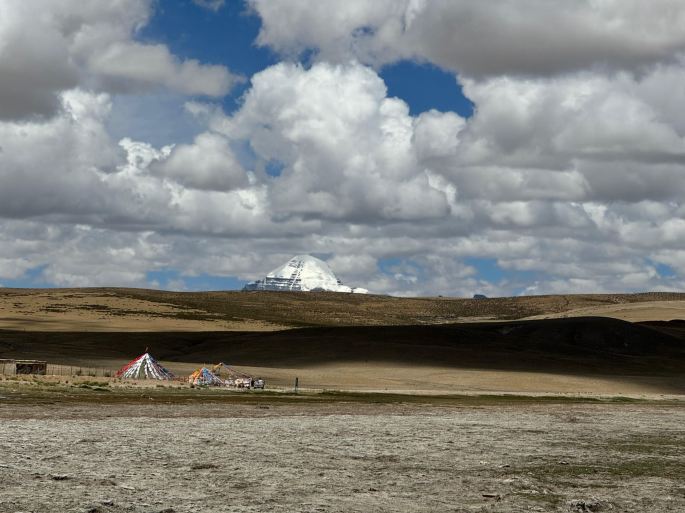
Our parikrama of the lake showed two additional things. One, it provided a broad view of MtK from different angles. It also showed up another nearby lake called the Rakshakshthal (or devil’s place), a salty cursed lake. There is fascinating mythology around how a freshwater lake and a dear salty water lake happen to coexist at this high elevation, and both of them barely to the south of Mt. Kailash. (Kailash in English means a pure crystal).

At Manasarovar Lake, we spent a night in a modest dormitory, for acclimatization at this height of 4500 meters. The next day we did a nice short drive to the small town of Darchen and stayed there at a nice hotel, for another night of acclimatization.  The parikrama of Mt Kailash formally begins from the Yama Dwar (Death God’s Gate) in Darchen. We left our duffel bags at the hotel in Darchen, and packed only water and lunch and a raincoat in our backpacks. We began the first leg of the parikrama, which is a 12 km semicircle walk from Darchen to Derapuk (at 5000 m elevation). This was a tough but exhilarating uphill 8-hour walk, with clear views of the west face of Mt Kailash all through the hike.  We took many beautiful pictures and videos on the way. I was happy to have completed this half of the parikrama on foot without a horse or sherpa, though the rest of the group had used sherpas to carry their backpacks. However, my heart rate became highly elevated and stayed that way through the 8 hours it took us to cover the 12 km. My wife and I had great trouble completing the journey, as did most of our group.
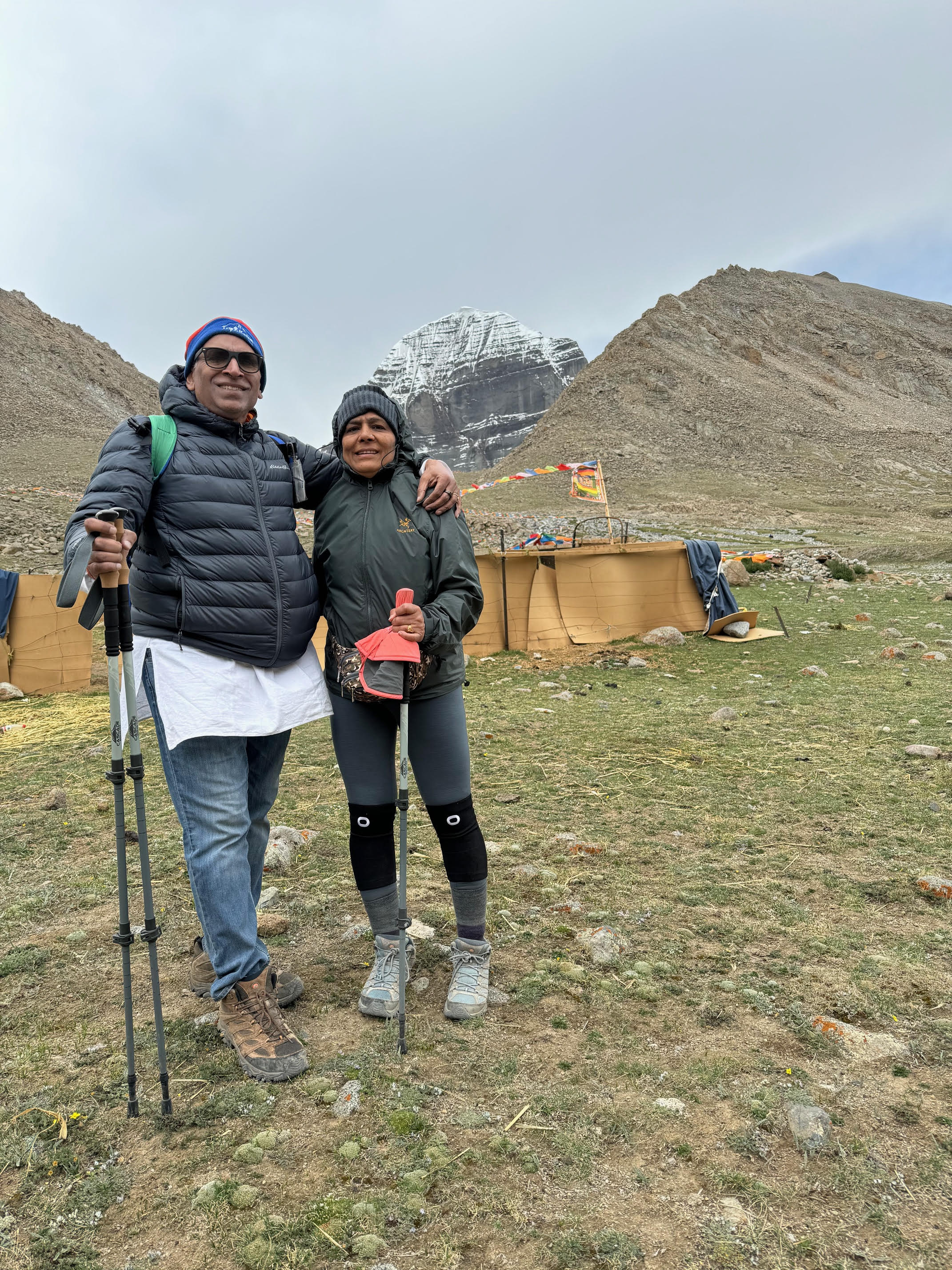
By the time we reached the monastery at Derapuk, most of us developed cough and/or cold and mild fever. The dormitory accommodations at Derapuk were very modest and had no toilets. Defecating outside in the open felt too primitive to most of us. Consequently most of us also began to become severely constipated. I felt that the most significant part of the parikrama had been completed, and there was no point in pushing oneself at risk of deterioration of health.  My wife and I therefore made the call to abandon the second half of the parikrama. Not only us, but three others also decided to return to Darchen by jeep the next morning.  

At Derapuk the view of the north face of Mt Kailash is totally awe-inspiring. This is Shiva’s abode. I felt that I am one among many Shivas. Mt Kailash is everyone’s abode.  The other 8 people in our group continued the parikrama using horses to climb up to Dorma la pass. Then they walked downhill 4 km on foot with their respective sherpas. Then they took a jeep to be extracted from there for the remaining 30 km of the parikrama and returned to Darchen. 

After resting in Darchen for two days, we again visited and stayed close to the Manasarovar lake on the auspicious Guru Purnima day (July 21). We did an auspicious RudraAbhishek puja o the banks of the lake. From the lake I also recorded a nice 2-min video showing both Kailash and the lake so near each other. Some people visited the Mansarovar lake during the late night hours to see ‘stars falling in the lake’.  

The next morning we began the return journey with an 800 km long bus ride from Manasarovar to the town of Keirung on the China-Nepal border. It was not an easy journey with most of us in constipated conditions, with no proper toilets on the way. However the Keirung valley was a spectacular green mountains with flowing river and waterfalls. The following morning we crossed the border into Nepal by road. The conditions on the Nepal side were extremely chaotic, and the roads were broken. Five of us took a spectacular but expensive helicopter ride to get to KTM, while the others came by jeep. After gathering our suitcases from the hotel in KTM, the next day we bid adieu and took our flights to our next or home destinations.  

Conclusion 

The trip was a glorious success for all of us, differently and at many levels.  For myself, I got to spend abundant time at Mt Kailash the abode of Shiva who is the god of pure Silence and Peace. I also gathered the exquisitely tasty holy water from the lake to bring home for various uses. I also enjoyed some of the most beautiful greenery in the Keyrung valley and enjoyed the helicopter ride through a spectacularly green Nepal. We also made new good friends among our team of pilgrims. 

Lessons learned: This trip exposed several logistical challenges. Here are a couple of  insights and lessons for those wanting to visit Mt Kailash.  

  1. Altitude: The lived reality at a 5000-meter elevation is very different from that at normal city level. The air is very thin. One needs to acclimatize for many days. Even then one’s physiology may or may not cooperate. So, prepare hard and yet be open to surprises.  Next, the accommodation at these high altitudes are very basic. Nothing prepared us for the open-air defecation, even though we cognitively knew that there will be no proper toilets. Our health suffered. Then there were a few landslides that slowed down the travel.
  2. Guides and Sherpas: These are the people who understand the local terrain and reality. They can soften the shock for the pilgrims. We had an excellent team to support us. However, the availability of porters and horses can be difficult depending upon season. It led to many heated altercations and disagreements between the support team and the pilgrim clients, which did not reflect well on anyone. We therefore found ourselves constantly comparing our support team with the other teams supporting other pilgrim groups. A more organized and mature tour operator may cost a little more, but it may be worth it in terms of good use of your time and good comfort. 
  3. Clarity of purpose: One can go to Mt Kailash as a tourist to complete an item on the bucket list. One can also go there as a seeker to brave the harsh situation with total devotion to Lord Shiva. Or the purpose can also be a mix of a tough mountaineering experience mixed with some pilgrimage. Only a clarity of purpose will provide the endurance to complete the mission, when unforeseen challenges occur. 
  4. Security: The Chinese security and immigration system was intense but efficient. We found security cameras everywhere in China/ Tibet, including five cameras in our tour bus from Lhasa. Our tour guide in Lhasa told us not to take pictures of police patrols on the way to Manasarovar. We were also advised that we should not discuss the politics of Tibet and China even in the bus.

In closing, given its remoteness and the tough terrain, the trip to Mk Kailash is long, tough and expensive.  As Adi Shankara noted, no amount of pilgrimaging can lead to enlightenment. The bliss of Silence or shanti is within us, here and now. Shivoham Shivoham. However, it feels good to be visiting one of the holiest and most mystical of sites on the roof of the world. Good luck on your visit to Mt Kailash. Bon voyage! 

Life is Pure Existence

Life is pure existence. It is pure consciousness at the bottom of the V in V-theory of Transcendence (Figure below). The top of the V is the dynamic manifestations of life. These manifestations arise and transform and disappear at different time frames. Human beings appear at the ~ 80-year time frame. Other entities appear at longer or shorter time frames. Trees last 100s of years. Bacteria last just a few days. Longer life span is not a sign of greater intelligence or success. Attachment to this human body and its perpetuation is the ultimate mithya or illusion. We should detach from our human body (and near and dear ones’ bodies etc.) as it goes through its cycle of maturing and dissolving.

So, what are we to do with our individual short gross physical bodily existence? Doing is manifesting. We can create things and situations but should not be attached to those manifestations. Objects such as houses and cars and jewelry are a very low life form. The higher life form is that which is free from illusions and boundaries and is intent on accomplishing its assigned task of manifesting ever greater reality. Our hearts should be open to receiving guidance from higher life forms, or from pure life itself. We should be aware of our own divine powers and be a channel for creation as the time and situation demands.

Why do we manifest gross physical forms? Why do we take pleasure in creating such low-level toy forms? Why are we attached to these less significant creations? The answer may lie in social conditioning and legal structures. Such attachments provide a handle to any powerful evolved entity to manipulate us. Why do we fall for such manipulations? Some call ii God’s lila or divine play. It sometimes takes up to fag end of the individual human life span to realize the futility of attachments to manifestations. The young are mostly unable to learn this lesson from the elders. For the young, these toys are seductive. That is just the way it is!

There is enormous seduction of numbers, words, and language. Everything important should be measurable and comparable. By dividing, discretizing, and abstracting everything into tokens, the intellect allows the creation of new toys with ease, especially using machines and more recently Artificial Intelligence. Analog processes such as feelings vanish. Hearts close to what one does not already know. Awe and wonder vanish from awareness. The notion of an open divine unbounded invincible self seems ludicrous. This continues till some misfortune such as cancer or pandemics strikes and breaks that spell. Then the wisdom shines, and life appears valuable for its own sake!  

Mental Health for the whole world

I appreciate the discussion about mental health. In my next avatar or phase of life, I want to become some kind of a mental health practitioner.  A big cause of mental health may be financial insecurity in a capitalist world. …And the social inequalities and pressures and heartburn that causes. The pharma lobby and DSM lobby and many other money-making machines in the West are hard at work to not fully cure but mostly contain the problems. The Federal government has created a strategy to combat mental health issues, however it remains to be seen how effective it will be.

The human body and mind have many ailments arising from whatever thoughts or beliefs or practices etc. Patanjali’s yoga sutras provide the 8-limbed formula to get away from it all.  Different practitioners or gurus have emphasized different limbs to suit the times and their purpose. Mahatma Gandhi emphasized Yama and Niyamas to uplift hundreds of millions of Indian people out of colonization. Maharishi Mahesh Yogi used dhyana and samadhi to uplift millions of people from deep stress and anxiety of nuclear annihilation towards a vision of a permanent peace. Ramdev used Asana and Pranayama to uplift a billion people from all sorts of ailments.  But from personal stories one knows that any combination of these could cure eyesight, hypertension, and backache etc. Add to it Bhagavad Gita’s message that ‘you are neither born nor do you die’ that also reminds us of our true higher / Yogic self. That is the Truth (capital T) that alone can deliver strong healthy minds.

The language of health needs to change. We are becoming self-educated semi-experts at cancer and hypertension and diabetes and an infinite number of specific diseases and disorders and syndromes that may afflict us. The solution may lie in the language of Chitta vritti nirodha (yoga sutras) and balance of doshas and vikritis (Ayurveda) and harmony (classical / Gandharva music), … and activation of chakras and kundalini and more such vibrational and energetic constructs. The dualist and disease-naming language could be replaced by a more holistic joy-feeling language. As Chomsky famously said that the primary role of language is the self-talk or inner chatter, and not so much communication with others. If the inner monkey-mind chatter could be transformed to coherent silence and awareness, health will be a natural outcome. If health is what we want, a health-ful language may be a starting point.

A health-ful language should be beneficial to the health of body or mind. It should describe something corrective or beneficially effective, even though it may be unpleasant. It should speak to the helpful effects of clean air and water and surroundings. It should speak to what benefits and sustains life physically, mentally, and spiritually. It should make a positive contribution to a healthy condition.

With gratitude to all of you for reading it! 

I am Inspired ….

Inspiration is more important than motivation. The former pulls while the latter provides a reason. That is what set me thinking about who or what inspired me. So, I listed some of my major inspirations in life, and what they meant.

I was inspired … 

  • By my paternal uncle who was a terror and yet  jolly as President of our ethnic community in our native town in India, and who said that I could achieve anything 
  • By my maternal uncle who was an excellent teacher always suggesting do what you like 
  • By my father for his disciplined hard work, unshakable confidence, work ethic,  commitment to excellence and financial prowess 
  • By Mahatma Gandhi whose life inspired the whole country of India, and whose thoughts were lofty and  formed a central component of Indian Administrative service exams
  • By Maharishi Mahesh Yogi for his ability to see the unmanifest Vedas and make enlightenment accessible through a great movement and a Vedic university
  • By Swami Ramdev for the size of his ambition fearlessness and boldness in bringing well being at all levels 
  • By my friend and IITD / IIM classmate the perfect student and gentleman now at Harvard 
  • By my friend and IITD classmate the magical perfect student who did Ph.D. at Stanford 
  • By my friend and IITD / IIMA  classmate and free soul who did Ph.D. at MIT and is a great seeker and social reformer and entrepreneur 
  • By my mom for her deep investment in and ferocious defense of her children, and great tolerance 

I am also inspired …

  • By my colleague and mentor at MIU who is here to pursue moksha and which made me get it 
  • By my colleague and mentor who is the foremost  researcher on collective consciousness and led me to organize international conference on consciousness based leadership and management 
  • By my students who said that they loved my data analytics course and for whom I wrote the data analytics book that is globally #1 recommended book 
  • By my student and colleague who is ultra-blissful and does soft thinking and is a trail blazer
  • By Vastu architecture for its ability to create de-stressing and high creativity 
  • By my bold and beautiful wife who is unafraid and a creative entrepreneur 
  • By my beautiful daughter who is a fanstastic English editor, and holistic health practitioner and communicator
  • By my other beautiful daughter who is a smart engineer and a great packer 
  • By my brother who knew about group dynamics, yoga, and Vipassana way before me and which all I spontaneously followed into. 
  • By my book club community especially its founder and coordinator who is a cool, creative and compassionate architect.

Question for you: What inspired you in life? What continues to inspire you?

Do you inspire yourself? Do you inspire others? Chances are that you are proud of some of your own accomplishments. And they probably inspire many people close to you!

Live and Work Successfully and Blissfully in 21st century

Here is a 15 minute opening speech, as the chief guest at a management conference in Dehradun in India. Building on the colorful theme of Holi festival just gone by, and the onset of a popular cricket season just coming up, I paint a big picture for life and work in 6 colorful charts, like six balls in a cricket over.

The key messages are:

1. Know thyself, as a specific person, and as the most unbounded being.

2. Human beings have complementary sets of needs at the global, interpersonal and the spiritual levels.

3. We need six capabilities of confidence, compassion, creativity, collaboration, courage, and consciousness to flourish in 21st century

4. Do the actions using SEAMS model – Straight, Strong, Enough, Adequate, in the Moment, and Wholeness on the move.

5. The life must be balanced with peace in the world and peace within

6. Finally in the last chart, I exhort the audience to paint life colorfully on the biggest canvas. Live life not just for yourself, but for the civilization and the universe.

Comments are welcome!

Mind Without Fear – A Book Review

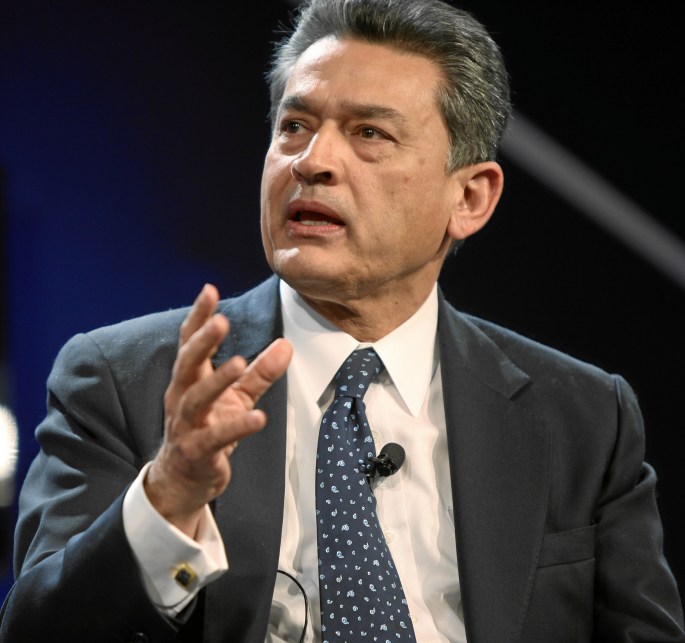
I finished listening to Mr. Rajat Gupta’s [photo credit: Wikipedia] memoir ‘Mind without Fear’ in just two sessions. It is a compelling story of the Mind and the Times of an exceptionally accomplished person. He had the good luck to be the right person in the right place to become first non (white) American managing director of McKinsey & Co, when the firm was ripe to go global. He was the wrong guy at the wrong time when he entered the financial markets with the wrong guy, and got the wrong overzealous prosecutor thus getting jailed for two years. He draws inspiration from his father who was an Indian Civil Services officer during the British rule but resigned Mahatma Gandhi’s call for freedom and was jailed and beaten mercilessly with permanent damage. He also draws inspiration from the Nobel Laureate Rabindranath Tagore, whose beautiful poetry threads the book and gives it the title of Mind without Fear. He also draws solace from his strong family and the many friends who stood with him and believed his story. He however deeply regrets not taking the stand and testifying in his own trial, as he received overwhelming advice from his lawyers and his loving family that allowing the prosecutor to question him directly will be too risky. At the end of it all, he comes out of the ordeal with his head held high, without much bitterness for those who deserted him including the McKinsey firm who dismissed him summarily and took his name off their alumni list.

I believe Rajat Gupta’s story, as I have done over the years. He is a fellow IIT-Delhi alumnus ten years my senior. I met him at Pan-IIT meets in 2007 and 2009. He looked handsome and seemed very honest and a good listener. I do remember some of the stories of the next few years as the attorney Preet Bharara with political ambitions set his sights on a fellow successful Indian. There was a story in the Indian press about Preet Bharara and Dr Sanjay Gupta, whose moms knew each other from India, about whose son is doing better in the US. I recall a feeling of a certain revulsion at that approach to achieving success by beating down an iconic fellow Indian. Some of my well-meaning friends however felt at that time that greed and power had gotten the better of Rajat Gupta.

Rajat Gupta has done much good work including seting up Indian School of Business and starting the Public Health Foundation of India. He also started the Global Fund against three major diseases. These inspirational stories are laid out in great detail in the book. That alone makes the book worthy of attention. What the book does not tell is that none other than Narayana Murthy, the founder of Infosys, compared Rajat Gupta with the first prime minister of India Jawaharlal Nehru for having started two world class organizations in India. I also salute Rajat Gupta for his great work. May God grant him strength to continue his good work. He wants to work on the American penal system which he observed from the inside and found deeply lacking. He should also write a commentary on the Bhagavad Gita, the book that he read during his incarceration and which helped him come out stronger, with malice towards none and with his head held high!

Why Tulsi Gabbard is the best candidate in this 2020 Presidential race

Aloha! I believe that Ms. Tulsi Gabbard is the best candidate in this 2020 presidential race.

First, Tulsi holds the bigger picture in mind. She focuses on World Peace. She focuses on the global environment. Her message is about humanity as a whole, even though she focuses first and foremost on the health and welfare of the American people.

Second, she is against wasteful unending regime-change wars that serve mostly commercial interests of the military-industrial complex. She volunteered for two tours of active military duty. She is fearless and can meet just as calmly with foes as with friends. Those foes include the vested interests inside the country. She wants a government truly of, by, and for the people.

Third, she is determined and takes initiative with a fierce sense of urgency. She does not take anything for granted. Coming from the island state of Hawaii reminds her of the constant dangers of nuclear wars, environmental disasters, and the devastation of the local people and cultures. She introduced a comprehensive bill against use of fossil fuels, which can become a cornerstone of the Green New Deal!

Fourth, she is an excellent communicator. She is an active listener and, surprisingly and refreshingly, answers the questions that are asked of her. She speaks truth to power. She is a good debater and brings out the truth in the most accessible way while cutting through other people’s circumambulations.

Finally, as a person, she is remarkably talented and attractive. Tulsi Gabbard has the temperament of a centered and experienced leader, and the warmth and innocence of a girl next door. She is a friendly and compassionate person who hugs easily and warmly. She speaks of service with love. Her voice is measured, and her speech is to the point.

Truth will win, ultimately! Truth and Non-violence go together and win, as Mahatma Gandhi showed! Tulsi is committed to truth-telling and to promoting World Peace. No other candidate comes even close! That is why Tulsi IS the best candidate in this race.

One last thing …. she is very young and has a lot of time ahead of her. So, irrespective of what happens in 2020, she has a tremendous opportunity to make impact on this country and the world. Like the other young Hawaiian-born candidate before her, she is destined for the White House!!


Aloha! President Tulsi Gabbard!

Aloha! President Tulsi Gabbard!

I support the young beautiful Hindu liberal veteran Congresswoman from Hawaii for President of the United States of America in 2020 and beyond.

  • She has the inclusive compassionate leadership style to guarantee basic rights of health and education for all people, and to rebuild the nation’s infrastructure.
  • She has a veteran’s courage to call out the futility and indeed the mistake of costly regime-change wars that produce no benefit for America or the people of those countries.
  • She is guided by the authentic perennial Vedic values of Bhakti (love) and Karma (service).
  • She commands presence and answers the audience’s questions calmly, directly and succinctly.
  • She has the youthfulness to be playful and engage the attention of young generation itching to take charge of the destiny of the planet and the country.
  • And … she has the right amount of national political experience to understand the game and come out victorious!

Maheshwari family with Tulsi

I met her on campaign trail a few times in different towns of Iowa recently. She is the new Obama. I feel that she is the right one to usher in world peace and joy for all in this country and beyond! I plan to volunteer for and contribute to her campaign like I did for Obama in 2008.


Increasing self-awareness

Do I know the context around me, the neighborhood and the neighbors, the friends and family, now and over the many decades of my life? The answer is that I hardly know things and people around me. I barely know my own full reactions to most of the situations I found myself in. I have a few pet theories of who I am, and who were responsible for guiding me. These are super simplifications that do not help come up with productive and promising ideas for the future. I think it is important now to know all or more around me.

What does it mean to know a person? How does one define a person? By their accomplishments or their goals, by their friends, or by how they carry themselves? We can seek out and learn about their interests. And accept whatever they are, positive or negative. It can take a long time to know people.

What does it mean to know a neighborhood or a situation? The neighborhood is about its support for life, liberty and pursuit of happiness. Safety. Limited regulations. Liveliness of activity. Plenty of wealth around. The situation would depend upon its difficulty and its impact on oneself, and how much one can do about it.

I think it is important to retain a sense of personal agency about oneself and the situations one finds oneself in. It is helpful to stop obsessing about one’s own interests and goals and accomplishments. The world is deeply interconnected and there is hardly anything one can accomplish without support from and alignment with the context around oneself.


Carving out the Middle Ground

President Abraham Lincoln did a masterful job of defining an ambiguous situation. By the time he took office, seven southern states had passed resolutions of secession. The outgoing President Buchanan famously noted that under the constitution, the states had no right to secede, but he had no power to force them to stay. Lincoln never called them secessionist states, just my unhappy fellow countrymen. He never threatened aggression, just use of force in self-defence. He eventually won the Civil War!

I completed listening to a delightful 24-lecture course on Lincoln’s speeches. Here are some highlights on how he won and led.

Gain attention: Lincoln followed Douglas around the state of Illinois to rebut him till Douglas, the incumbent senator, would agree to formally debate him during the 1858 senate election. They agreed on seven 3-hour debates around the state, with each one opening the debate in an alternate manner.

Define the opportunity: Lincoln started on the defensive but at the end of the debates came out ahead. Lincoln actively answered Douglas’ questions while Douglas focused on Lincoln’s House Divided speech and kept mostly repeating the same tried and tested stuff. Douglas tried to paint Lincoln as a dangerous radical who would abolish slavery. Lincoln meanwhile began to own the middle ground. He plucked out from Douglas’ speech a ‘I don’t care whether slavery lives or dies’ statement and skewered him mercilessly. Using the Dred Scott decision, he now identified a clear logical slippery slope and said that it is only a matter of time that a second Dred Scott decision will make slavery permanent, and unoverturnable by Congress. Lincoln lost the Senate race because of vote distributions, even though in the aggregate Lincoln’s side won more adherents and votes.

Do the hard work: Lincoln went on to give a speech at Cooper Union in New York City in January 1860. He later said that that speech made him President. He had to do a masterful twin task of skewering the pro-slavery Douglas (the leading presidential hopeful for the opposite side) and differentiating himself from William Seward, the leading candidate from Lincoln’s own party, when his party itself had almost taken the strong position of abolition of slavery. Lincoln took the middle ground by saying that let’s listen to what the founding fathers wanted about slavery. In an astoundingly well-researched speech for the era, Lincoln spelled out that 24 of the 39 founders of the country had left written records on the issue and 21 of them said or implied that slavery was only to be tolerated while it lasted. That speech made him look reasonable and electable. He was nominated and won the election.

Anyways… the war had to come. And so on. Just thought I would share how Lincoln carved out the middle ground and won public support which too was critical for a military victory.