Feel whole, feel blissful

Feel whole, feel blissful

Freedom of choice is key to joy and bliss. Loss of wholeness is the primary affliction. Choices made from a lack of wholeness can be wrong, leading to pain and suffering. However, that pain leads to self-correction in choice-making, bringing back towards balance and wholeness. One should return to the whole Self, and operate from there, i.e. “Yogastha Kuru Karmani.” (Bhagvad Gita, 2:40). One should be making fulfilling choices. These choices are all recorded at the level of consciousness. One can even overcome past karma by being wider and broader, and more wholesome.

Even the most evolved and enlightened person can occasionally ‘fall’ into specificity, and lose the wholeness. The feeling of ‘I am’ is that destructive specificity. Balance must be re-established at every moment. It is good to be energetic, powerful and growing. But it is good only when one maintains contact with wholeness. When that wholeness is lost, then that person becomes like a cancer cell. Healthy communication between human cells can inspire the development of healthier bodies, and healthier societies.

One should maintain a correct perspective for the experience of any objective reality. The perception and joy can be vastly different depending upon one’s state of consciousness. What we call ‘real’ is the three-fold dynamic interaction of the properties of the observer, the observed, and the process of observation. If the observer changes himself, there will be a different outcome in terms of experience. Even the experience of seeing a simple thing, such as an apple, in front of us can evoke a different structure of experience depending upon one’s state of consciousness. New connections in the nervous system and new patterns of consciousness emerge from new experiences, and they transform us.

Knowledge from the other fields can lead to progress in one’s field, and in one’s quality of choice-making. Nature’s intelligence is distributed across what we called ‘disciplines’. It is all one, and therefore applicable to all the fields, to some extent or the other. Instead of studying just one discipline, one should study the laws of nature, and operate from that level of wholeness. The Vedas embody that wholeness of knowledge, which can also be found in the body and mind.

The general principles of wholeness-based choice-making are applicable at any level and time. What is true at the individual level can also be true for the development of consciousness of countries and societies. Balanced development will lead to the evolution of societies in the right direction, towards greater happiness and prosperity.  It can take decades or even centuries for society to evolve to perfection. Ram Raj is the culmination of the evolution of societies into a perfect system of governance.


Indigestion: The Source of Maladies

Indigestion: The Source of Maladies

Undigested food in the body putrefies and leads to many ailments. Eating is easy and pleasurable. However, digesting all the ingested food is a task. Indigestion is the inability to reduce and assimilate all that food into the body. Ayurveda calls undigested food as ama. It is a toxin. Ama shows up on the tongue in the morning as a white coating. Removing ama with a tongue-cleaner is like removing ama (american medical association) from one’s life. i.e. detoxifying, and mitigating the possibility of disease and medical intervention.

Walt Whitman in his newly-found series on articles in 1860 on Men’s Health in the now-defunct newspaper ‘New York Atlas’ talks essentially about avoiding indigestion. Discussing “The great American evil: indigestion,” Whitman says, “It is doubtless here that four-fifths of the weaknesses, breakings-down, and premature deaths, of Americans begin.” Overeating, To combat this great evil, Whitman recommends eating “simple and hearty food, and no condiments” and avoiding “solid and liquid stimulants, artificial tastes, condiments” that have unfortunately become an integral part of the standard American diet.

(image source: stomachbloating.net)

Undigested food can also lead to increase in body weight. An effective way to lose weight is to eat early in the evening, as there is no undigested food in the stomach at the time of sleep.

Undigested information is the source of stress, confusion, and many mental maladies. Collecting facts and information is fun and pleasurable. However, analyzing and integrating all that information in one’s mind is quite a challenge. Mind needs deep rest, as in meditation, to rise above the din of random sets of information, to let the useless information float away and evaporate from the mind, and let one’s consciousness develop and expand blissfully with a greater integrated awareness of the Self and the world.


Power of Visuals

Just a few days ago, I started a morning walk group in our town of Fairfield. The weather is getting warmer and nicer, and the days are getting longer.

First day I walked alone. I took a selfie picture in the orange morning sun glow on the trail. That picture came out looking very interesting and blissful. I shared it with many friends on WhatsApp.

image1.JPG

This picture was pretty motivating to others.  One called me the Martian Red Man. Another thought I looked like a Hollywood actor. Many people liked it.

Next morning one person joined me on the walk. Both of us convinced another one to join the next day. All three had so much fun laughing and discussing many things, that yet another one joined the next day. And the next day the most unexpected person joined and became the fifth member. Again next day, another person joined and became the sixth member to join.

This is the power of pictures to jump-start a group. We hope the group will continue to grow!

Moksha: Download my new book

My new book, ‘Moksha: Liberation through Transcendence‘ was published on April 13th, my birthday.

For your benefit, here is the url and description of the book from its Amazon site:
http://www.amazon.com/dp/B01E88QUB2/

Moksha is total liberation, from everything. This short experiential book flows from my own journey towards moksha, and is meant for seekers everywhere. A person in Moksha experiences total bliss. The experience is so special that we cannot miss the experience. Moksha is achieved by a deep desire, and the right way to transcend the world of mind and body. Moksha cannot be achieved by using the intellect alone. Vedic Technologies like Meditation, Sidddhis, and Yagyas can help transcend the sensory surface reality and realize our unbounded invincible creative Self, and progress on the path to Moksha.

Transcendental Meditation™ technique from Maharishi Mahesh Yogi is a Vedic mantra-based meditation technique. Hundreds of published research studies show that regular practice of TM, and advanced techniques, helps with the reduction in stress and anxiety, increase in brain integration and creativity, improvement in cardiac health, and reduction in negativity in society.

Table of Contents
Chapter 1: Moksha and Enlightenment
Chapter 2: Vedas and Vedic Technologies
Chapter 3: Personal Development through Transcendence

Enjoy!

Check out my other bestselling book  Data Analytics Made Accessible

On Running a Marathon

I ran a marathon race 10 years ago in Austin, TX. My motivation was simply to become a more outdoors person. An athlete friend suggested we run a marathon, and so we did.

2006_poster_593

It was an exhilarating 6-month journey. I signed up for the Austin Distance Challenge, a series of seven increasingly longer races (5k, 5M, 10K, 10M, half-marathon, 20M) culminating in the marathon (26.2miles). I selected the best local marathon coaching company, and got a fantastic coach. Over this period, I made new running friends, became a more outdoors person, improved my health and stamina, and accumulated medals and running shirts, among other things. And, of course, successfully finished the marathon. I also learned a couple of lessons.

Anil marathon 010

  1. A good marathon is a completed marathon. I took longer than most people to complete the race, but I finished it successfully. I got my medal and jacket and kudos. Out coach told us that 98% of those who show up at the starting line, end up reaching the finish line. That was a great comfort, and a strong motivator to get up early in the morning, be excited about it, and get to the starting line. I had running buddies from my coaching group also running the race. We had physically traversed the race’s course the previous day using the coach’s script to ensure the mind does not get bored or anxious. Also, the 6 months of preparation … with long runs (or competitive races) every weekend, and a 2-hour exercise drill every Wednesday, gave us stamina and confidence. We had also been careful to stay free of running injuries to be ready for the marathon. That brings up my second lesson.

Anil marathon 005

  1. Keep it fun and injury-free. When we are preparing for the marathon, we are stretching the body to great extremes. It becomes easy to overdo and injure oneself. Many people injure their IT-band (the side of the leg from hip to the foot), knees, muscles pulls, and so on. So, run at your natural pace, with just a little bit of stretch, and make that your target pace. Do not chase the other younger and more athletic guys, the seasoned runners. Running at a natural pace uses your red-colored short-fiber leg muscles. These muscles keep up an efficient supply of oxygen and disposition of toxins (lactic acid) to keep themselves fresh and energized. Running from those muscles makes you will feel you can run all day. Do not try to sprint during long runs or the marathon … especially during those seductive downhill stretches. Sprinting utilizes the white long-fiber muscles of the thighs. These super-flexible muscles give you superb speed, but not much range. You will very soon hit a ‘wall’ when your legs freeze, and will have to abandon the marathon right there.

P.S. There were some minor lessons. Such as about investing in the right running shoes, that are one size bigger than normal to allow your feet some wiggle room. And to stay hydrated and keep the energy level high with yummy quick-release high-energy snacks bars/gels.  And of course, always listen to the coach, so you can escape a lot of grief down the road!

Visiting Harry Truman Presidential Library

A few days ago, I had the good fortune of visiting the Truman Presidential Center and Library based in Independence, a suburb of Kansas City, Missouri. It was an amazing experience spending a couple of hours there. In the past, I have visited similar centers for President Bill Clinton in Little Rock, Arksnsas; President Jimmy Carter in Atlanta, Georgia; and President Lyndon Johnson in Austin. President Truman’ story was quite different and simply inspiring.
AnilwHarryTruman
Truman had been a fresh Vice-President for just a couple of months when the super-popular President Franklin Delano Roosevelt (FDR) died in April 1945.  This fairly young President at that time made the momentous decision of dropping atomic bombs on Hiroshima and Nagasaki and ended the World War II. The jury is still out on whether this was the right decision, but he saw it very clearly and had no regrets even much later in his life, as he saw its as a way of saving many more lives.
Truman oversaw the formation of United Nations Organization, which endures till this day.
Truman crafted the Marshall Plan to deliver aid to Europe and help the vanquished countries of Germany and Italy and Japan rebuild; this helped stave off the real possibility of Communist guerillas take over Italy, Greece and and many other countries. He chose to name the plan after his Secretary of State George Marshall who was a very popular man and thus the plan would win Congressional backing and release of funds. He even innovated and resisted the Russian blockade of Berlin by supplying them exclusively through airplanes, till the Russians gave up. This ‘Berlin Airlift’ would mean more than a quarter million flights!
Truman fought the Korean War against the Russians. After a bit of back and forth victories by the two sides, he let it become a Cold War, a stalemate, rather than make it a hot war by attacking China who had begun to back North Korea. He relieved the super-popular hero General Douglas MacArthur when he began to defy the President, after the President refused to accept his advice of attacking the Chinese.
He was not quite as successful in getting his domestic policies on healthcare and others pass. However,  the great postwar growth of the American economy happened on his watch!
‘The buck stops here’, said this diminutive ordinary man who would  become a consequential President under extraordinary circumstances.  Truman does not get nearly as much respect and adulation as the other Presidents. May be it was because he was considered to be a creature of Democratic Party bosses, and had little political base of his own. However, on the basis of his overall accomplishments, I think he should be up there with the likes of Abraham Lincoln.

Age and Happiness

I did data analytics for a long-term project on family businesses, while at Case Western Reserve University a little over 2 decades ago. Using survey data from hundreds of respondents across dozens of companies over several years, we tried to analyze predictors of success at family firms. The astonishing finding was that the biggest finding was not about usual factors like ‘Succession Planning’ and ‘Clear Strategy’ etc. The biggest amazement was that across almost all dependent variables, the age of the respondent showed the greatest impact. We found what I used to call a bucket curve. For respondents under the age of 30 and below, their perceptions of their company was good. Similarly, for respondents of age 50 and over, their perceptions of their company was good. In the middle age, the respondents’ perceptions were not too good, across all variables. No other independent variables, like gender and education level and years of experience and even whether the respondent-employee was also a member of the owning family, made any difference. The AGE variable ran away with the whole variance, and thus the whole story.
We went to the retired dean of the school of business to express our excitement, amazement as well as trepidation at such a result. This old wise man looked at the results, asked some questions, and said that it all makes sense. The younger employees are glad for what the company has given them. The older people are looking back with pride at what they have achieved. It is the folks in the middle who are nervous and frustrated  as they have half their career behind them and want/expect the company to give them more opportunities to do better.
The paper was sent for publication on the strength of this finding. It got published at Family Business Review, the top journal in the field, in 1997.  Twelve years later I accidentally discovered that this paper had been included in the authoritative Handbook of Family Business all these years (there are less than 30 papers in that handbook). This paper was significant for just this insight, that age changes perceptions like nothing else. At our age, we are mostly happy as we have accomplished a lot!

On Moksha (Liberation)

Moksha is the ultimate thing. It is liberation from the biggest falsehood – that we are this body or the mind. Moksha is the liberation of the soul from the confines of the mind and body. We say that we have a mind, and we have a body. We are the master of our mind and body. We should devote our time living in touch with our true self, which is the soul, or whatever other name it may be called by.

Moksha brings freedom from the afflictions of the mind and body. The body is frail; it can be broken; it can get diseased. The mind is fickle and flighty; it can get anxious or fearful or angry; it can get depressed. The body is a great tool while it works; it houses us and allows us to engage in the relative world of other souls and the material things. The mind is an even more powerful tool while it works; it helps us grasp things unmanifest and subtle, through the power of thinking. The mind allows to plan, act and be happy. To be liberated does not mean discarding the body or the mind; it means not to be confined or defined by them.

A person who has achieved Moksha experiences total and eternal bliss. Such a person is not moved or agitated by anything in the relative world. Such a person is able to ‘see’ the soul in every other person and can connect with them. Such a person can communicate with their mere presence, without using any words or even raising a finger.

Moksha is achieved by (a) a deep desire for it, and (b) the right way to transcend the relative world of mind and body. I believe that everyone fundamentally desires moksha, as no one wants to suffer pain and misery. However, the strength and the depth of desire can be different for different people. I do not believe we can will a desire, i.e. the mind cannot create a desire. Desires are what they are, and they exert the most powerful force upon us. The right way to fulfill the desire of Moksha is the way of meditation. All meditations are not the same. I believe that transcendental techniques such as TM (from Maharishi Mahesh Yogi) and Vipassana (from Buddha through Mr. Goenka) are two such techniques, though there could be many more of them.


ISOL 2015 conference in Chicago

ISOL 2015 conference in Chicago – a summary of select presentations

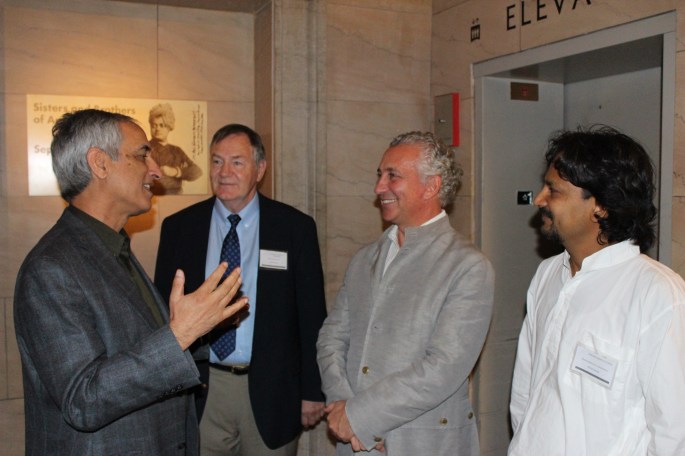
The goal of this unique international conference was to focus on global economic development through integrating spirituality with management practices. Dozens of speakers from MUM, and from universities and organizations around the world covered a vast range of topics for three days from September 11-13, 2015. The conference was held in the historic and beautiful Fullerton Hall at the Art Institute of Chicago, to build on the legacy of Swami Vivekananda’s legacy of a path-breaking speech at the World Parliament of Religions on September 11, 1893 in that same hall. The conference was organized by a Delhi, India, based organization called ISOL (Integrating Spirituality and Organizational Leadership).

Most speakers implicitly or explicitly referred to the Vedic idea that consciousness is a unity, and that it is reflected in all sentient beings just as the same Sun is reflected in all pots of water. Many people also cited Vivekananda’s humble statement: I am a voice without form. Almost all speakers emphasized that raising the consciousness of the managers is the primary lever to raise the collective consciousness in organizations. MUM came in for enormous glorious praise as an organization that by design promotes raising the level of consciousness as part of the education process and daily living. Many organizations were recognized with awards. There was a 30-minute guided meditation session every morning.

Here is a brief summary of some of the presentations, from MUM and other organizations.

Rajaraam Dr. Tony Nader was the plenary keynote speaker. He spoke of the complete congruence between the structure of Vedas and the structure of human physiology. Brain is the instrument for cognizing the wholeness of knowledge. The brain should be purified through regular transcendence using the TM technique to align with natural law and achieve great happiness. Dr. Craig Pearson, citing Ralph Waldo Emerson, said that man must turn within; and connect with the source of thought, the pure consciousness. We need to water the root (consciousness) to enjoy the fruit (happiness). Just like medications have different varieties and efficacy, so do meditations. TM excels in helping effortlessly transcend and connect with the infinite sources. Dr. Jeffrey Abramson said Vastu architecture is natural knowledge and not a man made knowledge. Sun is the most nourishing influence in our life. Our biorhythms are aligned around the Sun. Brain cells fire according to orientation. East-facing entrance is auspicious and creates enlightenment and affluence. People report positive influences when working in Vastu offices. Dr. Dennis Heaton said that connecting with the Unified Field is the basis for sustainable business practices. He briefly described MUM as vegetarianism, vastu and Veda. Dr. Anil Maheshwari spoke on the confluence of Leadership, Veda and Technology. The leadership model of a spiritual leader like Swami Vivekananda should be as compelling and attractive as that of a technological leader such as Steve Jobs. New models of leadership should include and transcend both models, and lead towards expansion of happiness in the world. Dr. Mohan Gurubatham spoke about Vasudeva Kutumbakam. Lord Krishna said that one can’t intellectually experience the entire range of objects. It can be achieved by transcending cognitive development towards wisdom thru TM. Mr. Stuart Valentine took a spiritual view of finance and investment. Through the right ethics and biomimicry, one can use finance in the service of human development.

Dr. Subhash Kak emphasized need to continue the dialogue between the east and the west. He suggested that connections between the inner and the outer (bandhu), paradox (paroksha), and yajna (sacrifice) are the basis of understanding of reality and a means to self transformation. He also spoke of the philosophy of srishti-drishti, according to which the divinity intercedes in the universe just by observation. Dr. Subhash Patri said that every person can be a Vivekananda, or Buddha or Jesus. There have been millions of great masters. We should integrate spirituality into everything we do. Feel like Buddha and you will become Buddha. Dr. Corne Bekker made an exquisite exposition on the life and message of St. Francis of Assisi, who wanted to be freed from the thirst for power and possessions. He said that narcissism is on the rise among corporate leaders. Our leaders need to pray to God, to ‘become an instrument of peace’. Dr. Jagadish Kohli said that mind is a prism that fragments holistic knowledge into diverse manifestations. Intellectuals need to start with consciousness education to lift collective consciousness. Dr. Ramnath Narayanswamy said that religion is a shell while spirituality is sweet nectar within. Narrating his own journey through compelling stories, he said that one needs a self realized guru to achieve self transformation. Values of faith, devotion and surrender can help achieve perfection on the inside and outside. Dr. John Reed implored everyone to make a commitment  to not lead a hedonistic life; and live a spiritual life. Dr. Shanmugamurthy challenged the western dogma of modern science and called for a more inclusive model of reality that values local contextual traditions that have embedded within them deep life-sustaining knowledge.

Leadership Lessons from Organizing Cultural Events

Leadership Lessons from Organizing Cultural Events  …. By Anil Maheshwari

Certain good ideas lead to properly-organized and well-attended ‘successful’ cultural events. This could be applicable to creating good organizations also. I write below from my experience of organizing a few big house-full South-Asian cultural events at MUM over the last 12 months. All the events had the customary song and dance elements. However, they also had new innovations. And they all brought in new challenges, opportunities, surprises and joy. It takes a certain gut-strength to manage it all.

Here is a list of the events we organized and the innovations we incorporated:

  1. Diwali function in November 2013. We created a beautiful innovative poster to promote the event. We introduced the idea of including participants from all South Asian countries including not only India, but also Nepal, Bangladesh, SriLanka, Pakistan, and others. We introduced the idea of a fashion show where all students could showcase their traditional dresses. We introduced the idea of a boy-girl pair of MCs, where the MCs were from different nationalities. We invited the Mayor of the city to the event, and he got the flavor of how important Diwali is for the entire South asian community. We introduced the idea of giving free organic Burfi Prasad to all the attendees. Last but not the least, we kept the event free to the public. The program was wonderful, and the event was a big success. (Pictures courtesy: Craig Shaw). Diwali at MUM 2013
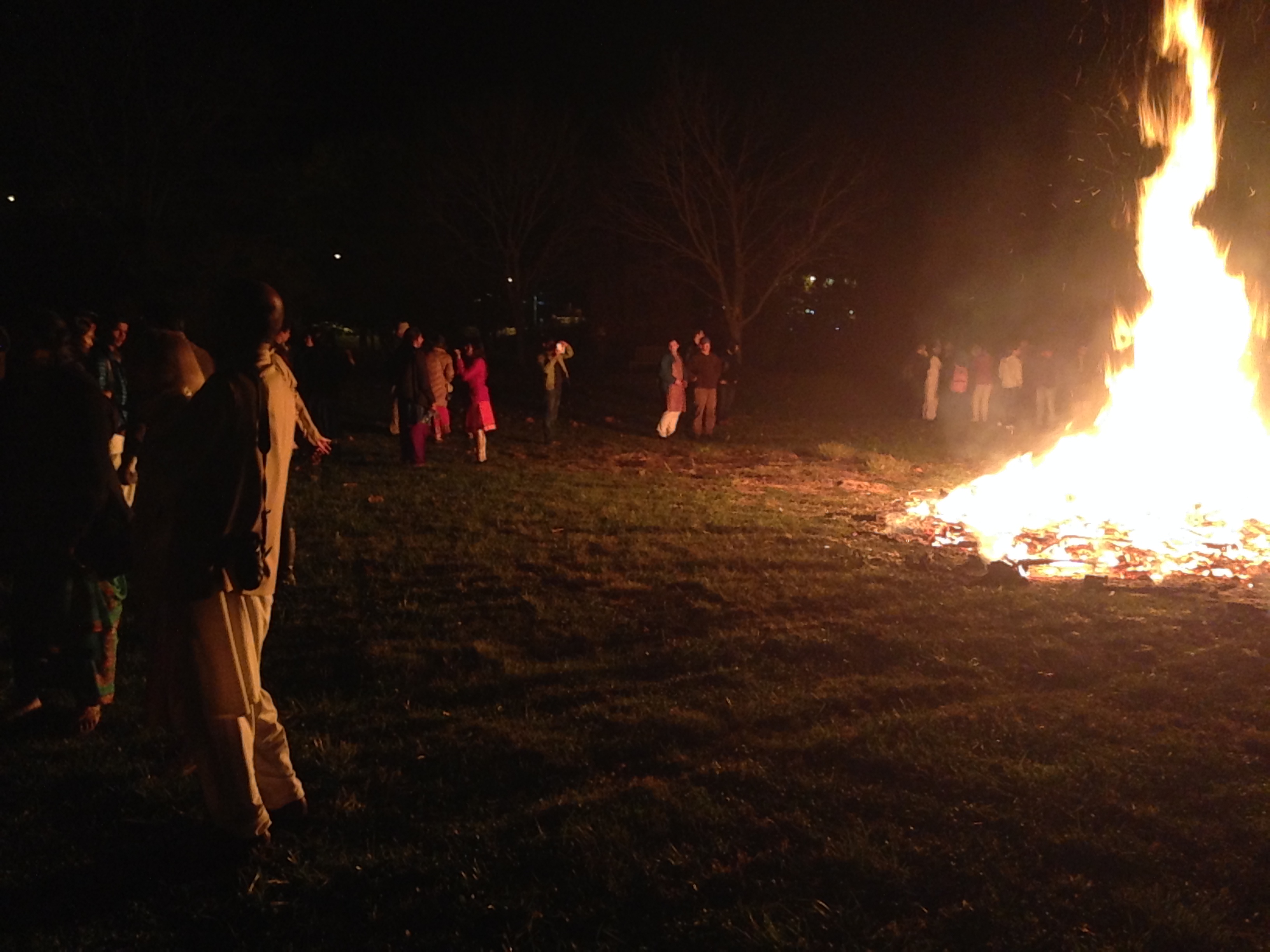
  2. Holi function in March 2014. We introduced the idea of a poetry recitation which is a Holi tradition in India. In this case, I did the recitation of a humorous old poem. We introduced the big idea of doing a large bonfire which is a Holi tradition: Students continued to sing and dance around the fire till midnight. We played with gulal (colored powder) in the night around the fire. We provided free munchies at the bonfire. We introduced the idea of a bhajan band, and this band continued playing at the bonfire also. The event was a super success.
  3. Baisakhi/Ugadi/Indian-New-Year event in April 2014. Coming soon after the Holi event, it was a low-key event. We invited the visiting head of the Maharishi movement in India who was visiting the US at that time. My daughter performed at the event.
  4. Krishna Janam Ashtami event in August 2014. This also worked as a welcoming event for all the new and returning students. We continued the ideas of a MC pair, free burfi Prasad, and a large bonfire. We introduced the idea of playing a Maharishi knowledge tape where he was talking of the significance and power of Lord Krishna. We invited the President of the university; he liked the event and said we needed more of such things to enliven the campus. The event was a house-full and standing room only performance.
  5. Garba dance party in September 2014. This was a dance party for people to dance to traditional Indian garba music. We brought the Dandiya sticks for the dance. At this event we also discovered our new student president of the South asian club.
  6. Diwali event in October 2014. This event used many of our previous ideas. We had the usual Bollywood song and dance shows, an MC pair, a large bonfire, a fashion show that now included people from Africa also. We added a professional Gandharva performance to the event. I led a group bhajan performance. People stood up and joyfully sang the Aarti together. This event was so packed that latecomers could not find space to get into the auditorium.

AKM Diwali 2014MUM campfire picture Oct2014

The organizing of all these events followed a similar pattern, was but there were different challenges each time. Different people pitched in to help when things looked bleak. Through all this I persevered. Here are some of my lessons:

  1. Commitment: Someone has to hold the flag high. Even when no one else is interested or seems to be ready to contribute, the key organizer must love the idea, and should have complete faith that the event will happen, and well. There were moments when there was no one else who came to the event planning meeting.
  2. Self-sufficiency. One should be prepared to invest your own time and resources to make the event happen. One should have the talent to sing and dance, or have your friends and family participate as needed. One can usually find the talent, strength and resources within oneself.
  3. Openness: Be open to surprises. Be open to what might actually happen at the event. Do not get stuck in a preconceived notion of a cultural event. Be open to new ideas from unexpected sources. Be open to support from unexpected sides. Totally different people, faculty or students, pitched in to support each of the events at crucial moments. Later in the year, we found consistent support from one like-minded person on campus.
  4. Integrity: Make sure every event has integrity at a high level. The higher level idea should be to have fun, or whatever else. Do not get caught in the weeds of this item or that, this performer or that, this issue or that. Gradually the reputation will grow and people would love to attend the events.