
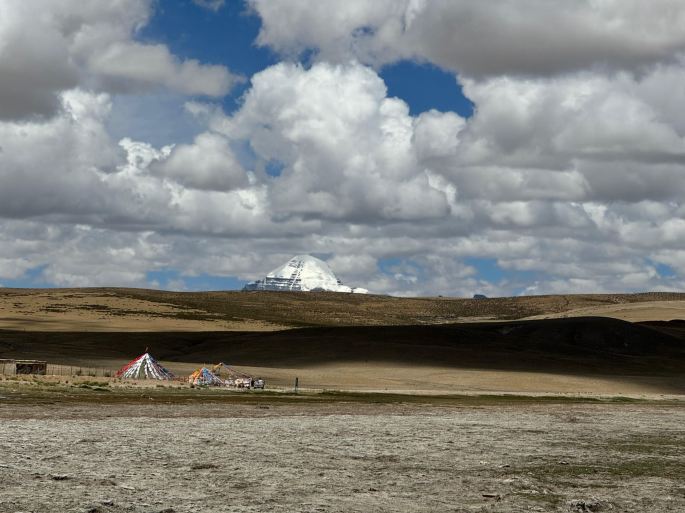
Mount Kailash and Manasarovar Lake, located in Western Tibet, are among the holiest and mystical of pilgrimage sites across many religious traditions including Hinduism and Buddhism. Mt Kailash, considered the abode of Lord Shiva, is at a 6600+ meter elevation, while the Manasarovar lake nearby is the highest freshwater lake in the world. This trek is a tough 52-km circumambulation (parikrama) of Mt Kailash, using limited housing and other facilities. This is a report on our small group’s 17-day trip to this magnificent place in July 2024. It concludes with some recommendations for future pilgrims, especially seniors.
Think of this pilgrimage trek in two parts. The core part is the 3 days spent doing the parikrama around the holy mountain and the lake. The longer 14-day part is getting to this high place from home, and back. There were 13 of us pilgrims in our group, with 12 from the US and one from Singapore. All were citizens of Indian origin, including four senior married couples. All members had different personalities, and half of us were Ph.Ds. Three of the pilgrims were repeat visitors to Mt Kailash. We went to this trek with an experienced Kathmandu based tour operator to organize the tour.
We all landed in Kathmandu (KTM) from our respective home locations all over the US. We spent four nights in KTM (1350 meters above sea level) doing a little bit of acclimatization, while the tour operator applied for and received travel special permits for us to travel to Tibet. While in KTM, we visited the world famous Pashupatinath (Shiva) temple at their evening puja time. We also climbed to the Tarkeshwar (Shiva) temple to an elevation of 1900 meters.

After four days in KTM, we packed a subset of our baggage into a big duffel bag and a backpack, and left our travel suitcases in the hotel. We took the flight to Lhasa. There is a direct flight but it was sold out. So, we had to make an indirect flight through Chengdu hub airport. That took up an extra day which could have been used for sightseeing and acclimatization in Lhasa (3500 m above sea level). In Lhasa we had time enough to visit the spectacular Potala Palace, a huge 1000 year old structure, that contains the offices and tombs of many Dalai Lama’s from the first to the 13th. From Lhasa, we did a 2-day 1000 km long bus drive through the beautiful Tibetan mountains and valleys to reach Lake Manasarovar.

It felt magical to reach Lake Manasarovar which is the highest freshwater lake on the planet. We immediately did a parikrama of the lake itself by bus. We gathered holy water from the Manasarovar lake to bring back home.

Our parikrama of the lake showed two additional things. One, it provided a broad view of MtK from different angles. It also showed up another nearby lake called the Rakshakshthal (or devil’s place), a salty cursed lake. There is fascinating mythology around how a freshwater lake and a dear salty water lake happen to coexist at this high elevation, and both of them barely to the south of Mt. Kailash. (Kailash in English means a pure crystal).

At Manasarovar Lake, we spent a night in a modest dormitory, for acclimatization at this height of 4500 meters. The next day we did a nice short drive to the small town of Darchen and stayed there at a nice hotel, for another night of acclimatization. The parikrama of Mt Kailash formally begins from the Yama Dwar (Death God’s Gate) in Darchen. We left our duffel bags at the hotel in Darchen, and packed only water and lunch and a raincoat in our backpacks. We began the first leg of the parikrama, which is a 12 km semicircle walk from Darchen to Derapuk (at 5000 m elevation). This was a tough but exhilarating uphill 8-hour walk, with clear views of the west face of Mt Kailash all through the hike. We took many beautiful pictures and videos on the way. I was happy to have completed this half of the parikrama on foot without a horse or sherpa, though the rest of the group had used sherpas to carry their backpacks. However, my heart rate became highly elevated and stayed that way through the 8 hours it took us to cover the 12 km. My wife and I had great trouble completing the journey, as did most of our group.
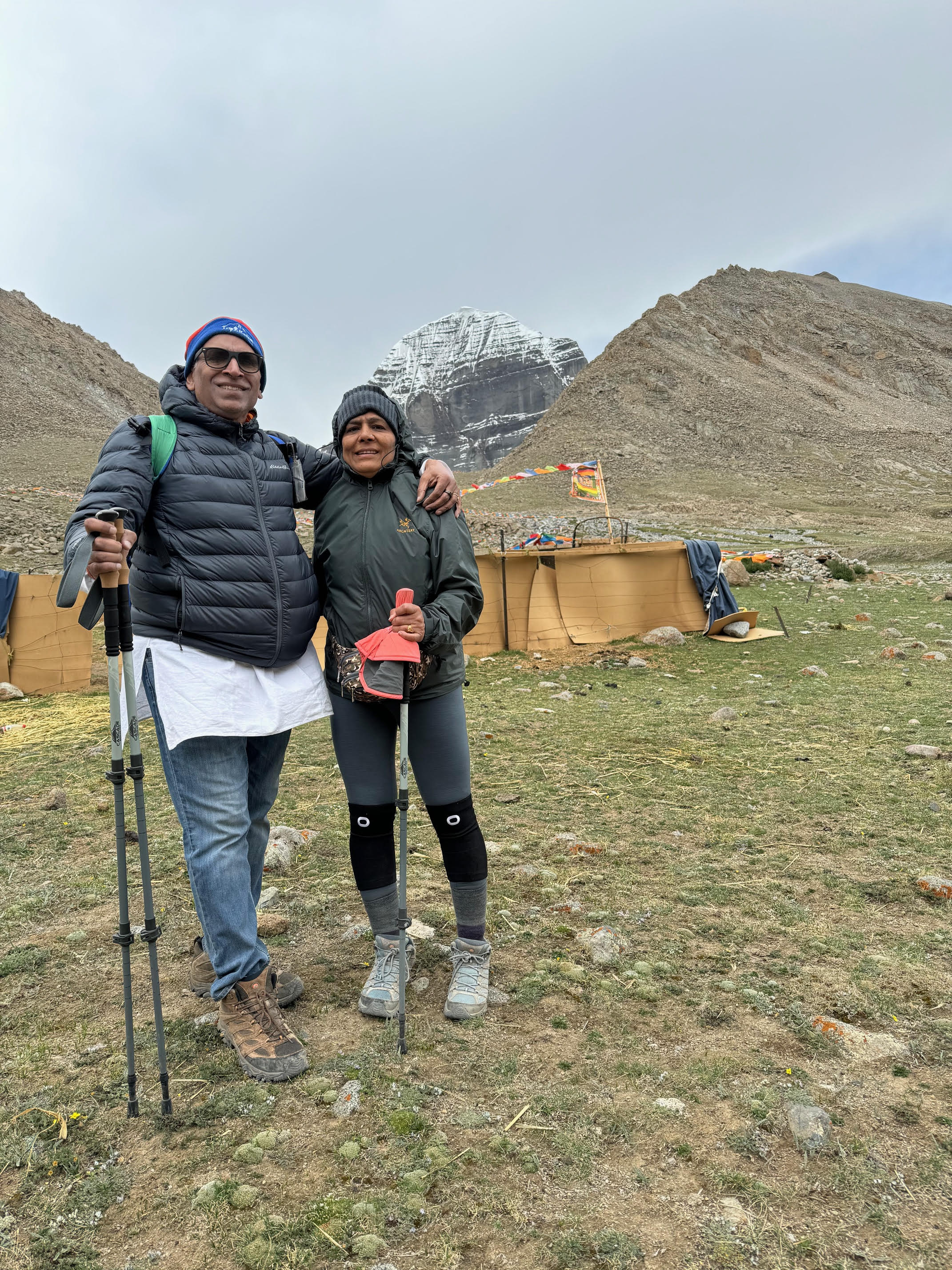
By the time we reached the monastery at Derapuk, most of us developed cough and/or cold and mild fever. The dormitory accommodations at Derapuk were very modest and had no toilets. Defecating outside in the open felt too primitive to most of us. Consequently most of us also began to become severely constipated. I felt that the most significant part of the parikrama had been completed, and there was no point in pushing oneself at risk of deterioration of health. My wife and I therefore made the call to abandon the second half of the parikrama. Not only us, but three others also decided to return to Darchen by jeep the next morning.
At Derapuk the view of the north face of Mt Kailash is totally awe-inspiring. This is Shiva’s abode. I felt that I am one among many Shivas. Mt Kailash is everyone’s abode. The other 8 people in our group continued the parikrama using horses to climb up to Dorma la pass. Then they walked downhill 4 km on foot with their respective sherpas. Then they took a jeep to be extracted from there for the remaining 30 km of the parikrama and returned to Darchen.

After resting in Darchen for two days, we again visited and stayed close to the Manasarovar lake on the auspicious Guru Purnima day (July 21). We did an auspicious RudraAbhishek puja o the banks of the lake. From the lake I also recorded a nice 2-min video showing both Kailash and the lake so near each other. Some people visited the Mansarovar lake during the late night hours to see ‘stars falling in the lake’.
The next morning we began the return journey with an 800 km long bus ride from Manasarovar to the town of Keirung on the China-Nepal border. It was not an easy journey with most of us in constipated conditions, with no proper toilets on the way. However the Keirung valley was a spectacular green mountains with flowing river and waterfalls. The following morning we crossed the border into Nepal by road. The conditions on the Nepal side were extremely chaotic, and the roads were broken. Five of us took a spectacular but expensive helicopter ride to get to KTM, while the others came by jeep. After gathering our suitcases from the hotel in KTM, the next day we bid adieu and took our flights to our next or home destinations.

Conclusion
The trip was a glorious success for all of us, differently and at many levels. For myself, I got to spend abundant time at Mt Kailash the abode of Shiva who is the god of pure Silence and Peace. I also gathered the exquisitely tasty holy water from the lake to bring home for various uses. I also enjoyed some of the most beautiful greenery in the Keyrung valley and enjoyed the helicopter ride through a spectacularly green Nepal. We also made new good friends among our team of pilgrims.
Lessons learned: This trip exposed several logistical challenges. Here are a couple of insights and lessons for those wanting to visit Mt Kailash.
- Altitude: The lived reality at a 5000-meter elevation is very different from that at normal city level. The air is very thin. One needs to acclimatize for many days. Even then one’s physiology may or may not cooperate. So, prepare hard and yet be open to surprises. Next, the accommodation at these high altitudes are very basic. Nothing prepared us for the open-air defecation, even though we cognitively knew that there will be no proper toilets. Our health suffered. Then there were a few landslides that slowed down the travel.
- Guides and Sherpas: These are the people who understand the local terrain and reality. They can soften the shock for the pilgrims. We had an excellent team to support us. However, the availability of porters and horses can be difficult depending upon season. It led to many heated altercations and disagreements between the support team and the pilgrim clients, which did not reflect well on anyone. We therefore found ourselves constantly comparing our support team with the other teams supporting other pilgrim groups. A more organized and mature tour operator may cost a little more, but it may be worth it in terms of good use of your time and good comfort.
- Clarity of purpose: One can go to Mt Kailash as a tourist to complete an item on the bucket list. One can also go there as a seeker to brave the harsh situation with total devotion to Lord Shiva. Or the purpose can also be a mix of a tough mountaineering experience mixed with some pilgrimage. Only a clarity of purpose will provide the endurance to complete the mission, when unforeseen challenges occur.
- Security: The Chinese security and immigration system was intense but efficient. We found security cameras everywhere in China/ Tibet, including five cameras in our tour bus from Lhasa. Our tour guide in Lhasa told us not to take pictures of police patrols on the way to Manasarovar. We were also advised that we should not discuss the politics of Tibet and China even in the bus.
In closing, given its remoteness and the tough terrain, the trip to Mk Kailash is long, tough and expensive. As Adi Shankara noted, no amount of pilgrimaging can lead to enlightenment. The bliss of Silence or shanti is within us, here and now. Shivoham Shivoham. However, it feels good to be visiting one of the holiest and most mystical of sites on the roof of the world. Good luck on your visit to Mt Kailash. Bon voyage!





 Blissful Living