Feel whole, feel blissful

Feel whole, feel blissful

Freedom of choice is key to joy and bliss. Loss of wholeness is the primary affliction. Choices made from a lack of wholeness can be wrong, leading to pain and suffering. However, that pain leads to self-correction in choice-making, bringing back towards balance and wholeness. One should return to the whole Self, and operate from there, i.e. “Yogastha Kuru Karmani.” (Bhagvad Gita, 2:40). One should be making fulfilling choices. These choices are all recorded at the level of consciousness. One can even overcome past karma by being wider and broader, and more wholesome.

Even the most evolved and enlightened person can occasionally ‘fall’ into specificity, and lose the wholeness. The feeling of ‘I am’ is that destructive specificity. Balance must be re-established at every moment. It is good to be energetic, powerful and growing. But it is good only when one maintains contact with wholeness. When that wholeness is lost, then that person becomes like a cancer cell. Healthy communication between human cells can inspire the development of healthier bodies, and healthier societies.

One should maintain a correct perspective for the experience of any objective reality. The perception and joy can be vastly different depending upon one’s state of consciousness. What we call ‘real’ is the three-fold dynamic interaction of the properties of the observer, the observed, and the process of observation. If the observer changes himself, there will be a different outcome in terms of experience. Even the experience of seeing a simple thing, such as an apple, in front of us can evoke a different structure of experience depending upon one’s state of consciousness. New connections in the nervous system and new patterns of consciousness emerge from new experiences, and they transform us.

Knowledge from the other fields can lead to progress in one’s field, and in one’s quality of choice-making. Nature’s intelligence is distributed across what we called ‘disciplines’. It is all one, and therefore applicable to all the fields, to some extent or the other. Instead of studying just one discipline, one should study the laws of nature, and operate from that level of wholeness. The Vedas embody that wholeness of knowledge, which can also be found in the body and mind.

The general principles of wholeness-based choice-making are applicable at any level and time. What is true at the individual level can also be true for the development of consciousness of countries and societies. Balanced development will lead to the evolution of societies in the right direction, towards greater happiness and prosperity.  It can take decades or even centuries for society to evolve to perfection. Ram Raj is the culmination of the evolution of societies into a perfect system of governance.


Indigestion: The Source of Maladies

Indigestion: The Source of Maladies

Undigested food in the body putrefies and leads to many ailments. Eating is easy and pleasurable. However, digesting all the ingested food is a task. Indigestion is the inability to reduce and assimilate all that food into the body. Ayurveda calls undigested food as ama. It is a toxin. Ama shows up on the tongue in the morning as a white coating. Removing ama with a tongue-cleaner is like removing ama (american medical association) from one’s life. i.e. detoxifying, and mitigating the possibility of disease and medical intervention.

Walt Whitman in his newly-found series on articles in 1860 on Men’s Health in the now-defunct newspaper ‘New York Atlas’ talks essentially about avoiding indigestion. Discussing “The great American evil: indigestion,” Whitman says, “It is doubtless here that four-fifths of the weaknesses, breakings-down, and premature deaths, of Americans begin.” Overeating, To combat this great evil, Whitman recommends eating “simple and hearty food, and no condiments” and avoiding “solid and liquid stimulants, artificial tastes, condiments” that have unfortunately become an integral part of the standard American diet.

(image source: stomachbloating.net)

Undigested food can also lead to increase in body weight. An effective way to lose weight is to eat early in the evening, as there is no undigested food in the stomach at the time of sleep.

Undigested information is the source of stress, confusion, and many mental maladies. Collecting facts and information is fun and pleasurable. However, analyzing and integrating all that information in one’s mind is quite a challenge. Mind needs deep rest, as in meditation, to rise above the din of random sets of information, to let the useless information float away and evaporate from the mind, and let one’s consciousness develop and expand blissfully with a greater integrated awareness of the Self and the world.


Ayurveda – a cellular view

‘The cost of good health is the cost of good food’ – Maharishi Mahesh Yogi.
For good health, please consider this image as a guiding metaphor; from my limited but growing appreciation of AyurVeda (literally meaning Knowledge of Life).

How many cells are there in the human body? …
It is 100 TRILLION!!
Is every cell alive?
YES.   Each cell has its own happy individual existence, and a life cycle. Each cell dances to its own tune, while also lovingly cooperating with all others in the body. All that a cell needs is some nutrients, oxygen, and removal of waste.
Now consider a flotilla of a few thousand boats going together on the ocean in a smooth way. There would be a certain degree of coordination, and every boat would move along nicely according to its capability. Now comes a particular disturbance or imbalance in that flotilla.  Suppose it is caused by a perceived or real attack from outside, on one side of the flotilla. The defense system is engaged.  The boats regroup and are re-purposed to deal with that event. Some drown, some gain power, etc. New configurations are created. The boats gaining power could be for the good of the flotilla, or it could be cancerous for the flotilla as a whole.
Now consider 100 TRILLION such partially autonomous, or interdependent, boats (cells) moving along. Who can coordinate such a flotilla (body). There could be many internal and external systemic sources of disturbances or imbalances. Each imbalance could be of a particular type. Too fast, call it VATA imbalance. Too angry and intense, call it PITTA imbalance. Too slow or sticky, call it KAPHA imbalance.
Thus Ayurveda looks for the dosha (literally means imperfection, fault, or imbalance) in the body as a whole. And then it brings the body back to balance, by some new generally helpful and herbs and practices. It does not heal the body by shocking the system, i.e. not by sudden chemical attacks or invasive surgeries. Those shocks have their own after-effects … such as the flotilla will have to reorganize if a certain collection of boats are removed enmasse from the flotilla.
In the absence of proper supplies and services, the cells will fight with each other for nutrition and cleanliness. Chaos and inflammation ensue. External help (allopathic medicines) only exacerbates the imbalance by correcting the problem of some cells of the body, and creating problems for the rest of the cells of the body.
Therefore, on a daily basis, we should give the cells good supplies of food and air, and take away the byproducts and toxins. That is all the cells/body want and need. When imbalances do arise, Ayurveda looks for root cause, and slowly brings the body back to harmonious and blissful flow through smooth and gentle intervention.
Yoga and meditation suitably support the practice of AyurVeda.

Moksha: Download my new book

My new book, ‘Moksha: Liberation through Transcendence‘ was published on April 13th, my birthday.

For your benefit, here is the url and description of the book from its Amazon site:
http://www.amazon.com/dp/B01E88QUB2/

Moksha is total liberation, from everything. This short experiential book flows from my own journey towards moksha, and is meant for seekers everywhere. A person in Moksha experiences total bliss. The experience is so special that we cannot miss the experience. Moksha is achieved by a deep desire, and the right way to transcend the world of mind and body. Moksha cannot be achieved by using the intellect alone. Vedic Technologies like Meditation, Sidddhis, and Yagyas can help transcend the sensory surface reality and realize our unbounded invincible creative Self, and progress on the path to Moksha.

Transcendental Meditation™ technique from Maharishi Mahesh Yogi is a Vedic mantra-based meditation technique. Hundreds of published research studies show that regular practice of TM, and advanced techniques, helps with the reduction in stress and anxiety, increase in brain integration and creativity, improvement in cardiac health, and reduction in negativity in society.

Table of Contents
Chapter 1: Moksha and Enlightenment
Chapter 2: Vedas and Vedic Technologies
Chapter 3: Personal Development through Transcendence

Enjoy!

Check out my other bestselling book  Data Analytics Made Accessible

On Running a Marathon

I ran a marathon race 10 years ago in Austin, TX. My motivation was simply to become a more outdoors person. An athlete friend suggested we run a marathon, and so we did.

2006_poster_593

It was an exhilarating 6-month journey. I signed up for the Austin Distance Challenge, a series of seven increasingly longer races (5k, 5M, 10K, 10M, half-marathon, 20M) culminating in the marathon (26.2miles). I selected the best local marathon coaching company, and got a fantastic coach. Over this period, I made new running friends, became a more outdoors person, improved my health and stamina, and accumulated medals and running shirts, among other things. And, of course, successfully finished the marathon. I also learned a couple of lessons.

Anil marathon 010

  1. A good marathon is a completed marathon. I took longer than most people to complete the race, but I finished it successfully. I got my medal and jacket and kudos. Out coach told us that 98% of those who show up at the starting line, end up reaching the finish line. That was a great comfort, and a strong motivator to get up early in the morning, be excited about it, and get to the starting line. I had running buddies from my coaching group also running the race. We had physically traversed the race’s course the previous day using the coach’s script to ensure the mind does not get bored or anxious. Also, the 6 months of preparation … with long runs (or competitive races) every weekend, and a 2-hour exercise drill every Wednesday, gave us stamina and confidence. We had also been careful to stay free of running injuries to be ready for the marathon. That brings up my second lesson.

Anil marathon 005

  1. Keep it fun and injury-free. When we are preparing for the marathon, we are stretching the body to great extremes. It becomes easy to overdo and injure oneself. Many people injure their IT-band (the side of the leg from hip to the foot), knees, muscles pulls, and so on. So, run at your natural pace, with just a little bit of stretch, and make that your target pace. Do not chase the other younger and more athletic guys, the seasoned runners. Running at a natural pace uses your red-colored short-fiber leg muscles. These muscles keep up an efficient supply of oxygen and disposition of toxins (lactic acid) to keep themselves fresh and energized. Running from those muscles makes you will feel you can run all day. Do not try to sprint during long runs or the marathon … especially during those seductive downhill stretches. Sprinting utilizes the white long-fiber muscles of the thighs. These super-flexible muscles give you superb speed, but not much range. You will very soon hit a ‘wall’ when your legs freeze, and will have to abandon the marathon right there.

P.S. There were some minor lessons. Such as about investing in the right running shoes, that are one size bigger than normal to allow your feet some wiggle room. And to stay hydrated and keep the energy level high with yummy quick-release high-energy snacks bars/gels.  And of course, always listen to the coach, so you can escape a lot of grief down the road!

Moksha (Liberation) and Beyond

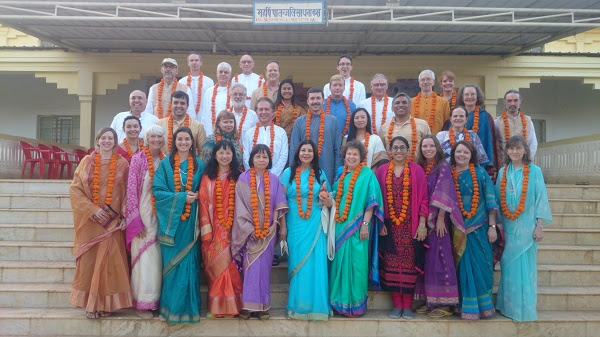
I had the good fortune of visiting the Brahmistan of India a few weeks ago. It is located at the geographical center of the country of India, a two hour drive from the city of Jabalpur. Maharishi Mahesh Yogi’s movement owns a large tract of land, where a beautiful and blissful residential and Transcendental Meditation facility has been established. A large number of Vedic Pandits meditate together at this location to spread peace around India, and indeed the world. The Pandits also do Vedic chanting here. In particular, everyday they do a Rudra Abhishekam, homage to Lord Shiva every day.  The chanting in this particular location is special, with 1331 (being 11 x 11 x 11) highly trained Maharishi Vedic pandits chanting together. Thus it is called Ati Rudra Abhishekam, (Ati means Extremely Large). It was Maharishi’s dream project, and it got fulfilled a few years after he passed on.

Brahmistan 2016 group

My daughter and I went to the Brahmistan knowing that Ati Rudra Abhishekam is a highly transformative event. Just listening to and witnessing this live chanting can have a powerful and liberating effect on oneself. We were taken to the huge meditation hall and we were seated comfortably on sofas. All the pandits, young and old, sat  on the floor, while a few pandits sat on stage doing the actions of bathing the shivlingas with milk.(see picture)

AtiRudraAbhishek

The chanting began with an hour-long obligatory oblations to many gods as well as donors. Then began the real Rudra Abhishekam chanting by the almost 1500 pandits present in the room. It was a very deeply resonant experience for me. In just a couple of minutes, my head grew heavy and woozy-doozy, and my eyes naturally closed. I was neither awake nor sleepy, and began to have amazing perceptual experiences. I ‘saw’ a giant crane, like the ones used in constructing tall buildings, pick me up by my head from the well of a tall building, and place me on the side of the building.  I felt liberated from the confines of my physical body. This is the state or the feeling of ‘moksha’.

I had never had such a vision before. Such visions are rare but powerful indicators of a quantum leap into higher wisdom, say my learned friends with whom I have shared this experience. Where do we go from here though? How do we use our liberation and higher states of consciousness for the maximum good? Do we evaporate into air like camphor, and spread like a fragrance that is always there everywhere? Do we become like a sun and emit powerful light in all directions at all times?

This leads into my Billion Buddha Project … to ensure that at least a billion people wake up to their true divine infinite powerful creative nature and live a naturally and effortlessly happy life. Enlightening others to this reality is the theme of the rest of my life.


Visiting Harry Truman Presidential Library

A few days ago, I had the good fortune of visiting the Truman Presidential Center and Library based in Independence, a suburb of Kansas City, Missouri. It was an amazing experience spending a couple of hours there. In the past, I have visited similar centers for President Bill Clinton in Little Rock, Arksnsas; President Jimmy Carter in Atlanta, Georgia; and President Lyndon Johnson in Austin. President Truman’ story was quite different and simply inspiring.
AnilwHarryTruman
Truman had been a fresh Vice-President for just a couple of months when the super-popular President Franklin Delano Roosevelt (FDR) died in April 1945.  This fairly young President at that time made the momentous decision of dropping atomic bombs on Hiroshima and Nagasaki and ended the World War II. The jury is still out on whether this was the right decision, but he saw it very clearly and had no regrets even much later in his life, as he saw its as a way of saving many more lives.
Truman oversaw the formation of United Nations Organization, which endures till this day.
Truman crafted the Marshall Plan to deliver aid to Europe and help the vanquished countries of Germany and Italy and Japan rebuild; this helped stave off the real possibility of Communist guerillas take over Italy, Greece and and many other countries. He chose to name the plan after his Secretary of State George Marshall who was a very popular man and thus the plan would win Congressional backing and release of funds. He even innovated and resisted the Russian blockade of Berlin by supplying them exclusively through airplanes, till the Russians gave up. This ‘Berlin Airlift’ would mean more than a quarter million flights!
Truman fought the Korean War against the Russians. After a bit of back and forth victories by the two sides, he let it become a Cold War, a stalemate, rather than make it a hot war by attacking China who had begun to back North Korea. He relieved the super-popular hero General Douglas MacArthur when he began to defy the President, after the President refused to accept his advice of attacking the Chinese.
He was not quite as successful in getting his domestic policies on healthcare and others pass. However,  the great postwar growth of the American economy happened on his watch!
‘The buck stops here’, said this diminutive ordinary man who would  become a consequential President under extraordinary circumstances.  Truman does not get nearly as much respect and adulation as the other Presidents. May be it was because he was considered to be a creature of Democratic Party bosses, and had little political base of his own. However, on the basis of his overall accomplishments, I think he should be up there with the likes of Abraham Lincoln.

Be Here Now: Art of Happiness

Be Here Now: Art of Happiness


I watched this well-presented video on the new science of happiness by a professor from Harvard medical school. It showed that neither wealth nor accomplishment nor fame nor beauty nor youth makes a person healthy. Living constantly in a sunny weather or on a beach will not bring happiness either.

Not surprisingly, what makes people most happy is to be present, to be here now! We are happy when we are fully engaged in whatever we are doing at the moment. Whether we are washing dishes or teaching a class, we should be aware of and pay full attention to what we are doing in the moment. There is no need to hold on to any experiences, whether pleasant or unpleasant, of the present or of the past. ‘This too shall pass’, Buddha said. Holding on to positive feelings is just as counterproductive as holding on to negative feelings. Just let go, and enjoy life every moment!

Gratitude and Forgiveness are other habits that bring happiness.  We should be grateful for what we have: our functioning body, sane mind, caring family and friends, …everything. I am grateful to the people who invented the internet and manage it, for making available a platform where to share this message with all. I am grateful to those who raise the food and deliver it so we may nourish our body. And so on.

Forgiving others also makes us happy; it releases us from the unnecessary burden of holding on to grudges. Forgiving them makes us not suffer. Forgive them because they may not even be aware that they have done any harm to us, while we may be stewing in anger and hate and thus wasting our time and energy and life-force.

Compassion for others also brings happiness. Happiness has that paradoxical quality: the more we chase it, the more it will flee from us. The more we care about others’ well-being and happiness, the more we are likely to become happy.

May all Beings be happy!


On Moksha (Liberation)

Moksha is the ultimate thing. It is liberation from the biggest falsehood – that we are this body or the mind. Moksha is the liberation of the soul from the confines of the mind and body. We say that we have a mind, and we have a body. We are the master of our mind and body. We should devote our time living in touch with our true self, which is the soul, or whatever other name it may be called by.

Moksha brings freedom from the afflictions of the mind and body. The body is frail; it can be broken; it can get diseased. The mind is fickle and flighty; it can get anxious or fearful or angry; it can get depressed. The body is a great tool while it works; it houses us and allows us to engage in the relative world of other souls and the material things. The mind is an even more powerful tool while it works; it helps us grasp things unmanifest and subtle, through the power of thinking. The mind allows to plan, act and be happy. To be liberated does not mean discarding the body or the mind; it means not to be confined or defined by them.

A person who has achieved Moksha experiences total and eternal bliss. Such a person is not moved or agitated by anything in the relative world. Such a person is able to ‘see’ the soul in every other person and can connect with them. Such a person can communicate with their mere presence, without using any words or even raising a finger.

Moksha is achieved by (a) a deep desire for it, and (b) the right way to transcend the relative world of mind and body. I believe that everyone fundamentally desires moksha, as no one wants to suffer pain and misery. However, the strength and the depth of desire can be different for different people. I do not believe we can will a desire, i.e. the mind cannot create a desire. Desires are what they are, and they exert the most powerful force upon us. The right way to fulfill the desire of Moksha is the way of meditation. All meditations are not the same. I believe that transcendental techniques such as TM (from Maharishi Mahesh Yogi) and Vipassana (from Buddha through Mr. Goenka) are two such techniques, though there could be many more of them.


Mathematics is Fun

I often say that I eat because of my comfort in math. It is my love and comfort with math that makes me confident and successful (sometimes), no matter what role in what organization. I was lucky to have parents who cared about math so much that I practiced and practiced, for funny money, always trying to find faster ways to accomplish my ‘practice load’. I was lucky to have a high-school math teacher who always emphasized starting from first principles, whenever in doubt. I have instilled in both our daughters the love for math.

An anecdote here. My wife was working at a Kumon center in Austin, tutoring 4-6 year old kids in English. I was then happily working at IBM. The live-wire Taiwanese-American lady owner of that Kumon center was bragging one day to her staff that not even CS professors at UT Austin can pass the G-level math test (They go from A to M levels). My wife casually said that I would pass it. Jennifer, the owner, said no way and said she would bet $100 that I won’t be able to pass. So, my wife chose to call me and told me about it. Never shy about such challenges, I drove up to the Kumon center, and took the G-level test. It is a good test that the kids have to score within a couple of errors, in a time frame of about 30 min, to pass. I was able to do it pretty quickly. Blood drained out of her face, as she went through my answers skipping many intermediate steps. She said she had never lost a bet in her life, especially around Kumon activities. We declined the $100, but she insisted on my accepting that crisp $100 note. So we organized a party for all the Kumon students. I later showed her my GRE transcript showing a perfect 800 score in math. I said she messed with the wrong guy, and she laughed.

I wonder if programmatizing anything is a kiss of death. The reason people feel bored in large organizations is because of large programs with rigid structures and limited scope for initiatives. May be the education departments should take note and teach the teachers to teach according to inside-out model, where students learn by expressing what they feel and see. That goes for teaching math, Psychology, Computer Science, Management, and everything else.